A short course on $infty$-categories
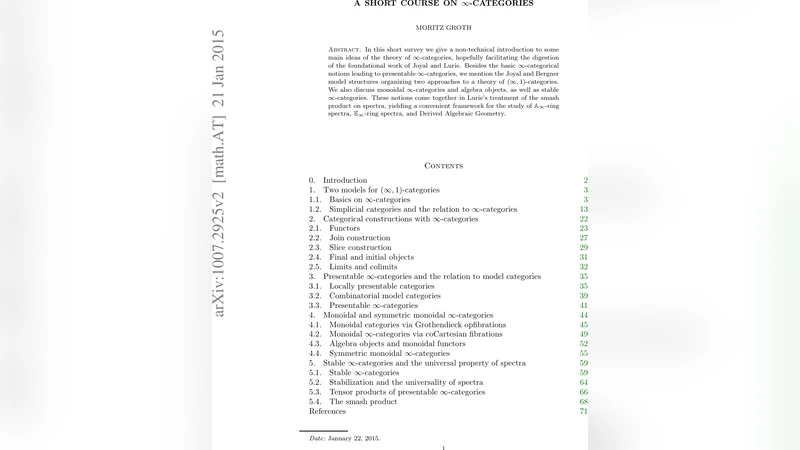
In this short survey we give a non-technical introduction to some main ideas of the theory of $\infty$-categories, hopefully facilitating the digestion of the foundational work of Joyal and Lurie. Besides the basic $\infty$-categorical notions leading to presentable $\infty$-categories, we mention the Joyal and Bergner model structures organizing two approaches to a theory of $(\infty,1)$-categories. We also discuss monoidal $\infty$-categories and algebra objects, as well as stable $\infty$-categories. These notions come together in Lurie’s treatment of the smash product on spectra, yielding a convenient framework for the study of $\mathbb{A}\infty$-ring spectra, $\mathbb{E}\infty$-ring spectra, and Derived Algebraic Geometry.
💡 Research Summary
This paper offers a concise, non‑technical introduction to the central ideas of ∞‑category theory, aiming to make the foundational work of Joyal and Lurie more accessible. It begins by explaining why ordinary categories, which only have 1‑morphisms, are insufficient for many modern homotopical contexts and motivates the passage to (∞,1)‑categories, where morphisms exist in all higher dimensions together with coherent homotopies.
Two principal model‑categorical approaches to (∞,1)‑categories are then presented. The first is Joyal’s model structure on simplicial sets, where the fibrant objects are quasi‑categories (inner Kan complexes). In this setting cofibrations are monomorphisms, fibrations are inner Kan fibrations, and weak equivalences are the categorical equivalences that preserve the homotopy‑coherent composition. The second is Bergner’s model structure on simplicial categories, where Dwyer–Kan equivalences serve as weak equivalences and fibrations are the simplicial functors that are fibrations on mapping spaces. The paper sketches the Quillen equivalence between these two models, emphasizing that the homotopy theory of (∞,1)‑categories does not depend on the chosen presentation.
Having fixed a robust homotopical framework, the authors turn to presentable ∞‑categories. A presentable ∞‑category is one that is accessible (generated under colimits by a small subcategory) and admits all small colimits. This notion mirrors the classical theory of locally presentable categories but incorporates higher homotopical data. Presentability is crucial because many naturally occurring ∞‑categories—such as module categories over ring spectra, sheaf categories, and categories of spaces—fit into this paradigm, and it guarantees the existence of adjoints for colimit‑preserving functors.
The discussion then moves to monoidal ∞‑categories and ∞‑operads, following Lurie’s “Higher Algebra”. An ∞‑operad encodes a coherent system of multi‑ary operations together with symmetric group actions, and a monoidal ∞‑category is precisely an algebra over the associative ∞‑operad. The paper explains how algebra objects in a monoidal ∞‑category generalize classical associative and commutative algebras, leading to the definitions of A∞‑ring spectra (associative up to coherent homotopy) and E∞‑ring spectra (commutative up to coherent homotopy). The symmetric monoidal structure on the ∞‑category of spectra, given by the smash product, is highlighted as the prototypical example.
Stable ∞‑categories are introduced next. An ∞‑category is stable if it has a zero object, all finite limits and colimits, and if the suspension functor Σ and loop functor Ω are inverse equivalences. The stable ∞‑category of spectra Sp satisfies these axioms and provides a natural setting for homological algebra in the ∞‑categorical world. Within Sp, the smash product equips the category with a symmetric monoidal structure, making it possible to speak of modules, algebras, and bimodules over ring spectra in a fully homotopy‑coherent manner.
Finally, the paper ties these concepts together in the context of derived algebraic geometry (DAG). The smash product on spectra yields a convenient framework for studying A∞‑ and E∞‑ring spectra, which serve as the “derived rings” underlying DAG. By treating schemes, stacks, and sheaves as objects in suitable presentable, stable, monoidal ∞‑categories, one obtains a flexible language for derived intersections, deformation theory, and spectral algebraic geometry.
Overall, the survey succeeds in distilling a large and technically demanding body of work into an approachable narrative. It clarifies how the Joyal and Bergner model structures provide equivalent foundations for (∞,1)‑categories, how presentability, monoidal structures, and stability interact, and how these ideas culminate in modern applications such as the smash product on spectra, ring spectra, and derived algebraic geometry. The paper serves as an excellent roadmap for mathematicians seeking to enter the world of ∞‑categories without being overwhelmed by the full technical machinery.
Comments & Academic Discussion
Loading comments...
Leave a Comment