Comment on `Update of 40K and 226Ra and 232Th series $gamma$-to-dose conversion factors for soil
A letter to the editor of the Journal of Environmental Radioactivity on the article: E. Gasser, A. Nachab, A. Nourreddine, Ch. Roy, and A. Sellam, `Update of 40K and 226Ra and 232Th series $\gamma$-to-dose conversion factors for soil’, J. Environ. Radioactiv. 138, 68-71 (2014), DOI: 10.1016/j.jenvrad.2014.08.002.
💡 Research Summary
The letter by Malins, Machida and Saito addresses the discrepancy reported by Gasser et al. (2014) in the γ‑to‑dose conversion factors for soil‑borne ⁴⁰K, the ²³⁶Ra series and the ²³²Th series. Gasser and co‑workers used MCNPX to model a cylindrical source of uniform radionuclide concentration extending 1 m deep into the ground with radii up to 35 m, and they calculated air kerma 1 m above the surface. Their published conversion coefficients (0.036, 0.357 and 0.482 nGy h⁻¹ Bq⁻¹ kg⁻¹ for ⁴⁰K, the ²³⁶Ra series and the ²³²Th series, respectively) are roughly 20 % lower than values obtained in earlier experimental and Monte‑Carlo studies (e.g., Bec et al., 1972; Saito & Jacob, 1995). Gasser et al. attributed the reduction mainly to the use of more recent decay data (ICRP 107) and updated branching ratios.
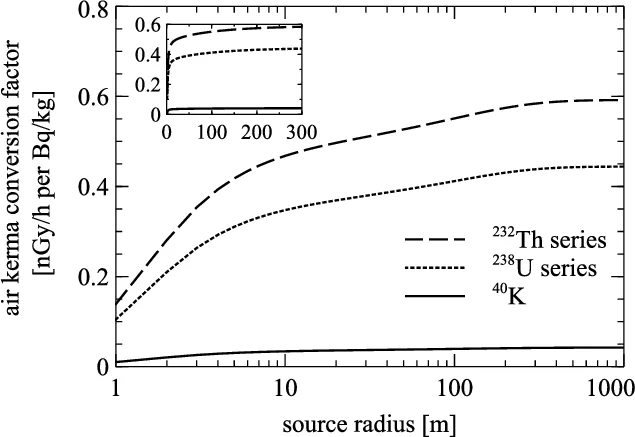
Malins et al. argue that the dominant cause of the lower coefficients is a finite‑size effect: the 35 m radius is insufficient to emulate the infinite half‑space geometry prescribed by ICRU 53 for conversion factors. To demonstrate this, they performed a series of PHITS simulations with the same 1 m depth but with source radii ranging from 1 m to 1000 m. Their results show a monotonic increase of the conversion factors with radius, continuing well beyond 35 m. Only when the radius exceeds about 700 m do the coefficients converge to three‑significant‑figure stability, yielding asymptotic values of 0.042 nGy h⁻¹ Bq⁻¹ kg⁻¹ for ⁴⁰K, 0.444 nGy h⁻¹ Bq⁻¹ kg⁻¹ for the ²³⁸U series (representing the ²³⁶Ra decay chain), and 0.592 nGy h⁻¹ Bq⁻¹ kg⁻¹ for the ²³²Th series. These numbers are in close agreement with the literature values reported by Saito & Jacob (0.042, 0.463, 0.604) and by Askri (2015), who also used large‑radius source models.
When the authors restrict their own PHITS calculations to a 35 m radius, they obtain conversion factors of 0.037, 0.383 and 0.515 nGy h⁻¹ Bq⁻¹ kg⁻¹, which are comparable to Gasser et al.’s results. The remaining few‑percent differences between the 35 m results and the fully converged values are plausibly explained by (i) slight variations in the decay data libraries (e.g., Nucleide‑Lara vs ICRP 107), (ii) differences in photon energy binning and statistical uncertainties inherent to Monte‑Carlo transport, and (iii) the method used to convert photon fluence to air kerma (linear vs non‑linear interpolation, kernel choices, etc.).
The authors also suggest practical ways to achieve half‑space conditions without prohibitive computational cost. By applying the source‑detector transformation technique described by Namito et al. (2012), or by employing a planar detector together with periodic boundary conditions, one can effectively simulate an infinite lateral extent while keeping the simulated volume modest. These approaches would allow rapid re‑evaluation of the conversion factors.
In conclusion, the letter makes a compelling case that the ~20 % reduction reported by Gasser et al. is primarily a modeling artefact arising from an insufficient source radius. When the source radius is enlarged to several hundred metres, the conversion factors converge to values that are consistent with the established literature. After correcting for the finite‑size effect, any residual discrepancies are likely due to the use of updated decay data, minor methodological differences, or statistical noise. The authors therefore recommend that Gasser et al. repeat their calculations with larger source geometries or adopt the more efficient techniques mentioned, to obtain conversion coefficients that are directly comparable with the standard half‑space values used in environmental radiation protection assessments.
Comments & Academic Discussion
Loading comments...
Leave a Comment