Maximum Entropy Models of Shortest Path and Outbreak Distributions in Networks
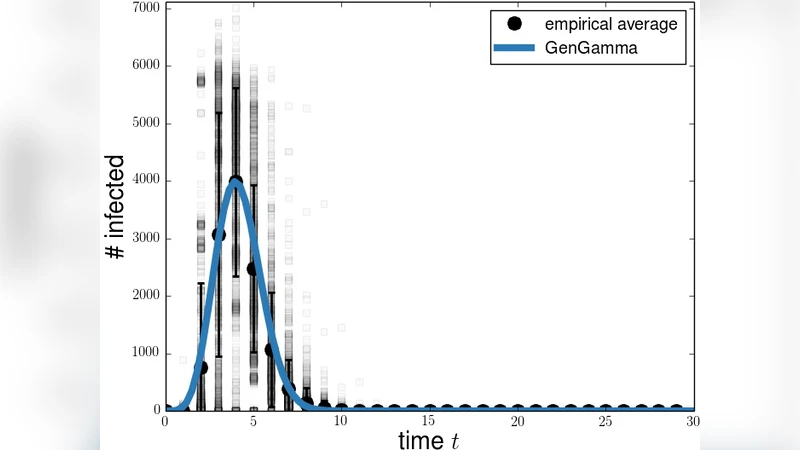
Properties of networks are often characterized in terms of features such as node degree distributions, average path lengths, diameters, or clustering coefficients. Here, we study shortest path length distributions. On the one hand, average as well as maximum distances can be determined therefrom; on the other hand, they are closely related to the dynamics of network spreading processes. Because of the combinatorial nature of networks, we apply maximum entropy arguments to derive a general, physically plausible model. In particular, we establish the generalized Gamma distribution as a continuous characterization of shortest path length histograms of networks or arbitrary topology. Experimental evaluations corroborate our theoretical results.
💡 Research Summary
The paper addresses the problem of characterizing the distribution of shortest‑path lengths in complex networks and, by duality, the distribution of outbreak sizes in highly infectious spreading processes. While many network analyses focus on degree distributions, average path lengths, clustering coefficients, etc., the authors argue that shortest‑path histograms contain valuable information both for structural inference (e.g., average distance, diameter) and for predicting the speed and reach of diffusion phenomena such as epidemics, rumors, or viral marketing campaigns.
Building on the observation that in a maximally infectious SIR cascade the number of newly infected nodes at time t equals the number of nodes at graph distance d = t from the source, the authors treat shortest‑path length statistics and outbreak time series as two faces of the same stochastic process. They then apply the principle of maximum entropy to this process, imposing constraints on (i) normalization, (ii) the first moment (mean distance or mean outbreak time), and (iii) a second‑order moment (log‑squared mean). Solving the resulting constrained optimization yields a three‑parameter probability density function known as the generalized Gamma distribution:
f(t | σ, α, β) = (β / σ^α Γ(α/β)) t^{α‑1} exp
Comments & Academic Discussion
Loading comments...
Leave a Comment