LTE enhancements for Public Safety and Security communications to support Group Multimedia Communications
Currently Public Safety and Security communication systems rely on reliable and secure Professional Mobile Radio (PMR) Networks that are mainly devoted to provide voice services. However, the evolution trend for PMR networks is towards the provision of new value-added multimedia services such as video streaming, in order to improve the situational awareness and enhance the life-saving operations. The challenge here is to exploit the future commercial broadband networks to deliver voice and multimedia services satisfying the PMR service requirements. In particular, a viable solution till now seems that of adapting the new Long Term Evolution technology to provide IP-based broadband services with the security and reliability typical of PMR networks. This paper outlines different alternatives to achieve this goal and, in particular, proposes a proper solution for providing multimedia services with PMR standards over commercial LTE networks.
💡 Research Summary
**
The paper addresses the pressing need to evolve traditional Professional Mobile Radio (PMR) systems—historically voice‑centric and built on narrow‑band 2G technologies—into broadband, IP‑based solutions capable of delivering rich multimedia services for Public Safety and Security (PSS) agencies. While commercial Long Term Evolution (LTE) networks already provide the necessary data rates (10 MHz bandwidth is estimated to support 256 kbps synchronous video streams and other data services), they lack several mission‑critical features that are mandatory for public‑safety communications. The authors systematically examine the functional and performance requirements of PMR, outline the gaps in current LTE specifications, and propose a comprehensive roadmap for integrating LTE into the public‑safety domain.
Key PMR Requirements
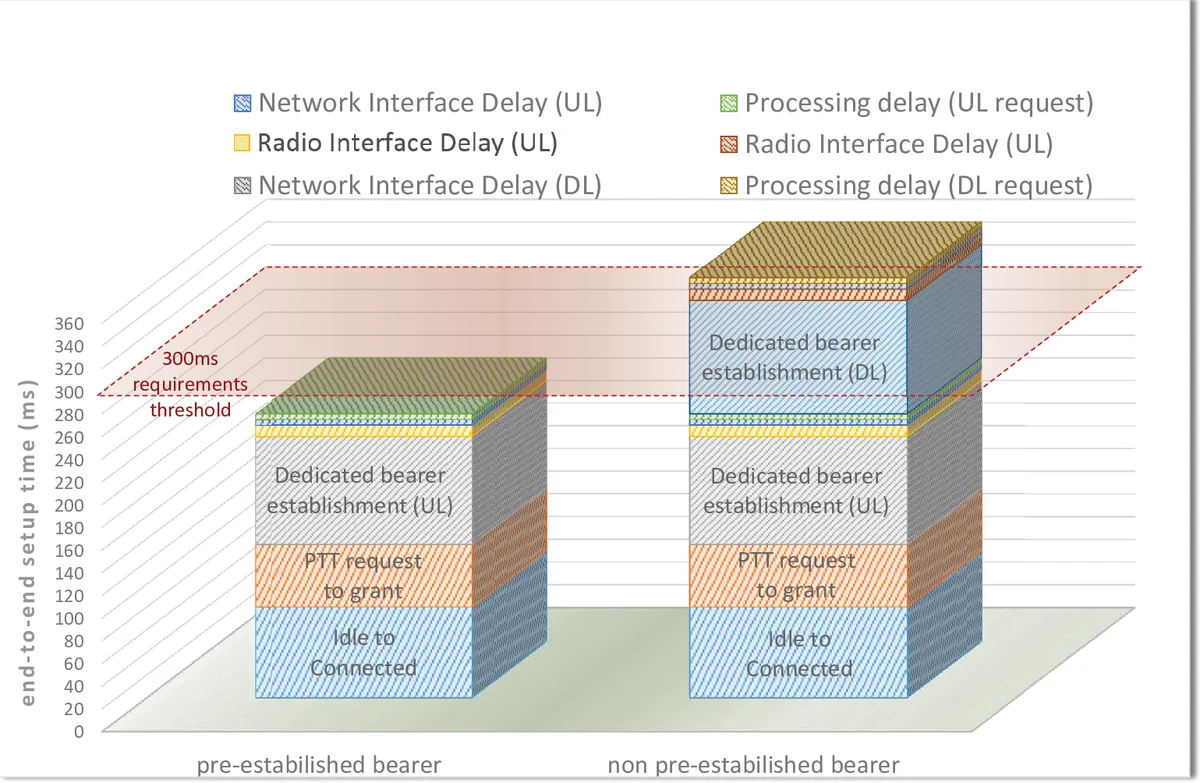
The paper first enumerates the essential PMR capabilities: extremely high reliability and availability (99 % per day, 99.9 % per year), fast call set‑up (<300 ms), half‑ and full‑duplex voice, Push‑to‑Talk (PTT) management, priority and pre‑emption, Direct Mode Operation (DMO) for device‑to‑device communication without network assistance, text messaging, PSTN inter‑working, emergency calls, and especially Group Calls (GC) that must support thousands of users simultaneously. The authors note that a realistic scenario may involve 36 voice groups serving at least 2 000 users, with up to 500 participants per group, and that each user can belong to multiple groups.
LTE Shortcomings for PSS
The authors then map these requirements onto LTE’s capabilities and identify four major gaps:
-
Direct Mode (DMO) / Proximity Services (ProSe) – LTE’s ProSe, still under definition in 3GPP, offers two operation modes: network‑assisted (authentication, resource allocation, security handled by the core) and non‑network‑assisted (devices use pre‑allocated resources). For public‑safety, both modes must be supported to guarantee communication even when the infrastructure is unavailable.
-
Voice Service – LTE is fundamentally packet‑switched. The transition path involves an initial Circuit‑Switched Fallback (CS‑Fallback) to legacy PMR networks, followed by Voice over LTE (VoLTE) based on the IP Multimedia Subsystem (IMS). Current VoLTE implementations lack mission‑critical functions such as group and direct calls, and they suffer from high call‑setup latency (4–7 seconds for Push‑to‑Talk over Cellular, PoC), which is unacceptable for emergency services.
-
Multicast / Group Call Delivery – Unicast transmission is inefficient for large‑scale group communications. LTE’s Enhanced Multimedia Broadcast Multicast Service (eMBMS) provides Point‑to‑Multipoint (P2M) delivery, with two transmission schemes: Single Cell (SC) and Single Frequency Network (SFN). SFN synchronizes multiple eNodeBs, improving coverage and spectral efficiency. The paper presents throughput simulations showing that SFN‑eMBMS can sustain higher data rates for both voice and video services, especially when larger bandwidth (10 MHz) is allocated.
-
Security – While the paper does not delve into detailed cryptographic mechanisms, it acknowledges that PMR‑grade end‑to‑end encryption, robust authentication, and key management are mandatory and must be integrated into any LTE‑based public‑safety solution.
Proposed Architectural Evolution
To bridge these gaps, the authors propose a staged network architecture:
-
Stage 1 – MVNO on Commercial LTE: The public‑safety operator acts as a Mobile Virtual Network Operator (MVNO), sharing the core network (EPC) and possibly the radio access network (RAN) with a commercial carrier (GWCN sharing). This enables rapid deployment of non‑mission‑critical services while leveraging existing infrastructure.
-
Stage 2 – Partial Core/RAN Sharing: The public‑safety operator gains greater control by sharing only parts of the EPC (e.g., using MOCN for RAN sharing) and deploying dedicated eUTRAN nodes in critical coverage areas. This improves QoS guarantees and allows the introduction of ProSe and enhanced security functions.
-
Stage 3 – Fully Dedicated LTE PMR Network: The operator owns the entire eUTRAN and EPC, possibly still using passive sharing (site or antenna sharing) to reduce costs. At this point, all mission‑critical features—DMO, priority/pre‑emption, group call via eMBMS, and hardened security—are fully integrated and managed by the public‑safety entity.
Implementation Considerations
The paper discusses practical aspects such as spectrum allocation (a harmonized 10 MHz band is suggested to meet the 256 kbps video requirement), the need for 3GPP to standardize ProSe for public‑safety, and the importance of integrating IMS extensions that support group call and direct mode. It also highlights that while eMBMS is designed primarily for downlink broadcast (e.g., TV streaming), its multicast capabilities can be repurposed for group voice and video, provided that latency and reliability requirements are met through SFN operation and appropriate QoS configurations.
Conclusions
The authors conclude that LTE can become the backbone for next‑generation public‑safety communications, but only if the standard evolves to incorporate direct device‑to‑device communication, mission‑critical voice extensions, robust multicast for group calls, and PMR‑grade security. A gradual migration—starting with shared commercial infrastructure and moving toward a dedicated LTE PMR network—offers a realistic path that balances cost, deployment speed, and the stringent reliability demanded by emergency services. The paper calls for continued 3GPP work on ProSe, group call enhancements, and security mechanisms to fully realize this vision.
Comments & Academic Discussion
Loading comments...
Leave a Comment