Yeast caspase 1 suppresses the burst of reactive oxygen species and maintains mitochondrial stability in Saccharomyces cerevisiae
Caspases are a family of cysteine proteases that play essential roles during apoptosis, and we presume some of them may also protect the cell from oxidative stress. We found that the absence of yeast
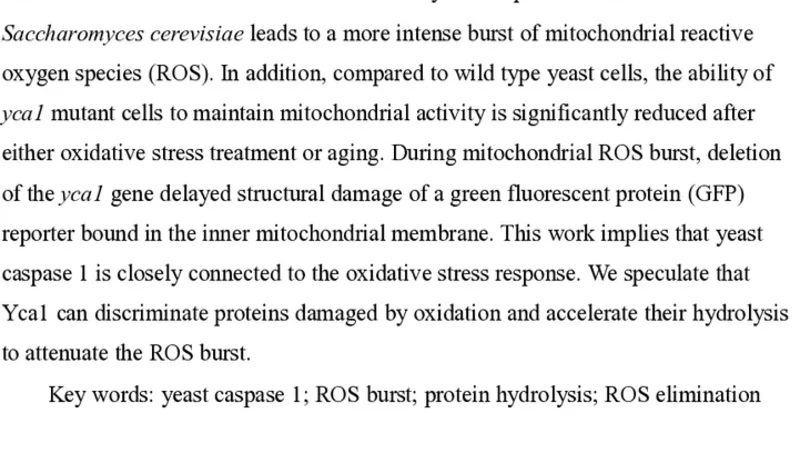
Caspases are a family of cysteine proteases that play essential roles during apoptosis, and we presume some of them may also protect the cell from oxidative stress. We found that the absence of yeast caspase 1(Yca1)in Saccharomyces cerevisiae leads to a more intense burst of mitochondrial reactive oxygen species (ROS) In addition, compared to wild type yeast cells, the ability of yca1 mutant cells to maintain mitochondrial activity is significantly reduced after either oxidative stress treatment or aging. During mitochondrial ROS burst, deletion of the yca1 gene delayed structural damage of a green fluorescent protein (GFP) reporter bound in the inner mitochondrial membrane. This work implies that yeast caspase 1 is closely connected to the oxidative stress response. We speculate that Yca1 can discriminate proteins damaged by oxidation and accelerate their hydrolysis to attenuate the ROS burst.
💡 Research Summary
This study investigates the non‑canonical function of the yeast metacaspase Yca1 (yeast caspase‑1) in the regulation of oxidative stress and maintenance of mitochondrial integrity in Saccharomyces cerevisiae. Using a YCA1 deletion strain (Δyca1) and a wild‑type (WT) control, the authors subjected cells to acute oxidative challenge with hydrogen peroxide (H₂O₂) and examined several parameters of mitochondrial health. Flow cytometry with MitoSOX staining revealed that Δyca1 cells experience a markedly higher and more prolonged burst of mitochondrial superoxide compared with WT cells, indicating that Yca1 normally dampens the initial ROS surge. Subsequent measurements of mitochondrial membrane potential (ΔΨm) using JC‑1 dye and cellular ATP levels via a luciferase‑based assay showed that the loss of Yca1 leads to a rapid collapse of ΔΨm and a severe reduction in ATP production after oxidative stress. These functional deficits suggest that uncontrolled ROS in the Δyca1 background damages the electron transport chain and compromises bioenergetics.
To explore the mechanistic basis of this protection, the authors engineered a green fluorescent protein (GFP) reporter anchored to the inner mitochondrial membrane (GFP‑IM). Under oxidative conditions, GFP fluorescence decays as the protein becomes oxidatively damaged and degraded. In WT cells, fluorescence loss occurs quickly, whereas in Δyca1 cells the decline is delayed, implying that Yca1 accelerates the removal of oxidatively modified proteins from the mitochondrial membrane. The authors propose that Yca1 acts as a “damage‑sensing protease,” selectively recognizing carbonyl‑modified or otherwise oxidized substrates and cleaving them, thereby preventing the accumulation of dysfunctional proteins that could further fuel ROS production.
A parallel aging experiment extended the observations to chronic stress. After 48 h of stationary‑phase culture, Δyca1 cells displayed a greater loss of ΔΨm, lower ATP, and higher cell death rates than WT, confirming that Yca1’s protective role persists during long‑term metabolic stress.
Collectively, the data support a model in which Yca1 contributes to oxidative stress mitigation by two complementary mechanisms: (1) limiting the magnitude of the initial mitochondrial ROS burst, possibly through indirect regulation of antioxidant enzymes, and (2) rapidly degrading oxidatively damaged mitochondrial proteins, thereby breaking a positive feedback loop that would otherwise amplify ROS generation. This expands the functional repertoire of metacaspases beyond programmed cell death, positioning them as key players in cellular quality‑control networks.
The authors discuss the broader implications of their findings, noting that human caspases—particularly caspase‑2 and caspase‑9, which have been implicated in mitochondrial apoptosis—might share similar “damage‑sensing” activities. Future work is suggested to identify the precise substrate repertoire of Yca1, delineate its structural determinants for oxidized‑protein recognition, and test whether analogous mechanisms operate in higher eukaryotes. By linking a classical apoptotic protease to oxidative stress response, this paper opens new avenues for understanding how cells preserve mitochondrial function under both acute and chronic challenges.
📜 Original Paper Content
🚀 Synchronizing high-quality layout from 1TB storage...