A note on thick subcategories of stable derived categories
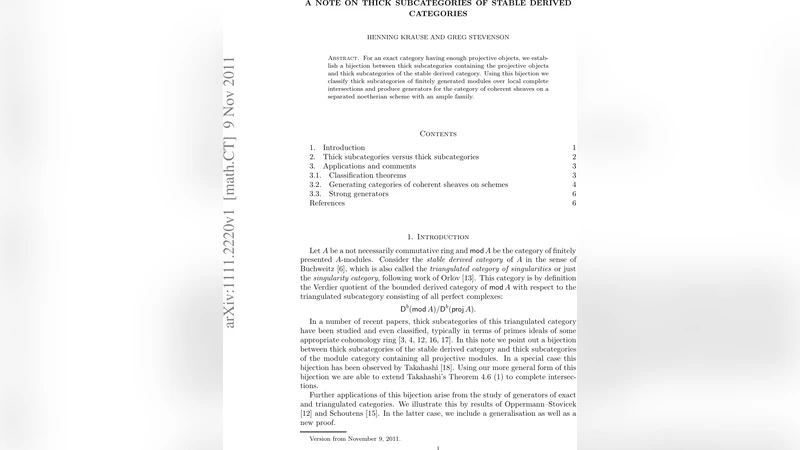
For an exact category having enough projective objects, we establish a bijection between thick subcategories containing the projective objects and thick subcategories of the stable derived category. Using this bijection we classify thick subcategories of finitely generated modules over local complete intersections and produce generators for the category of coherent sheaves on a separated noetherian scheme with an ample family.
💡 Research Summary
The paper establishes a fundamental correspondence between thick subcategories that contain the projective objects in an exact category A (with enough projectives) and thick subcategories of the stable derived category of A, i.e. the Verdier quotient Dᵇ(A)/Dᵇ(Proj A). The main result (Theorem 1) constructs two mutually inverse maps: one sends a thick subcategory 𝔇⊂Dᵇ(A) containing all projectives to its intersection with A (viewed as complexes concentrated in degree 0); the other sends a thick subcategory 𝔠⊂A containing all projectives to the bounded derived category Dᵇ(𝔠). The proof uses the fact that the inclusion 𝔠→A induces a fully faithful exact functor Dᵇ(𝔠)→Dᵇ(A) because 𝔠 already contains the projectives, and conversely any object of 𝔇 can be represented by a bounded complex of objects from 𝔇∩A. Consequently, thick subcategories of the stable derived category are in bijection with thick subcategories of A that contain the projectives.
Several applications illustrate the power of this bijection:
-
Local complete intersections. For a local complete intersection A, one constructs a hypersurface Y in a projective bundle over a regular ring B such that the singular locus Sing Y controls the thick subcategories of mod A containing the projectives. Corollary 5 gives an order‑preserving bijection between specialization‑closed subsets of Sing Y and thick subcategories of mod A containing A. This extends Takahashi’s earlier result from Gorenstein rings to arbitrary complete intersections.
-
Modular representation theory. For a finite group G over a field k whose characteristic divides |G|, the stable module category stmod kG is the Verdier quotient of Dᵇ(mod kG) by the perfect complexes. Applying Theorem 1 to the classification of thick tensor ideals in the stable category (Benson–Carlson–Rickard) yields Theorem 6: specialization‑closed subsets of the cohomology ring H⁎(G,k) correspond bijectively to thick tensor ideals of mod kG that contain the regular module kG.
-
Generators for coherent sheaves. Let X be a separated Noetherian scheme equipped with an ample family of line bundles {L_i}. Using the homotopy category of injective quasi‑coherent sheaves K(Inj X) and Bousfield localisation, Lemma 8 shows that if a subcategory C⊂coh X contains all twists L_i^{⊗m} and satisfies a vanishing condition on Hom‑groups into any injective complex, then the smallest thick subcategory containing C is the whole coh X. Theorem 7 (originally due to Schoutens) and Corollary 9 apply this to the set consisting of the ample twists together with structure sheaves of the closed subsets defined by points of the singular locus, proving that they generate all coherent sheaves on X.
-
Strong generators. Combining Theorem 1 with a result of Oppermann–Šťovíček (Theorem 10) shows that if a thick subcategory 𝔇⊂Dᵇ(A) contains all projectives and admits a strong generator, then 𝔇 must be the whole derived category Dᵇ(A). This lifts the notion of strong generation from triangulated categories to the underlying exact (abelian) category.
Overall, the paper provides a clean and general framework for translating problems about thick subcategories in singularity categories into the more concrete language of exact (or abelian) categories containing the projectives. This bridge enables the authors to recover known classification theorems, extend them to broader contexts (complete intersections, schemes with ample families), and obtain new results on generators and strong generators. The techniques blend Verdier quotients, tensor actions, Bousfield localisation, and classical homological algebra, offering a versatile toolkit for future work on triangulated and exact categories.
Comments & Academic Discussion
Loading comments...
Leave a Comment