Multi-state asymmetric simple exclusion processes
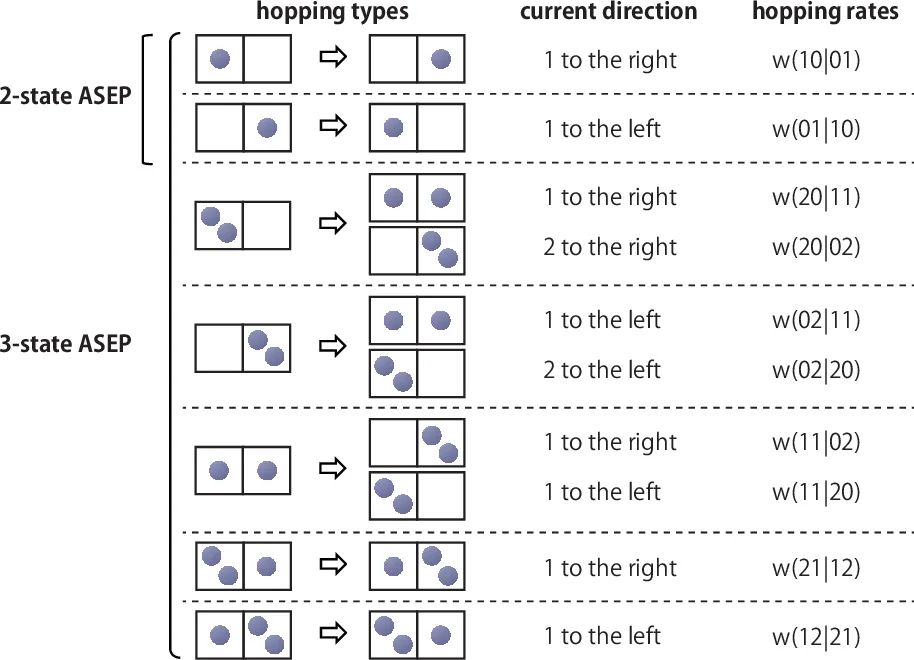
It is known that the Markov matrix of the asymmetric simple exclusion process (ASEP) is invariant under the Uq(sl2) algebra. This is the result of the fact that the Markov matrix of the ASEP coincides with the generator of the Temperley-Lieb (TL) algebra, the dual algebra of the Uq(sl2) algebra. Various types of algebraic extensions have been considered for the ASEP. In this paper, we considered the multi-state extension of the ASEP, by allowing more than two particles to occupy the same box. We constructed the Markov matrix by dimensionally extending the TL generators and derived explicit forms of the particle densities and the currents on the steady states. Then we showed how decay lengths differ from the original two-state ASEP under the closed boundary conditions.
💡 Research Summary
The paper investigates a natural extension of the asymmetric simple exclusion process (ASEP) by allowing more than one particle to occupy a site, thereby creating a multi‑state ASEP. The starting point is the well‑known fact that the Markov matrix of the ordinary two‑state ASEP is invariant under the quantum group U₍q₎(sl₂) and can be identified with a Temperley‑Lieb (TL) generator, the dual algebra of U₍q₎(sl₂). By exploiting this duality, the author constructs higher‑dimensional TL generators through a fusion procedure based on ℓ‑fold tensor products of the fundamental two‑dimensional representation.
Fusion and projection.
The ℓ‑fold tensor product decomposes into irreducible components; the largest irreducible subspace is the q‑symmetrized (ℓ + 1)‑dimensional sector. A recursively defined projection operator Y^{(k)} (built from TL generators and Chebyshev polynomials of the second kind) extracts this sector. Applying Y^{(ℓ)} to the product of fundamental TL generators yields ℓ distinct fused generators e^{(ℓ;r)}_i (r = 1,…,ℓ). These obey the SO(3) Birman‑Murakami‑Wenzl (BMW) algebra, a higher‑rank analogue of the TL relations.
Probability conservation and positivity.
Raw fused generators do not satisfy the stochastic requirements: their columns do not sum to zero and some off‑diagonal entries are negative. The author first finds a similarity transformation U that renders each fused generator column‑stochastic (zero column sum). Then, by taking a linear combination Σ_r c_r e^{(ℓ;r)}_i with appropriately chosen coefficients c_r, all off‑diagonal elements become non‑negative. The paper analytically identifies parameter regimes where such coefficients exist, thereby guaranteeing a legitimate Markov matrix.
Steady states via U₍q₎(sl₂) invariance.
With closed boundaries (no particle injection or extraction), the Markov matrix commutes with the global coproduct Δ(N) of the quantum group generators. Consequently, the empty configuration |0⟩ (all sites vacant) is a highest‑weight vector, and the family of states Δ(N)(S⁻)^n |0⟩ (S⁻ is the lowering operator of U₍q₎(sl₂)) forms a complete set of steady states. This algebraic structure enables exact evaluation of site‑dependent particle densities ρ_k(i) (k = 0,…,ℓ) and currents J_k(i).
Special limits and physical interpretation.
Two limits are examined in detail. In the symmetric case (p_R = p_L) the net current vanishes and the coefficients of the linear combination acquire the meaning of symmetric weighting of the fused generators. In the totally asymmetric case (p_L = 0) the coefficients separate into contributions to right‑moving and left‑moving currents, providing a clear physical picture of how each fused generator drives transport.
Large‑volume behavior and decay length.
Taking N → ∞, the density profiles develop a sharp interface separating a low‑density phase from a high‑density phase. The width of this interface, i.e., the decay length ξ, scales linearly with the number of internal states ℓ (ξ ∝ ℓ). Thus, increasing the number of allowed particles per site broadens the transition region and reduces the exponential decay rate compared with the standard two‑state ASEP, where ξ is a constant. Currents cancel in the interface region, yet each internal state still carries a biased current consistent with the underlying asymmetry.
Conclusions and outlook.
The work delivers three major contributions: (1) a systematic construction of a multi‑state ASEP preserving U₍q₎(sl₂) invariance, (2) a method to transform fused TL generators into a bona‑fide stochastic matrix via similarity transformation and linear combination, and (3) exact steady‑state expressions revealing a new scaling law for the decay length that depends on the number of states. The paper suggests several future directions, including open‑boundary conditions, coupling to external reservoirs, extensions to higher‑rank quantum groups (e.g., U₍q₎(slₙ)), and possible experimental realizations in driven colloidal or cold‑atom systems.
Comments & Academic Discussion
Loading comments...
Leave a Comment