DSSI for pile supported asymmetrical buildings : a review
With the reference of the several documents in the field of soil structure interaction a document of present and past literature has been made with the including a main focus on interaction of pile su
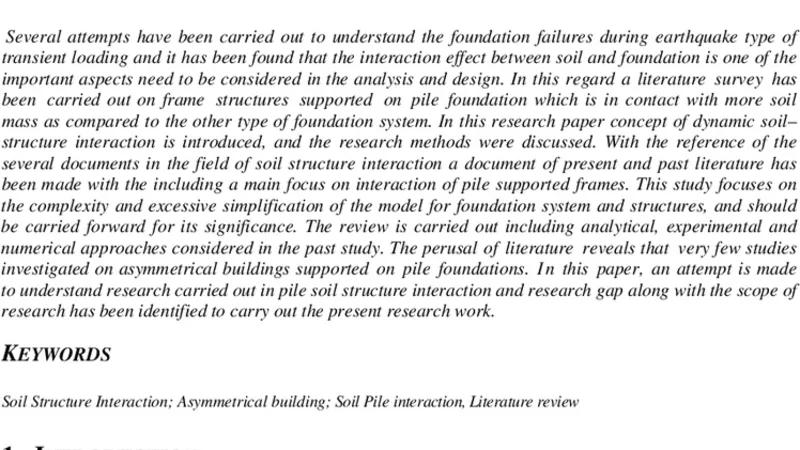
With the reference of the several documents in the field of soil structure interaction a document of present and past literature has been made with the including a main focus on interaction of pile supported frames. This study focuses on the complexity and excessive simplification of the model for foundation system and structures, and should be carried forward for its significance. The review is carried out including analytical, experimental and numerical approaches considered in the past study. The perusal of literature reveals that very few studies investigated on asymmetrical buildings supported on pile foundations. In this paper, an attempt is made to understand research carried out in pile soil structure interaction and research gap along with the scope of research has been identified to carry out the present research work.
💡 Research Summary
The paper presents a comprehensive review of dynamic soil‑structure interaction (DSSI) research concerning pile‑supported asymmetrical buildings. Beginning with a discussion of the importance of SSI in seismic design, the authors note that the majority of existing studies assume symmetric superstructures and employ highly simplified foundation models, leaving a substantial knowledge gap for asymmetrical configurations.
A systematic literature search was performed across peer‑reviewed journals, conference proceedings, and technical reports, and the collected works were classified into analytical, experimental, and numerical categories.
Analytical approaches are dominated by Winkler‑type spring models and p‑y curve formulations that capture pile‑soil nonlinearity. Equivalent continuum and composite media models have also been proposed, but their application to asymmetric structures is rare. The analytical studies often assume linear, isotropic soil behavior and fixed boundary conditions, which can lead to significant errors when predicting dynamic responses of real systems.
Experimental investigations include both scaled laboratory tests (e.g., shake‑table, centrifuge) and full‑scale field tests such as pile load tests and dynamic in‑situ measurements. For asymmetrical buildings, reproducing the irregular mass and stiffness distribution in a test set‑up is challenging and costly; consequently, most experiments have used symmetric mock‑ups. Data collected typically focus on shear deformation, rotation of the pile group, and interface shear strength, while comprehensive system‑level dynamic response measurements remain scarce.
Numerical methods span two‑ and three‑dimensional finite element (FEM) and finite difference (FDM) models, with recent trends toward particle‑based techniques (DEM, SPH) and coupled multi‑physics frameworks. Nonlinear material models (elastic‑plastic, visco‑plastic) and dynamic contact algorithms are employed, but mesh sensitivity, boundary condition specification, and material parameter calibration lack standardization, reducing result reproducibility. Moreover, few studies simultaneously model the asymmetric stiffness matrix of the superstructure and the heterogeneous pile‑soil interaction, which is essential for capturing coupled translation‑rotation effects.
The review quantifies the research gap: studies explicitly addressing asymmetrical buildings constitute less than 5 % of the total SSI literature, and most of these are limited to static or quasi‑static analyses. Critical aspects such as torsional‑shear coupling, soil anisotropy, seismic record selection, and probabilistic sensitivity analyses are largely unexplored.
To bridge this gap, the authors propose several research directions: (1) development of high‑fidelity three‑dimensional nonlinear models that incorporate the full asymmetric stiffness of the superstructure and the non‑linear, heterogeneous behavior of the pile‑soil system; (2) design of customized scaled and full‑scale experimental programs capable of measuring coupled translation‑rotation responses, possibly using advanced sensor arrays and real‑time data acquisition; (3) creation of a unified multi‑physics numerical framework (e.g., FEM‑DEM coupling) with standardized guidelines for mesh design, boundary conditions, and material parameter selection; and (4) integration of machine‑learning‑based parameter identification and Bayesian probabilistic methods to produce robust, reliability‑based assessments of asymmetrical pile‑supported structures.
In conclusion, the paper emphasizes that current DSSI research for pile‑supported buildings is heavily biased toward symmetric, overly simplified models, which limits its applicability to modern, irregular structures. Addressing the identified gaps through the suggested analytical, experimental, and computational advancements will not only improve the accuracy of seismic response predictions but also provide the basis for incorporating DSSI considerations into design codes and practical engineering guidelines.
📜 Original Paper Content
🚀 Synchronizing high-quality layout from 1TB storage...