Two Answers to a Common Question on Diagonalization
A common question from students on the usual diagonalization proof for the uncountability of the set of real numbers is: when a representation of real numbers, such as the decimal expansions of real n
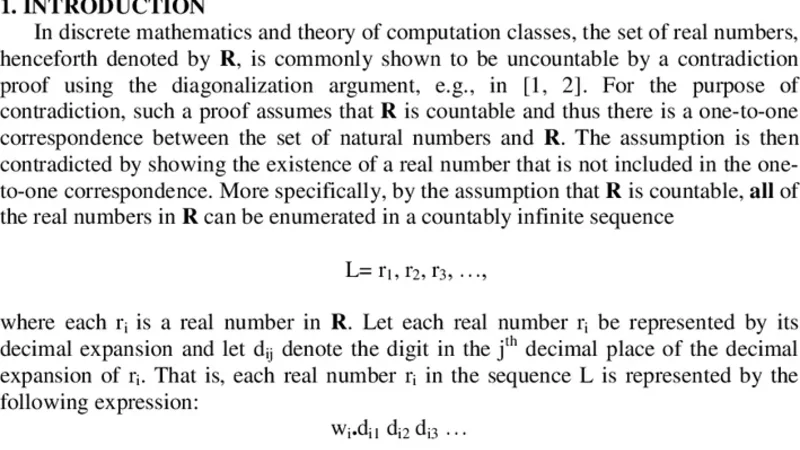
A common question from students on the usual diagonalization proof for the uncountability of the set of real numbers is: when a representation of real numbers, such as the decimal expansions of real numbers, allows us to use the diagonalization argument to prove that the set of real numbers is uncountable, why can’t we similarly apply the diagonalization argument to rational numbers in the same representation? why doesn’t the argument similarly prove that the set of rational numbers is uncountable too? We consider two answers to this question. We first discuss an answer that is based on the familiar decimal expansions. We then present an unconventional answer that is based on continued fractions.
💡 Research Summary
The paper addresses a frequently asked question by students: “If Cantor’s diagonal argument works for real numbers when we represent them by decimal expansions, why can’t we apply the same argument to rational numbers in the same representation? Wouldn’t that also prove that the rationals are uncountable?” The authors provide two distinct answers, one based on the familiar decimal expansion and the other on continued‑fraction representations.
First, the paper revisits the classic diagonal proof. Real numbers are written as infinite decimal strings 0.d₁d₂d₃…, and assuming a list of all reals, we construct a new number x by changing the i‑th digit of the i‑th entry. By construction x differs from every listed number in at least one digit, so x cannot be on the list; therefore the reals are not countable. The student’s objection is that the same construction could be performed on a purported list of all rationals.
The authors’ first answer points out the essential role of non‑periodicity. Every rational number has a decimal expansion that is either terminating or eventually periodic: after some finite block of digits a₁…aₖ the pattern repeats indefinitely. When we apply the diagonal construction to a list of rationals, the resulting number x will almost surely have a non‑repeating tail, because we are altering infinitely many positions without respecting any periodic pattern. Consequently x is a non‑periodic infinite decimal, which by definition is irrational. Thus the diagonal method does indeed produce a number not on the list, but that number is guaranteed to be irrational, not rational. The argument therefore does not contradict the fact that the rationals are countable; it simply shows that the diagonal construction cannot stay inside the class of rationals. The paper illustrates this with concrete examples, such as a list of fractions 1/2, 1/3, 1/4,… and shows that the diagonal number obtained by flipping each digit to 9 yields a number with a non‑repeating decimal expansion, i.e., an irrational.
The second answer adopts a less familiar but more structural viewpoint: continued fractions. Every real number can be expressed uniquely as a continued fraction a₀; a₁, a₂, … . Rational numbers correspond precisely to finite continued fractions (the expansion terminates after a finite number of partial quotients), whereas irrational numbers correspond to infinite continued fractions. If we list only rationals, each entry has a finite length. Performing a diagonal alteration on the i‑th partial quotient of the i‑th entry forces us to create an infinite sequence of partial quotients, because we never reach a terminating point. The resulting object is therefore an infinite continued fraction, which can only represent an irrational number. In this framework the obstruction is not the periodicity of decimal digits but the very finiteness of the representation. The diagonal method requires an infinite supply of independent “coordinates” to modify; rationals, having only finitely many coordinates in their continued‑fraction form, cannot support such a construction without leaving the rational class.
By presenting both perspectives, the authors clarify why the diagonal argument is a tool for demonstrating the existence of “more” infinite degrees of freedom than can be captured by any countable list. In decimal form the extra freedom appears as the ability to avoid eventual periodicity; in continued fractions it appears as the necessity of an infinite tail of partial quotients. Both analyses converge on the same conclusion: the diagonal argument inevitably produces an irrational number, so it cannot be used to prove that the set of rationals is uncountable. The paper thus resolves the pedagogical confusion, emphasizing that the diagonal method’s power lies precisely in the infinite, non‑terminating nature of the representations it manipulates, a property that rationals lack.
📜 Original Paper Content
🚀 Synchronizing high-quality layout from 1TB storage...