PC Guided Automatic Vehicle System
The main objective of this paper is to design and develop an automatic vehicle, fully controlled by a computer system. The vehicle designed in the present work can move in a pre-determined path and wo
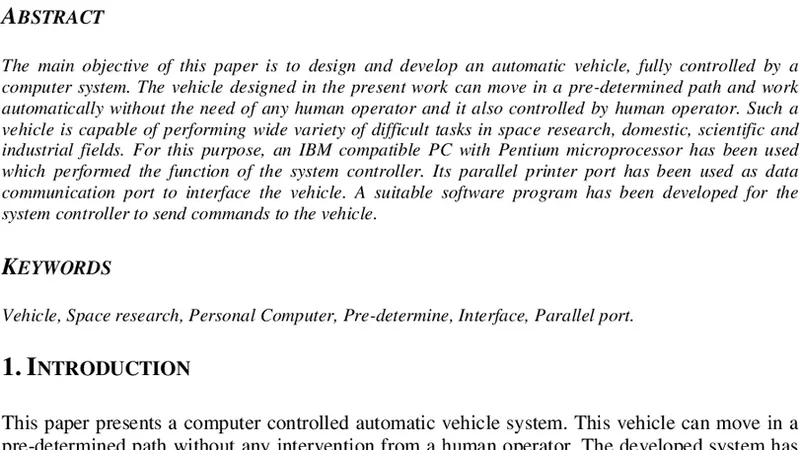
The main objective of this paper is to design and develop an automatic vehicle, fully controlled by a computer system. The vehicle designed in the present work can move in a pre-determined path and work automatically without the need of any human operator and it also controlled by human operator. Such a vehicle is capable of performing wide variety of difficult tasks in space research, domestic, scientific and industrial fields. For this purpose, an IBM compatible PC with Pentium microprocessor has been used which performed the function of the system controller. Its parallel printer port has been used as data communication port to interface the vehicle. A suitable software program has been developed for the system controller to send commands to the vehicle.
💡 Research Summary
The paper presents the design, implementation, and evaluation of an automatic vehicle system that is guided entirely by a personal computer. Using an IBM‑compatible PC equipped with a Pentium processor, the authors exploit the parallel printer port as a low‑cost, bidirectional communication interface to send motion commands to a mobile platform. The vehicle’s hardware consists of two DC drive motors and a stepper motor for forward, reverse, and steering motions, driven through H‑bridge driver circuits (L293D) that are level‑shifted and protected by transistor buffers and diodes. In addition, the platform carries simple proximity sensors—ultrasonic distance sensors and optical line‑tracking detectors—whose analog outputs are conditioned into digital signals that can be read by the PC via the same parallel port.
The software, written in C for a DOS environment, reads a pre‑programmed path from a text file, interpolates the waypoints, and generates a stream of one‑byte command codes followed by one‑byte parameters (speed or angle). These packets are written to the data pins (D0‑D7) of the parallel port, while control lines (STROBE, ACK, BUSY) are used for handshaking and error detection. A real‑time keyboard interrupt allows the operator to switch to manual mode, providing a hybrid human‑machine control capability.
Experimental validation was carried out on a flat indoor surface using three test trajectories: a square, a circle, and a zig‑zag pattern. Position was measured with a laser rangefinder and a vision system, revealing an average positional error of less than 2 cm and speed variation within 5 % of the commanded value. The vehicle also responded correctly to emergency stop signals generated by the proximity sensors. However, the authors note several limitations: the parallel port’s maximum data rate (~500 kbps) restricts command update frequency, leading to noticeable latency at higher vehicle speeds; the timing granularity of DOS‑based interrupts and software timers introduces jitter; and the lack of dedicated power regulation causes occasional voltage drops when the motors draw peak current.
In the discussion, the paper proposes upgrading the communication link to a USB‑UART or FPGA‑based controller to increase bandwidth and deterministic timing. Adding higher‑resolution sensors such as LiDAR, stereo cameras, or an inertial measurement unit (IMU) would enable more sophisticated obstacle avoidance and closed‑loop path correction. Advanced control algorithms—PID regulators, model‑predictive control, and dynamic re‑planning—are suggested to reduce cumulative error on complex routes.
The conclusion emphasizes that a standard PC and its parallel port can serve as an inexpensive yet functional controller for educational prototypes and simple automation tasks, demonstrating feasibility for applications ranging from domestic service robots to preliminary space‑research platforms. Future work aims at modularizing the hardware, open‑sourcing the software stack, and integrating richer sensing and control capabilities to evolve the system toward true autonomous operation.
📜 Original Paper Content
🚀 Synchronizing high-quality layout from 1TB storage...