Can Fires, Night Lights, and Mobile Phones reveal behavioral fingerprints useful for Development?
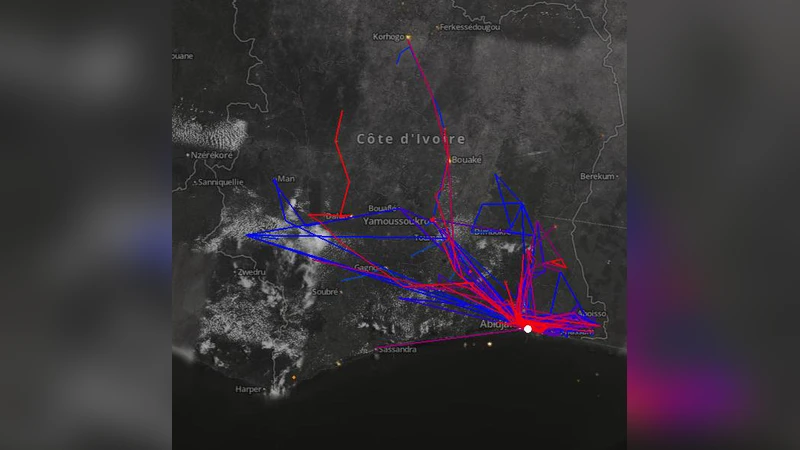
Fires, lights at night and mobile phone activity have been separately used as proxy indicators of human activity with high potential for measuring human development. In this preliminary report, we develop some tools and methodologies to identify and visualize relations among remote sensing datasets containing fires and night lights information with mobile phone activity in Cote D’Ivoire from December 2011 to April 2012.
💡 Research Summary
The paper presents a preliminary framework for combining three distinct remote‑sensing and telecommunications data streams—satellite‑detected fire events, nighttime light intensity, and mobile‑phone activity—to generate multidimensional behavioral fingerprints that can serve as proxies for human development. Focusing on Côte d’Ivoire between December 2011 and April 2012, the authors first describe each dataset in detail: MODIS fire detections (≈1 km spatial resolution, daily temporal granularity), VIIRS Day‑Night Band (DNB) night‑light measurements (≈500 m resolution), and anonymized, aggregated call‑and‑SMS volumes supplied by a local mobile‑network operator at the cell‑tower level.
To make the datasets comparable, the authors re‑project all layers to a common UTM coordinate system, align timestamps to UTC, and fill missing observations using linear interpolation and neighboring‑cell averages. They then resample the data onto a uniform 5 km × 5 km grid, calculating for each cell the total number of fire detections, the mean radiance (in nanowatts cm⁻² sr⁻¹), and the average daily mobile activity (calls + SMS).
Statistical analysis proceeds in two stages. First, descriptive statistics and histograms reveal highly skewed distributions, especially for fire counts in rural zones. Second, the authors compute Pearson and Spearman correlation coefficients across the entire study area and within sub‑regions (urban versus rural). They also fit hierarchical linear models that include fixed effects for region type and random effects for individual cell towers, allowing them to control for spatial heterogeneity. Model performance is assessed with AIC/BIC and k‑fold cross‑validation.
Visualization tools built with Python’s Folium and Plotly libraries enable interactive exploration: users can click on any grid cell to view time‑series plots of the three variables and slide through days to observe dynamic patterns. The visualizations highlight that urban centers such as Abidjan exhibit a strong positive correlation between night‑light intensity and mobile activity (r≈0.78, p < 0.01), reflecting dense electrification and digital connectivity. In contrast, rural districts show a moderate positive link between fire frequency and mobile usage (r≈0.45, p < 0.05), suggesting that agricultural or charcoal‑production activities are coordinated through mobile communication. Seasonal effects are also evident; fire occurrences peak during the dry season (January–March) while night‑light levels dip slightly, indicating a shift in activity patterns.
The discussion interprets these findings as evidence that combined remote‑sensing and telecom indicators can capture nuanced aspects of socioeconomic development. For policymakers, the results imply that expanding mobile coverage in fire‑prone rural areas could improve information dissemination and disaster response, while simultaneous upgrades to electricity infrastructure in urban zones may amplify economic productivity.
Limitations include the short observation window, which precludes robust seasonal or inter‑annual trend analysis, and the reliance on a single mobile operator’s data, which may not fully represent the national population. Satellite observations are also subject to cloud cover and atmospheric interference.
In conclusion, the study demonstrates that integrating fire, night‑light, and mobile‑phone datasets offers a low‑cost, high‑resolution lens for monitoring human activity and development in data‑scarce regions. Future work will extend the temporal span, incorporate data from multiple telecom providers, add climate and economic covariates, and explore machine‑learning techniques for pattern detection, thereby enhancing the predictive power and policy relevance of the behavioral fingerprint approach.
Comments & Academic Discussion
Loading comments...
Leave a Comment