First-principles study of four quaternary Heusler alloys ZrMnVZ and ZrCoFeZ (Z=Si, Ge)
We investigate the electronic structure and magnetic properties of four quaternary Heusler alloys ZrMnVZ and ZrCoFeZ (Z=Si, Ge) by using first-principle calculations. It is shown that ZrMnVSi, ZrMnVGe and ZrCoFeSi are half-metallic ferromagnets with considerable half-metallic gaps of 0.14, 0.18 and 0.22 eV, respectively. ZrCoFeGe is a nearly half-metallic, the changes of properties for this alloy under pressure is investigated, the spin polarization of this alloy is 98.99% at equilibrium lattice constant.
💡 Research Summary
The authors performed a systematic first‑principles investigation of four quaternary Heusler compounds—ZrMnVSi, ZrMnVGe, ZrCoFeSi and ZrCoFeGe—using density‑functional theory within the generalized‑gradient approximation (GGA‑PBE) as implemented in the FPLO code. After testing the three possible LiMgPdSn‑type configurations (space group F4̅3m), the most stable atomic arrangement was identified for each alloy, and the equilibrium lattice constants were determined to be 6.128 Å (ZrMnVSi), 6.219 Å (ZrMnVGe), 5.973 Å (ZrCoFeSi) and 6.056 Å (ZrCoFeGe). A dense 20 × 20 × 20 k‑point mesh and an angular momentum cutoff of l_max = 12 ensured convergence of total energies to 10⁻⁸ Hartree.
Magnetic moments follow the Slater‑Pauling rule precisely: the two Mn‑containing alloys (20 valence electrons) exhibit a total moment of 2 µ_B per formula unit, while the Fe‑containing alloys (25 valence electrons) show 1 µ_B. Detailed site‑resolved moments reveal that Co–Fe coupling in ZrCoFeSi is ferromagnetic, whereas Zr–Co and Zr–Fe interactions are antiferromagnetic; in the Mn‑based compounds, Zr–V is ferromagnetic while Zr–Mn and V–Mn are antiferromagnetic.
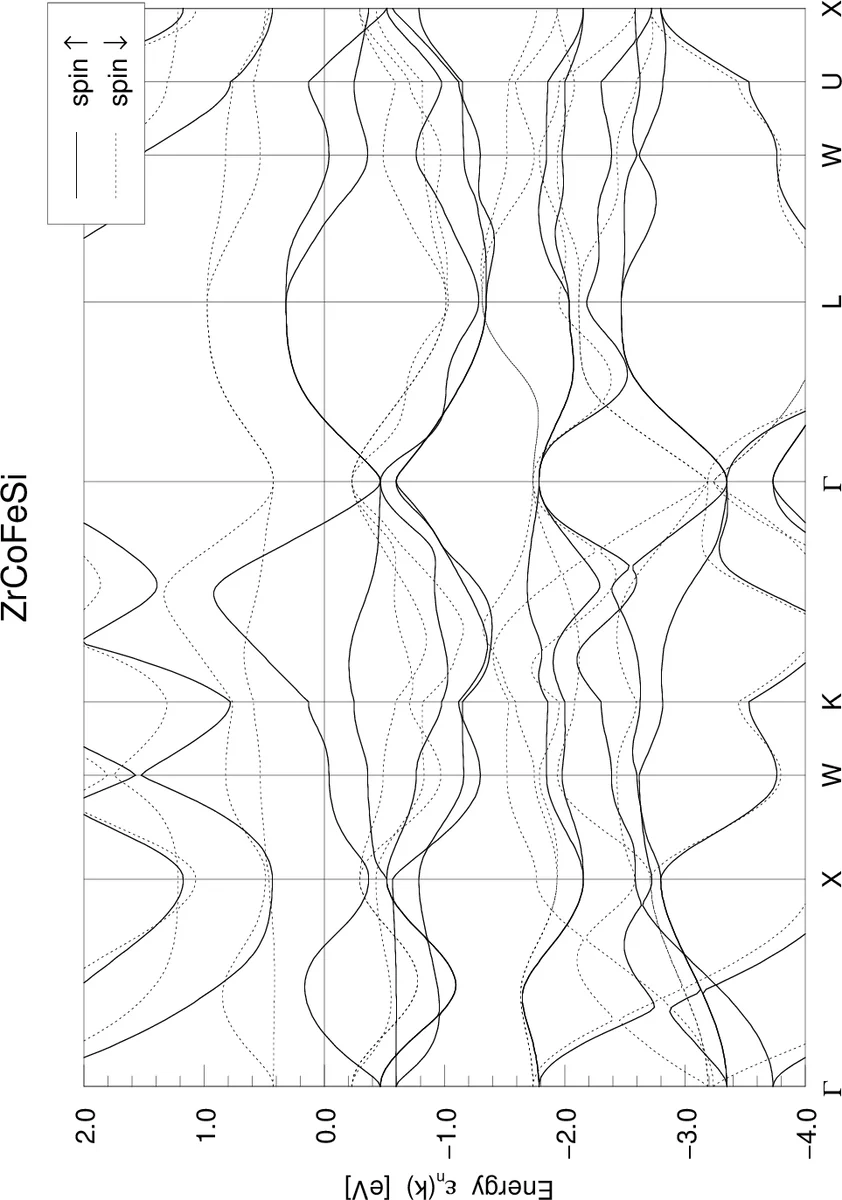
Electronic structure analysis shows classic half‑metallic behavior for ZrMnVSi, ZrMnVGe and ZrCoFeSi: the spin‑up channel is metallic, whereas the spin‑down channel possesses a finite band gap at the Fermi level. The calculated half‑metallic gaps (E_g) are 0.14 eV, 0.18 eV and 0.22 eV, respectively, leading to nearly 100 % spin polarization. Partial density‑of‑states (PDOS) indicates that the 3d states of Mn, Co and Fe dominate near the Fermi energy, with hybridization between transition‑metal d‑orbitals and Zr 4d states, while Si/Ge p‑states contribute mainly at lower energies.
ZrCoFeGe, by contrast, is a “nearly half‑metal”: the spin‑down band crosses the Fermi level, yielding a calculated spin polarization of 98.99 % at equilibrium. To explore tunability, the authors applied uniform strain and hydrostatic pressure. For the three true half‑metals, the half‑metallic character persists under up to 4 % (ZrMnVSi, ZrMnVGe) and 8 % (ZrCoFeSi) compressive strain, and also under moderate tensile strain, indicating robustness against lattice mismatch in thin‑film applications.
Pressure dependence of ZrCoFeGe was modeled using the Murnaghan equation of state. A modest pressure of 0.20 GPa opens a spin‑down gap, converting the alloy into a full half‑metal. The total magnetic moment remains at 1 µ_B up to 25.53 GPa; beyond this, the moment gradually declines, vanishing near 63.97 GPa, after which the system becomes non‑magnetic above ~66 GPa. The band gap disappears above 25.53 GPa, delineating a clear pressure window (0.20–25.53 GPa) where ZrCoFeGe behaves as a half‑metal.
In summary, the study identifies ZrMnVSi, ZrMnVGe and ZrCoFeSi as robust half‑metallic ferromagnets with sizable gaps and high spin polarization, suitable for spin‑injection electrodes and magnetic tunnel junctions. ZrCoFeGe, while not a perfect half‑metal at ambient conditions, can be driven into a half‑metallic state by low hydrostatic pressure and loses its magnetism only under extreme compression, making it an attractive candidate for pressure‑controlled spintronic devices. The work provides valuable quantitative guidance for experimental synthesis, strain engineering, and device integration of Zr‑based quaternary Heusler alloys.
Comments & Academic Discussion
Loading comments...
Leave a Comment