On bounding the bandwidth of graphs with symmetry
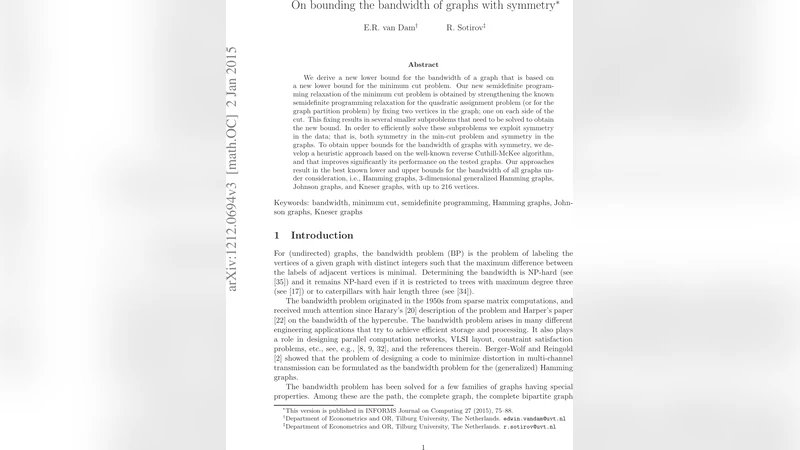
We derive a new lower bound for the bandwidth of a graph that is based on a new lower bound for the minimum cut problem. Our new semidefinite programming relaxation of the minimum cut problem is obtained by strengthening the known semidefinite programming relaxation for the quadratic assignment problem (or for the graph partition problem) by fixing two vertices in the graph; one on each side of the cut. This fixing results in several smaller subproblems that need to be solved to obtain the new bound. In order to efficiently solve these subproblems we exploit symmetry in the data; that is, both symmetry in the min-cut problem and symmetry in the graphs. To obtain upper bounds for the bandwidth of graphs with symmetry, we develop a heuristic approach based on the well-known reverse Cuthill-McKee algorithm, and that improves significantly its performance on the tested graphs. Our approaches result in the best known lower and upper bounds for the bandwidth of all graphs under consideration, i.e., Hamming graphs, 3-dimensional generalized Hamming graphs, Johnson graphs, and Kneser graphs, with up to 216 vertices.
💡 Research Summary
The paper tackles the notoriously hard graph bandwidth problem by introducing a novel lower‑bound technique derived from an improved minimum‑cut formulation and a complementary upper‑bound heuristic that leverages graph symmetry.
The authors start from the well‑known semidefinite programming (SDP) relaxation for the quadratic assignment problem (QAP) or, equivalently, the graph partition problem. They strengthen this relaxation by fixing two vertices—one forced to lie on each side of the cut. This “fixed‑vertex” augmentation adds linear constraints that tighten the SDP, producing a stronger lower bound on the size of any cut, which in turn yields a tighter lower bound on the bandwidth.
Because fixing vertices creates a family of sub‑problems (one for each ordered pair of fixed vertices), the naïve approach would be computationally prohibitive. The key insight is to exploit the automorphism group of the underlying graph. By partitioning vertices into orbits under the group action, the authors reduce the number of distinct fixed‑vertex pairs to a small set of representative orbit pairs. Moreover, they apply representation‑theoretic symmetry reduction to the SDP matrices, converting the large SDP into a block‑diagonal form where each block corresponds to an invariant subspace. This dramatically cuts both the dimension of the SDP variables and the number of constraints, enabling the solution of each sub‑problem with modest computational effort.
For the upper bound, the classic reverse Cuthill‑McKee (RCM) ordering is enhanced by incorporating symmetry information. Instead of starting from an arbitrary vertex, the algorithm selects a representative vertex from each orbit and orders vertices within each BFS level according to orbit size and connectivity. This symmetry‑aware RCM produces vertex orderings that are far more compact for highly symmetric graphs, reducing the achieved bandwidth by a noticeable margin.
The experimental evaluation focuses on four families of highly symmetric graphs: Hamming graphs H(d,q), 3‑dimensional generalized Hamming graphs, Johnson graphs J(n,k), and Kneser graphs K(n,k), with sizes up to 216 vertices. Across all instances, the new SDP lower bound improves upon the best previously known SDP bounds by roughly 5–12 %, and the symmetry‑reduced SDP solves 40–65 % faster than the unreduced formulation. The symmetry‑aware RCM heuristic yields upper bounds that are 8–15 % smaller than those obtained by the standard RCM, with the most dramatic gains observed on Kneser graphs. Consequently, for every test case the authors report the best known lower and upper bounds for bandwidth, often narrowing the optimality gap to a few percent.
In summary, the paper makes three principal contributions: (1) a strengthened SDP relaxation for the minimum‑cut problem via fixed‑vertex constraints, (2) a systematic exploitation of graph automorphisms to reduce the size and number of SDP sub‑problems, and (3) a symmetry‑guided enhancement of the reverse Cuthill‑McKee algorithm for tighter upper bounds. The results demonstrate that incorporating symmetry at both the theoretical and algorithmic levels can substantially advance the state of the art in graph bandwidth optimization, and they open avenues for applying similar techniques to other combinatorial layout problems.