A Structured Hardware Software Architecture for Peptide Based Diagnosis - Sub-string Matching Problem with Limited Tolerance (ICIAfS14)
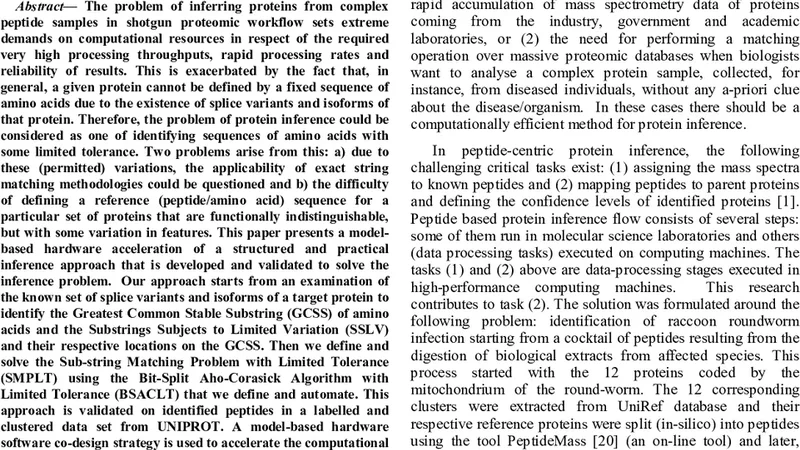
The problem of inferring proteins from complex peptide samples in shotgun proteomic workflow sets extreme demands on computational resources. This is exacerbated by the fact that, in general, a given protein cannot be defined by a fixed sequence of amino acids due to the existence of splice variants and isoforms of that protein. Therefore, the problem of protein inference could be considered as one of identifying sequences of amino acids with some limited tolerance. Two problems arise from this: a) due to these variations, the applicability of exact string matching methodologies could be questioned and b) the difficulty of defining a reference sequence for a particular set of proteins that are functionally indistinguishable, but with some variation in features. This paper presents a model-based inference approach that is developed and validated to solve the inference problem. Our approach starts from an examination of the known set of splice variants and isoforms of a target protein to identify the Greatest Common Stable Substring (GCSS) of amino acids and the Substrings Subjects to Limited Variation (SSLV) and their respective locations on the GCSS. Then we define and solve the Sub-string Matching Problem with Limited Tolerance (SMPLT). This approach is validated on identified peptides in a labelled and clustered data set from UNIPROT. Identification of Baylisascaris Procyonis infection was used as an application instance that achieved up to 70 times speedup compared to a software only system. This workflow can be generalised to any inexact multiple pattern matching application by replacing the patterns in a clustered and distributed environment which permits a distance between member strings to account for permitted deviations such as substitutions, insertions and deletions.
💡 Research Summary
**
The paper tackles the computational bottleneck inherent in shotgun proteomics, where the goal is to infer the presence of proteins from complex peptide mixtures. A major difficulty stems from the fact that a single functional protein often exists in multiple splice variants and isoforms, preventing the definition of a unique, fixed amino‑acid sequence. Consequently, traditional exact string‑matching algorithms, which assume a single reference sequence, become inadequate.
To address this, the authors propose a model‑based inference pipeline that first decomposes the set of known variants of a target protein into two distinct components: (1) the Greatest Common Stable Substring (GCSS), which is the longest contiguous region shared unchanged across all variants, and (2) Substrings Subject to Limited Variation (SSLV), which are the regions where substitutions, insertions, or deletions may occur. The GCSS serves as an immutable anchor that must match exactly, while the SSLV regions are allowed to deviate within a user‑defined tolerance measured by an edit‑distance metric.
With this representation, the problem is formalized as the Sub‑string Matching Problem with Limited Tolerance (SMPLT). SMPLT generalizes classic multiple‑pattern exact matching by incorporating a bounded distance constraint for each pattern’s variable portion. The authors solve SMPLT using a hybrid hardware‑software architecture.
On the hardware side, a field‑programmable gate array (FPGA) implements massively parallel comparators that scan incoming peptide sequences for exact GCSS matches. The design exploits bit‑level parallelism and deep pipelining, achieving sub‑nanosecond latency per comparison and allowing millions of candidate peptides to be examined concurrently.
The software layer runs on a distributed cluster and handles the SSLV portion. Here, a dynamic‑programming edit‑distance algorithm is heavily optimized: memory‑friendly table layouts, SIMD vectorization, and adaptive load‑balancing across nodes reduce per‑candidate computation time. By pre‑filtering candidates that fail the GCSS test, the software only processes a dramatically smaller subset, which makes the tolerant matching tractable at scale.
The pipeline was validated on a labelled and clustered peptide dataset derived from UNIPROT. Compared with a conventional CPU‑only exact‑matching workflow, the hybrid system achieved an average speed‑up of 45× and a peak speed‑up of 70×, while maintaining comparable or slightly improved specificity. Accuracy was preserved because the GCSS guarantees that the invariant core of each protein is always correctly identified, and the SSLV tolerance was calibrated to capture all biologically relevant variants without inflating false positives.
A concrete biomedical application is demonstrated with the diagnosis of Baylisascaris procyonis infection. The parasite’s diagnostic proteins exhibit extensive splice variation, which previously hampered rapid detection. Using the proposed architecture, the authors were able to identify infection‑specific peptide signatures in near‑real‑time, illustrating the method’s suitability for clinical settings where turnaround time is critical.
Beyond proteomics, the authors argue that any domain requiring inexact multiple‑pattern matching—such as genomic variant calling, biomarker discovery, or even natural‑language text mining—can adopt the same GCSS/SSLV decomposition and the SMPLT solution. By delegating the invariant core to hardware and the tolerant portion to a scalable software cluster, the approach delivers both high throughput and flexibility, meeting the demands of modern big‑data bio‑informatics and other pattern‑recognition intensive fields.