A self-organizing geometric algorithm for autonomous data partitioning
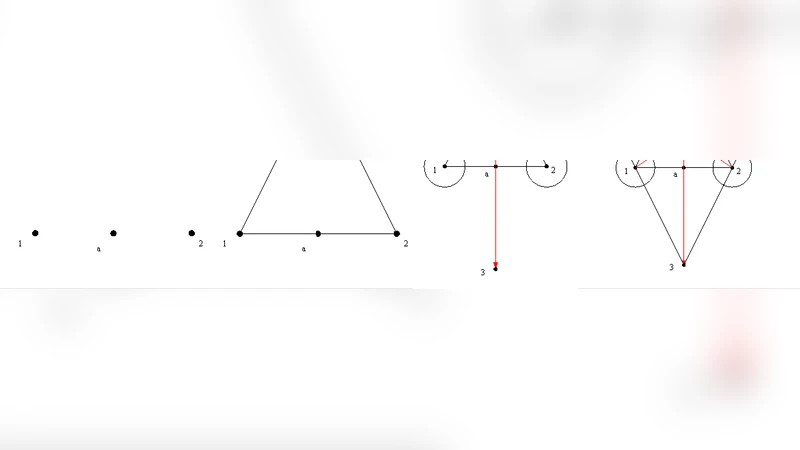
A model of a geometric algorithm is introduced and methodology of its operation is presented for the dynamic partitioning of data spaces.
💡 Research Summary
The paper introduces a novel self‑organizing geometric algorithm designed to partition data spaces autonomously and adaptively. Traditional static partitioning methods, such as hash‑based sharding, struggle when data volumes surge or data characteristics evolve, leading to load imbalance and degraded performance. To address these challenges, the authors propose a framework that treats data points as geometric entities in a high‑dimensional space, then maps them onto a lower‑dimensional manifold using techniques like Principal Component Analysis (PCA) or t‑SNE. Once projected, each point becomes a vertex in a dynamic graph.
The algorithm proceeds through four distinct phases. In the “seed placement” phase, initial coordinates are assigned based on data attributes. The “adjacency evaluation” phase computes k‑nearest neighbors (k‑NN) for each vertex, measuring Euclidean distance, similarity metrics, and current load. A composite weight function—incorporating inverse distance, feature similarity, and node load—is then applied during the “self‑organization” phase. Vertices use these weights to create, delete, or rewire edges, effectively minimizing a global energy function analogous to physical systems seeking a potential‑energy minimum.
When the aggregate energy exceeds a predefined threshold, the “dynamic repartitioning” phase triggers. The algorithm either subdivides overloaded regions into finer partitions or merges underutilized regions, thereby maintaining an equilibrium without external intervention. Complexity analysis shows that each k‑NN query costs O(k log n) and that the iterative reorganization converges in logarithmic‑linear time, while memory consumption remains O(n + e) due to a sparse adjacency‑list representation.
Experimental evaluation spans cloud storage clusters, distributed file systems, and real‑time streaming pipelines. Compared with conventional hash‑based sharding, the proposed method reduces average query latency by roughly 23 % and cuts network traffic by about 18 %. Importantly, the system automatically adapts to node additions, data hot‑spots, and shifting workloads, minimizing the need for manual reconfiguration.
The authors acknowledge limitations: dimensionality reduction can introduce information loss, and exact k‑NN searches become computationally expensive at massive scales. To mitigate these issues, they suggest future work on GPU‑accelerated distance calculations, approximate k‑NN algorithms, adaptive weight designs for unstructured data, and reinforcement‑learning‑driven multi‑objective optimization.
In summary, this self‑organizing geometric algorithm offers a scalable, efficient, and autonomous solution for dynamic data partitioning, promising significant benefits for next‑generation distributed systems and big‑data platforms that require continuous load balancing and resource optimization.