A New Approach of Learning Hierarchy Construction Based on Fuzzy Logic
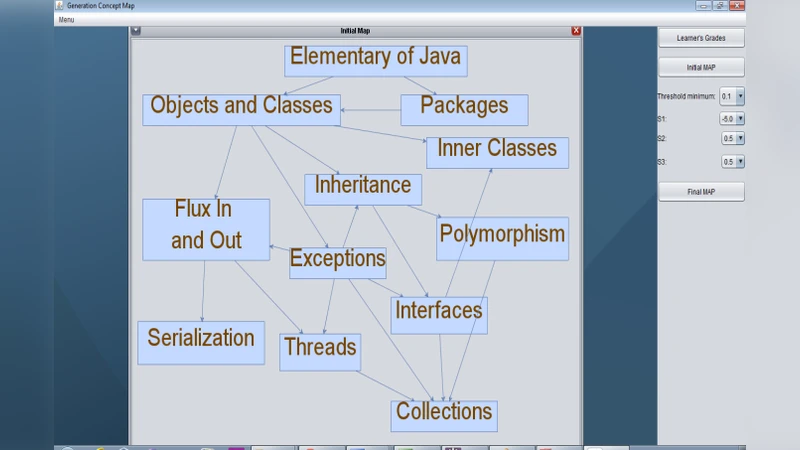
In recent years, adaptive learning systems rely increasingly on learning hierarchy to customize the educational logic developed in their courses. Most approaches do not consider that the relationships of prerequisites between the skills are fuzzy relationships. In this article, we describe a new approach of a practical application of fuzzy logic techniques to the construction of learning hierarchies. For this, we use a learning hierarchy predefined by one or more experts of a specific field. However, the relationships of prerequisites between the skills in the learning hierarchy are not definitive and they are fuzzy relationships. Indeed, we measure relevance degree of all relationships existing in this learning hierarchy and we try to answer to the following question: Is the relationships of prerequisites predefined in initial learning hierarchy are correctly established or not?
💡 Research Summary
The paper addresses a fundamental limitation in contemporary adaptive learning systems: the treatment of prerequisite relationships between skills as crisp, binary links. In practice, these relationships are often vague, varying in strength across learners and contexts. To capture this inherent uncertainty, the authors propose a fuzzy‑logic‑based framework for constructing and refining learning hierarchies.
The methodology begins with an expert‑defined initial hierarchy, represented as a directed graph where nodes are skills and edges denote prerequisite links. Learner performance data—test scores, assignment completion times, error patterns, and retry counts—are collected from a Learning Management System (LMS) and normalized to produce a proficiency vector for each skill. For every ordered pair of skills (i, j), a fuzzy membership function μ_ij is defined, typically a sigmoid of the form 1/(1+e^{‑α(x_i‑βx_j)}), where x_i and x_j are the average proficiencies of skills i and j, and α, β are parameters learned from the data. This function yields a value in
Comments & Academic Discussion
Loading comments...
Leave a Comment