A method for diffraction-based identification of annealing-produced restructuring of amorphous fullerene
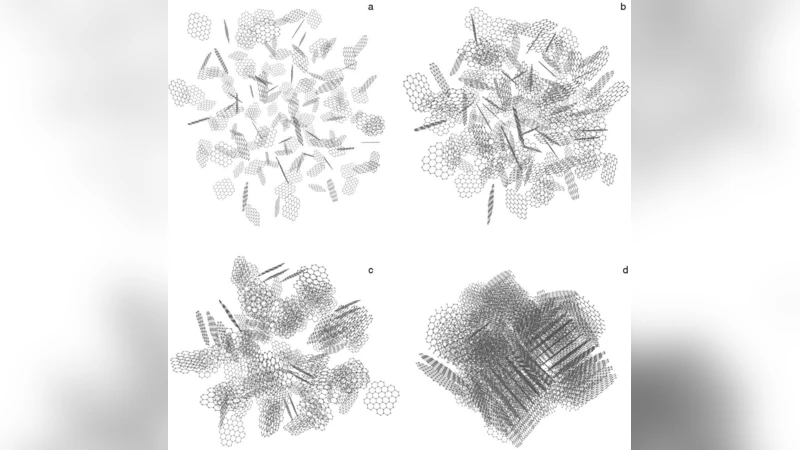
A method is suggested for estimation of structural properties of amorphous fullerene and its derivatives produced by vacuum annealing. The method is based on the fitting of the neutron or x-ray powder diffraction patterns for scattering wave vector’s modulus in the range from few units to several tens of inverse nanometers. The respective inverse problem assumes that the structured component of a sample can be described with a limited number, Nstr, of candidate sp2 carbon structures (fullerenes, flat and curved flakes with graphene-like atom arrangement) of a limited number of atoms, Natom. These structures are packed heterogeneously, in the domains with various average density of atoms and various degree of ordering of structures, using the Rigid Body Molecular Dynamics with variable parameter of pair interaction of atoms in the neighboring rigid-body nanostructures. The method is applied to interpreting the data of neutron diffraction by an amorphous fullerene annealed at temperatures 600, 800, 850, 900 and 1000 C. The results for Nstr equal to 36 and Natom in the range from 14 to 285 enabled us to quantify structural properties of the samples in terms of the average size and curvature of the sp2 carbon structures, and analyze sensitivity of results to the layout of these structures in the domains (mixture of various structures in each domain vs. mixture of domains of identical structures).
💡 Research Summary
The paper introduces a novel methodology for quantifying the structural evolution of amorphous fullerene and its derivatives during vacuum annealing, using neutron or X‑ray powder diffraction data. The authors treat the “structured component” of the material as a mixture of a limited set (Nstr) of candidate sp²‑carbon nanostructures—fullerenes, flat graphene‑like flakes, and curved graphene‑derived flakes—each characterized by a specific number of carbon atoms (Natom) ranging from 14 to 285. To model the heterogeneous packing of these nanostructures, the study employs Rigid Body Molecular Dynamics (RBMD). In RBMD each candidate structure is considered a rigid body; inter‑body interactions are described by a Lennard‑Jones‑type pair potential whose parameters (ε, σ) are varied to generate domains with different average atomic densities and degrees of orientational order.
The inverse problem is solved by fitting calculated structure factors S(q) to experimental diffraction patterns over a wide scattering‑vector range (q ≈ 1–50 nm⁻¹). For a given Nstr and Natom distribution, the fitting optimizes domain‑level density and ordering parameters as well as the weight fractions of each candidate structure. Two domain‑layout scenarios are examined: (i) a “mixed‑in‑domain” model where each domain contains a statistical mixture of several structures, and (ii) a “single‑structure‑per‑domain” model where each domain is populated by only one type of structure.
The method is applied to neutron diffraction data from amorphous fullerene samples annealed at 600 °C, 800 °C, 850 °C, 900 °C, and 1000 °C. At the lowest temperature the best‑fit solution consists mainly of small fullerenes (Natom ≈ 30–50) and mildly curved flakes, indicating limited restructuring. As the annealing temperature rises to 800 °C, the average Natom grows to 80–120 and curvature decreases, reflecting the formation of larger, flatter graphene‑derived fragments. At 900 °C and above, the dominant contributors are large curved flakes with Natom up to 285, whose curvature is substantially reduced, approaching planar graphene.
Sensitivity analysis shows that the mixed‑in‑domain model yields lower residuals at high temperatures, suggesting that high‑temperature annealing promotes coexistence of multiple nanostructures within the same domain. Conversely, the single‑structure‑per‑domain model fits the low‑temperature data reasonably well but fails to capture the heterogeneity observed at higher temperatures.
Overall, the study demonstrates that a constrained set of candidate sp² structures combined with RBMD‑based domain modeling can extract not only average size and curvature but also the degree of structural heterogeneity from powder diffraction data. This approach surpasses traditional average‑structure analyses, offering a quantitative bridge between annealing conditions and the resulting microstructure of amorphous carbon materials. The authors propose extending the candidate library, incorporating complementary techniques (e.g., TEM, Raman spectroscopy), and applying the framework to other disordered carbon systems to further validate and refine the methodology.