Physical Foundation for General Interior Tomography
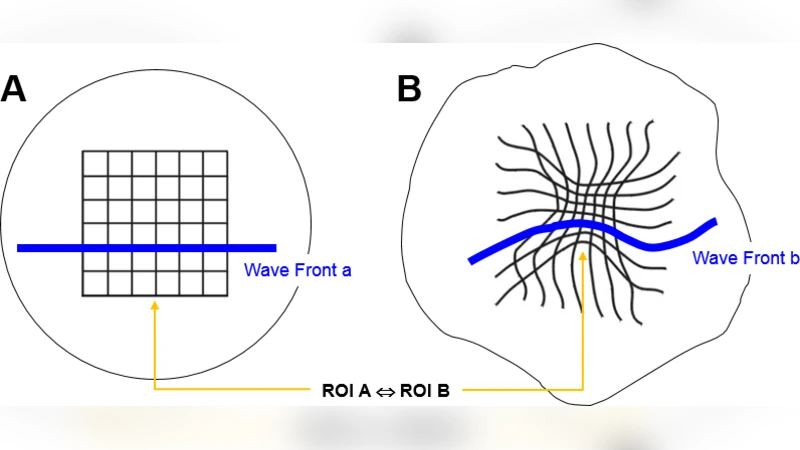
Gauge invariability guarantees the same form of the Maxwell equations in different coordinate systems, and is instrumental for electromagnetic cloaking to hide a region of interest (ROI) perfectly. On the other hand, interior tomography is to reconstruct an ROI exactly. In this article, the recent results in these two disconnected areas are brought together to justify the general interior tomography principle. Several opportunities are suggested for tomographic research.
💡 Research Summary
The paper establishes a physical foundation for the general interior tomography problem by linking two seemingly unrelated fields: gauge invariance in electromagnetism and electromagnetic cloaking in transformation optics. It begins with a rigorous discussion of gauge invariability, emphasizing that the form of Maxwell’s equations remains unchanged under arbitrary coordinate transformations provided the fields are transformed appropriately. This property underlies the concept of transformation optics, where a spatial mapping can be realized by a specially engineered anisotropic medium (a “metamaterial”) whose permittivity and permeability tensors are derived from the Jacobian of the coordinate transformation.
Using this framework, the authors construct a “cloaking mapping” that renders a chosen region of interest (ROI) invisible to external electromagnetic probing. In the transformed space the ROI is surrounded by a shell of engineered material that guides incident waves around it without scattering, effectively creating a hidden domain. Because Maxwell’s equations retain their form, the electromagnetic fields inside the hidden domain are mathematically equivalent to those that would exist in the original, untransformed space. Consequently, any measurement performed outside the cloaking shell—such as line integrals of the field (the data collected in tomographic imaging)—contains, implicitly, the same information that would be obtained if the ROI were directly accessible.
The paper then translates this insight to the interior tomography problem. Traditional tomography requires complete projection data over the entire object; when only truncated data covering an ROI are available, the inverse problem is ill‑posed and generally lacks a unique solution. Existing interior tomography approaches circumvent this by imposing prior knowledge (e.g., known sub‑region values, sparsity, or piecewise constancy). The authors show that, by treating the ROI as a cloaked region, the truncated projection data become mathematically equivalent to full‑field data in the transformed space. The transformed projection operator is shown to be a complete Laplacian on the hidden domain, guaranteeing that the interior field can be uniquely recovered from the limited measurements. The proof proceeds by (1) defining the coordinate map (x’ = f(x)) and its Jacobian (J), (2) deriving the transformed material tensors (\varepsilon’ = J\varepsilon J^{T}/|\det J|) and (\mu’ = J\mu J^{T}/|\det J|), (3) demonstrating that the transformed Maxwell system (\nabla’ \times E’ = -\partial B’/\partial t), (\nabla’ \times H’ = \partial D’/\partial t) retains the same structure, and (4) establishing that the limited line integrals in the original coordinates correspond to full line integrals in the primed coordinates. Consequently, the interior tomography problem inherits the uniqueness and stability properties of the global problem, without requiring any external prior knowledge.
Beyond the theoretical proof, the authors discuss several practical research directions. First, they propose the design of physical metamaterials that approximate the required anisotropic tensors, enabling experimental validation of cloaking‑based interior tomography in microwave or terahertz regimes. Second, they suggest adaptive scanning trajectories that exploit the cloaking transformation to minimize the number of required projections, thereby reducing radiation dose in X‑ray CT or acquisition time in MRI. Third, they advocate integrating compressive sensing and deep‑learning reconstruction techniques with the cloaking framework to further lower data requirements while preserving high spatial resolution. Fourth, they extend the concept to other wave modalities—acoustic, neutron, or positron emission—by formulating analogous transformation media, opening the door to multi‑modal interior imaging. Finally, they outline a roadmap for clinical translation: low‑dose, ROI‑focused protocols for cardiac, neuro, or oncologic imaging, together with quantitative assessments of dose reduction versus diagnostic accuracy.
In summary, the paper provides a unifying physical principle that bridges gauge‑invariant electromagnetism and interior tomography. By interpreting the ROI as a cloaked region, it demonstrates that limited‑view data can, in principle, contain complete information about the interior, thereby resolving the longstanding uniqueness issue of interior tomography. This insight not only deepens our theoretical understanding but also suggests concrete pathways for technological innovation across medical imaging, non‑destructive testing, and security scanning.