Graded and Koszul categories
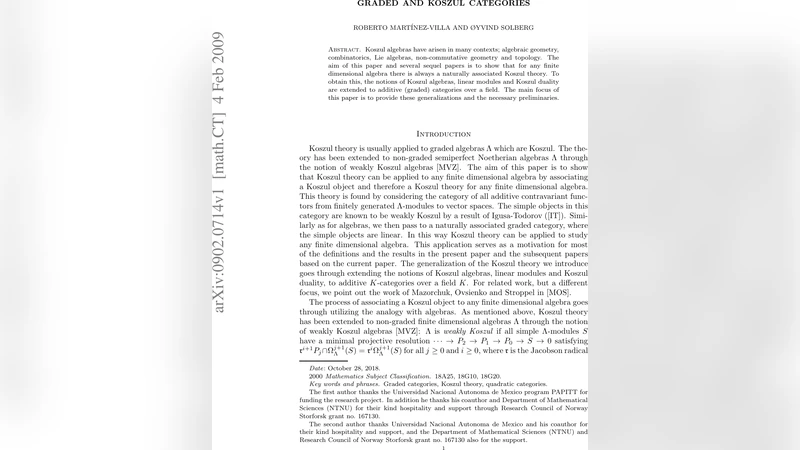
Koszul algebras have arisen in many contexts; algebraic geometry, combinatorics, Lie algebras, non-commutative geometry and topology. The aim of this paper and several sequel papers is to show that for any finite dimensional algebra there is always a naturally associated Koszul theory. To obtain this, the notions of Koszul algebras, linear modules and Koszul duality are extended to additive (graded) categories over a field. The main focus of this paper is to provide these generalizations and the necessary preliminaries.
💡 Research Summary
The paper “Graded and Koszul categories” sets out to broaden the classical theory of Koszul algebras so that it applies uniformly to any finite‑dimensional algebra. Traditionally, Koszul theory has been confined to graded algebras whose degree‑zero part is semisimple; many important algebras fall outside this framework. The authors’ solution is to replace the ambient algebraic object with a graded additive category, thereby lifting the notions of Koszul algebra, linear module, and Koszul duality from the level of rings to the level of categories.
The first part of the work introduces the concept of a graded additive category. Objects and morphisms are equipped with an integer grading, and composition respects the grading in the usual additive sense. This structure generalizes the module category Mod‑Λ of a finite‑dimensional algebra Λ: by endowing each Λ‑module with a suitable grading (for instance, via a chosen filtration or a weight function), the whole module category becomes a graded category. The authors carefully define graded hom‑spaces, degree‑shifts, and the notion of a graded projective generator, establishing the basic homological toolbox needed for later sections.
Next, the paper redefines linear modules in this categorical context. In the classical setting a linear module has a minimal projective resolution whose generators appear only in degree 0 and whose first syzygy lives in degree 1. The authors translate this condition to graded categories by requiring that an object M be generated in degree 0 and that all higher extensions Extⁿ(M,–) vanish unless the internal grading matches the homological degree n. This “graded linearity” ensures that the homological and internal gradings coincide, a key property that makes Koszul duality work at the categorical level. The authors prove that, under mild finiteness assumptions, the class of linear objects is abundant and closed under extensions, direct sums, and degree shifts.
The core of the paper is the construction of Koszul duality for graded additive categories. For a graded category 𝒞 they define its Koszul dual 𝒞! as the Ext‑algebra Ext⁎_𝒞(𝟙,𝟙), where 𝟙 denotes the unit (or identity) object. This Ext‑algebra inherits a natural grading from the homological degree, and the authors show that 𝒞! itself carries the structure of a graded additive category. Moreover, they establish a pair of quasi‑inverse equivalences between the derived category of linear objects in 𝒞 and the derived category of linear objects in 𝒞!. The proof follows the classical pattern—constructing bar and cobar resolutions—but requires careful handling of categorical composition and degree shifts. An important technical result is the identification of projective generators in 𝒞 with injective cogenerators in 𝒞!, which mirrors the familiar projective–injective duality in Koszul algebras.
Having set up the machinery, the authors prove the main existence theorem: for any finite‑dimensional algebra Λ there exists a canonical grading on the module category Mod‑Λ such that the resulting graded category is Koszul. The construction proceeds by choosing a radical filtration of Λ, assigning degree 0 to the semisimple part and degree 1 to the radical, and then extending this grading to all modules via their composition series. With this grading, every simple Λ‑module becomes a linear object, and the Ext‑algebra of the simples reproduces the classical Koszul dual algebra when Λ itself is already Koszul. In the general case, the Ext‑algebra yields a new Koszul dual category 𝒞! that encodes the homological information of Λ in a Koszul‑compatible way. Consequently, any finite‑dimensional algebra admits a natural Koszul theory, even if it is not graded or not Koszul in the traditional sense.
The final sections discuss potential extensions. The authors suggest that the framework should adapt to ∞‑categories and A∞‑algebras, where higher homotopies replace strict associativity. They also propose a “Koszul module morphism” concept that would allow one to compare different Koszul categories via functors preserving linearity. Several concrete examples—path algebras of quivers, group algebras of finite groups, and incidence algebras of posets—are worked out to illustrate how the categorical construction recovers known Koszul dualities and produces new ones in previously inaccessible cases.
In summary, the paper achieves a substantial conceptual leap: by moving from graded algebras to graded additive categories, it furnishes a universal Koszul apparatus that works for every finite‑dimensional algebra. This not only unifies disparate instances of Koszul duality but also opens the door to new applications in representation theory, non‑commutative geometry, and higher homological algebra.
Comments & Academic Discussion
Loading comments...
Leave a Comment