A Canonical Representation of Data-Linear Visualization Algorithms
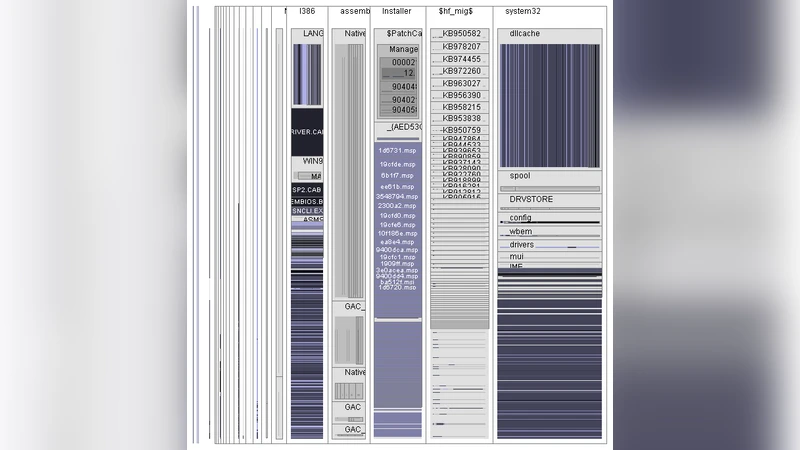
We introduce linear-state dataflows, a canonical model for a large set of visualization algorithms that we call data-linear visualizations. Our model defines a fixed dataflow architecture: partitioning and subpartitioning of input data, ordering, graphic primitives, and graphic attributes generation. Local variables and accumulators are specific concepts that extend the expressiveness of the dataflow to support features of visualization algorithms that require state handling. We first show the flexibility of our model: it enables the declarative construction of many common algorithms with just a few mappings. Furthermore, the model enables easy mixing of visual mappings, such as creating treemaps of histograms and 2D plots, plots of histograms… Finally, we introduce our model in a more formal way and present some of its important properties. We have implemented this model in a visualization framework built around the concept of linear-state dataflows.
💡 Research Summary
This paper introduces a canonical model for data-linear visualization algorithms, termed “linear-state dataflows.” The core of this model is a fixed dataflow architecture that includes the partitioning and subpartitioning of input data, ordering, generation of graphic primitives, and attributes. This model enables the declarative construction of various visualization algorithms with just a few mappings.
The paper emphasizes the flexibility of the proposed model, highlighting its ability to construct complex visualizations such as treemaps of histograms or 2D plots through simple combinations of mappings. Additionally, it introduces concepts like local variables and accumulators to extend the expressiveness of the dataflow architecture for handling state in visualization algorithms.
Furthermore, the paper formally presents this model and discusses some of its important properties. It also mentions that a visualization framework has been implemented around the concept of linear-state dataflows. This approach significantly contributes to standardizing and efficiently implementing data-linear visualization algorithms.
Comments & Academic Discussion
Loading comments...
Leave a Comment