Evaluation of the productivity of Brazilian hospitals by the methodology of diagnosis related group (DRG)
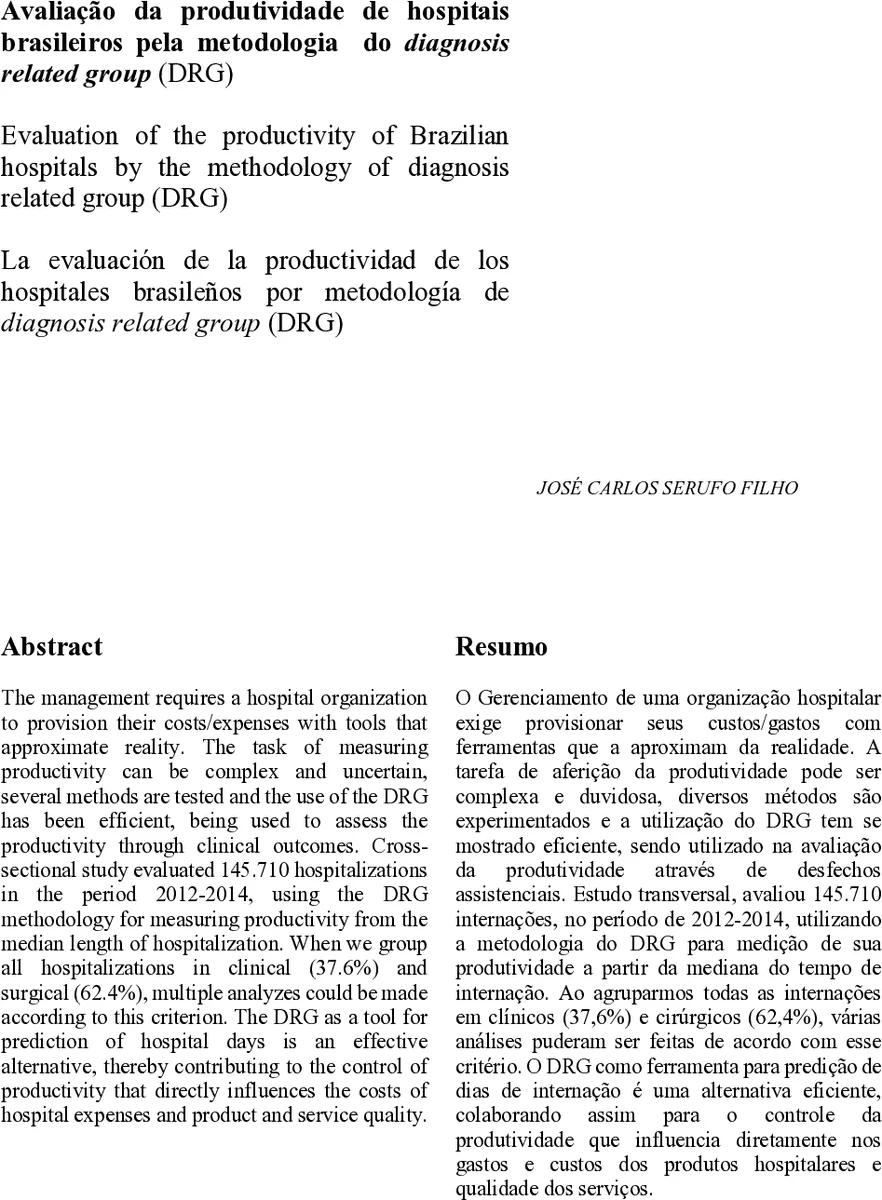
The management requires a hospital organization to provision their costs/expenses with tools that approximate reality. The task of measuring productivity can be complex and uncertain, several methods are tested and the use of the DRG has been efficient, being used to assess the productivity through clinical outcomes. Cross-sectional study evaluated 145.710 hospitalizations in the period 2012-2014, using the DRG methodology for measuring productivity from the median length of hospitalization. When we group all hospitalizations in clinical (37.6%) and surgical (62.4%), multiple analyzes could be made according to this criterion. The DRG as a tool for prediction of hospital days is an effective alternative, thereby contributing to the control of productivity that directly influences the costs of hospital expenses and product and service quality.
💡 Research Summary
This study evaluates the productivity of Brazilian hospitals using the Diagnosis Related Group (DRG) methodology and compares the results with United States benchmarks. A cross‑sectional analysis was performed on 145,710 hospitalizations recorded between 2012 and 2014. Patient-level data included sex, age, primary diagnosis (ICD‑10), comorbidities, and procedures (TUSS/SUS codes). The DRG classification employed the U.S. Centers for Medicare & Medicaid Services (CMS) MS‑DRG version 31.0. Because Brazil uses different coding systems, a specialized medical team mapped Brazilian ICD‑10 and procedure codes to the U.S. CID‑10‑CM and CID‑10‑PCS standards using the DRG‑Brasil® software, with manual validation of each equivalence. Only DRG categories with at least 20 cases were retained, resulting in 424 DRG groups (187 surgical, 237 clinical).
Productivity was defined as the ratio of the observed median length of stay (LOS) for each DRG in Brazilian hospitals to the corresponding percentile of LOS in the U.S. reference dataset (percentiles 10, 25, 50, 75, 90). A ratio greater than 1 indicates a longer stay than the U.S. benchmark (lower productivity), while a ratio less than 1 indicates a shorter stay (higher productivity). Statistical analyses included chi‑square tests, Pearson correlation, and sign tests, with significance set at p < 0.05.
Key demographic findings: 63.9 % of admissions were female, with a mean age of 42.8 years (median 39.9). Surgical admissions comprised 62.4 % of the sample, clinical 37.6 %. The most frequent surgical DRG was “Pregnancy, Childbirth and Puerperium” (23 % of surgical cases), reflecting the high proportion of female patients. In clinical DRGs, 46.5 % had at least one secondary diagnosis, whereas 47.4 % of surgical DRGs had no secondary diagnoses, suggesting differing case‑mix complexity.
When comparing LOS to U.S. percentiles, surgical DRGs were significantly more likely to have a median LOS at or below the U.S. 50th percentile. The odds ratio for surgical versus clinical DRGs achieving this benchmark was 3.4 (p < 0.001). Overall, 15.6 % of Brazilian DRGs had median LOS comparable to the U.S. median, 33.7 % were shorter (indicating higher productivity), and 50.7 % were longer (indicating lower productivity). Clinical DRGs performed worse: 63.7 % exceeded the U.S. 50th percentile, while only 34.2 % of surgical DRGs did so.
The discussion highlights that DRG classification homogenizes patient groups by clinical characteristics and resource use, enabling cross‑institutional performance comparisons. However, limitations include potential mismatches in code translation, omission of socioeconomic variables that affect LOS, and the structural differences between Brazilian and U.S. health systems that limit direct cost comparisons. The authors also note that the DRG‑based reimbursement system in the U.S. historically shifted costs to private insurers without necessarily improving efficiency, and similar dynamics may exist in Brazil.
In conclusion, the DRG methodology provides a robust framework for assessing hospital productivity in Brazil. The findings reveal that surgical services exhibit relatively high efficiency, while clinical services lag behind U.S. benchmarks. Policymakers and hospital managers can leverage DRG data to identify areas for LOS reduction, cost containment, and overall performance improvement, particularly focusing on clinical pathways where productivity is currently suboptimal.
Comments & Academic Discussion
Loading comments...
Leave a Comment