Online Covering with Convex Objectives and Applications
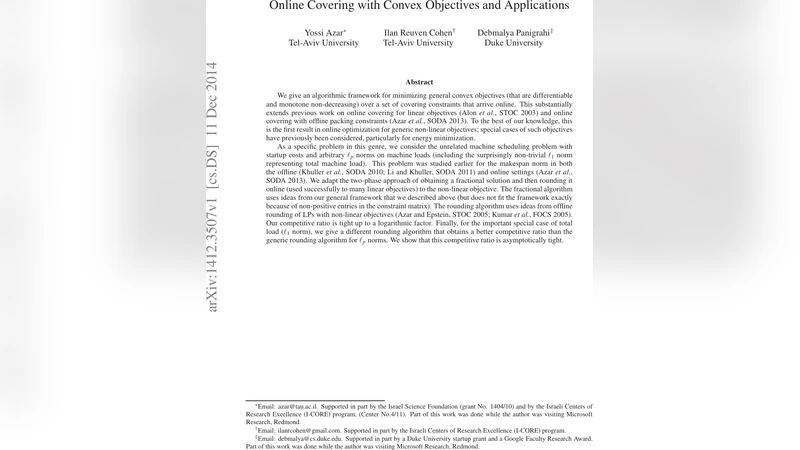
We give an algorithmic framework for minimizing general convex objectives (that are differentiable and monotone non-decreasing) over a set of covering constraints that arrive online. This substantially extends previous work on online covering for linear objectives (Alon {\em et al.}, STOC 2003) and online covering with offline packing constraints (Azar {\em et al.}, SODA 2013). To the best of our knowledge, this is the first result in online optimization for generic non-linear objectives; special cases of such objectives have previously been considered, particularly for energy minimization. As a specific problem in this genre, we consider the unrelated machine scheduling problem with startup costs and arbitrary $\ell_p$ norms on machine loads (including the surprisingly non-trivial $\ell_1$ norm representing total machine load). This problem was studied earlier for the makespan norm in both the offline (Khuller~{\em et al.}, SODA 2010; Li and Khuller, SODA 2011) and online settings (Azar {\em et al.}, SODA 2013). We adapt the two-phase approach of obtaining a fractional solution and then rounding it online (used successfully to many linear objectives) to the non-linear objective. The fractional algorithm uses ideas from our general framework that we described above (but does not fit the framework exactly because of non-positive entries in the constraint matrix). The rounding algorithm uses ideas from offline rounding of LPs with non-linear objectives (Azar and Epstein, STOC 2005; Kumar {\em et al.}, FOCS 2005). Our competitive ratio is tight up to a logarithmic factor. Finally, for the important special case of total load ($\ell_1$ norm), we give a different rounding algorithm that obtains a better competitive ratio than the generic rounding algorithm for $\ell_p$ norms. We show that this competitive ratio is asymptotically tight.
💡 Research Summary
This paper introduces a unified algorithmic framework for online covering problems where the objective function is a general convex, differentiable, and monotone‑non‑decreasing function. The setting is that linear covering constraints arrive one by one, and the decision variables may only increase over time. The authors first define two parameters that capture the difficulty of the objective: β, which measures the curvature of the function (β = maxₓ Σᵢ xᵢ·∂f/∂xᵢ / f(x)), and γ, the smallest positive number such that f(1/γ,…,1/γ) ≤ OPT. Using a continuous primal‑dual approach, they design a deterministic online algorithm that raises each variable at a rate inversely proportional to its current partial derivative. By analysing the growth of the primal objective together with the dual variables, they prove that the algorithm’s cost is at most f(β·log(γ/c_min)·x*) + β·f(x*), where x* is any optimal solution and c_min is the smallest positive entry of the constraint matrix. For linear objectives (β = 1) this recovers the classic O(log m) competitive ratio for online set cover and related problems.
The framework is then applied to the mixed packing‑and‑covering setting (OMPC) where, besides online covering constraints, a set of offline packing constraints must be approximately satisfied. The objective is the ℓₚ norm of the packing violations λₖ = Σᵢ Pₖᵢ xᵢ. By setting β = p and choosing γ = d·c_max·(p_max/p_min) (d is the maximum number of variables in any constraint, ρ = c_max/c_min, κ = p_max/p_min), the authors obtain a deterministic online algorithm with competitive ratio O(p·log(d·ρ·κ)). For 0‑1 matrices this simplifies to O(p·log d). They also prove a matching lower bound Ω(p·log(d/ log r)) for p ≤ log r, showing the result is essentially optimal.
The second major contribution concerns the Unrelated Machine Scheduling with Startup Cost (UMSC) problem. There are m machines, each with a startup cost cᵢ, and jobs arrive online with processing times pᵢⱼ. The goal is to minimize a bi‑criteria objective: total startup cost and the ℓₚ norm of machine loads. The authors first formulate a fractional linear program that captures both objectives. Because the naïve ℓₚ norm on partially opened machines creates a large integrality gap, they augment the objective with a term Σᵢ (Σⱼ pᵢⱼ yᵢⱼ)ᵖ xᵢ^{1‑p} and enforce yᵢⱼ ≤ xᵢ, where xᵢ denotes the fraction to which machine i is opened and yᵢⱼ the fraction of job j assigned to i. This LP has a much smaller gap.
A two‑phase online algorithm is then built. In the first phase a fractional solution is produced using the general OCG framework (with slight modifications to handle negative coefficients that appear in the UMSC constraints). In the second phase the fractional solution is rounded online. For general p the rounding combines techniques from offline LP rounding for ℓₚ objectives (Azar‑Epstein, Kumar et al.) with online rounding for exponential objectives, yielding a randomized algorithm with competitive ratio (α,β) = (O(log m·log (mn)), O(p²·log^{1/p}(mn))). Since p ≤ log m, the ℓₚ part simplifies to O(log² m·log^{1/p}(mn)).
For the special case p = 1 (total load), the authors devise a different rounding scheme that samples machines proportionally to their fractional load, achieving a much stronger bound: (α,β) = (O(log m·log n), O(1)). This matches known lower bounds up to constant factors, establishing essentially optimal bi‑criteria guarantees for both cost and total load.
The paper also proves lower bounds: no algorithm can achieve o(p) competitive ratio for the ℓₚ load and o(log m·log n) for the cost under standard complexity assumptions, confirming that the presented algorithms are near‑optimal.
In summary, the work makes three key advances: (1) a general online covering framework for arbitrary convex objectives, (2) tight competitive ratios for mixed packing‑and‑covering with ℓₚ norms, and (3) the first near‑optimal online algorithms for unrelated machine scheduling with startup costs across all ℓₚ norms, including a constant‑factor guarantee for total load. The techniques blend continuous primal‑dual updates, refined LP formulations, and novel online rounding methods, and they open the door to many further applications in energy‑aware cloud computing and beyond.
Comments & Academic Discussion
Loading comments...
Leave a Comment