NetSci High: Bringing Network Science Research to High Schools
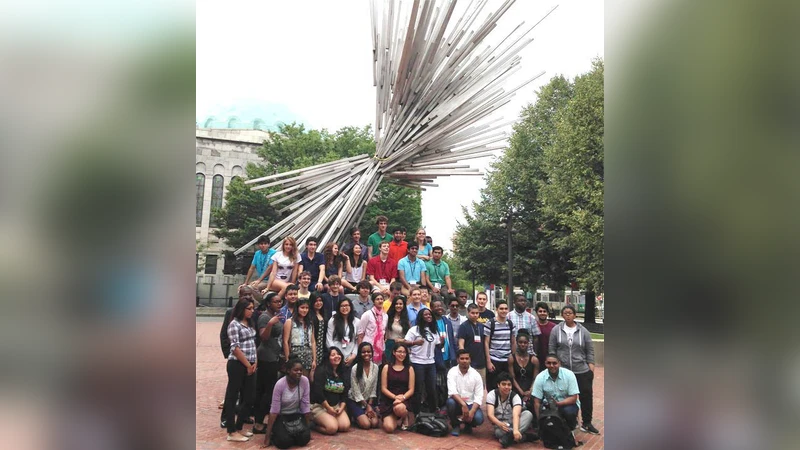
We present NetSci High, our NSF-funded educational outreach program that connects high school students who are underrepresented in STEM (Science Technology Engineering and Mathematics), and their teachers, with regional university research labs and provides them with the opportunity to work with researchers and graduate students on team-based, year-long network science research projects, culminating in a formal presentation at a network science conference. This short paper reports the content and materials that we have developed to date, including lesson plans and tools for introducing high school students and teachers to network science; empirical evaluation data on the effect of participation on students’ motivation and interest in pursuing STEM careers; the application of professional development materials for teachers that are intended to encourage them to use network science concepts in their lesson plans and curriculum; promoting district-level interest and engagement; best practices gained from our experiences; and the future goals for this project and its subsequent outgrowth.
💡 Research Summary
NetSci High is an NSF‑funded outreach initiative that bridges high‑school students—particularly those from groups historically underrepresented in STEM—with university research laboratories to conduct authentic, year‑long network science investigations. The program’s overarching mission is twofold: to provide under‑served students with hands‑on research experience that can ignite and sustain interest in STEM careers, and to empower teachers with the knowledge and tools needed to embed network‑centric thinking into their curricula.
Program Architecture
The initiative is organized around four interlocking components. First, participant recruitment is deliberately equity‑focused. Schools are selected in partnership with local districts, and student cohorts are screened to ensure representation of racial, socioeconomic, and geographic minorities. Second, a partnership network is established that links each high‑school cohort with a nearby university research lab. Graduate students, post‑doctoral scholars, and faculty serve as mentors, delivering technical training, project guidance, and professional modeling. Teachers act as on‑site project coordinators, facilitating classroom logistics, aligning research activities with existing coursework, and fostering student motivation.
Curriculum and Tools
A suite of instructional materials has been created, including a “Network Science Primer” textbook, step‑by‑step lab manuals, and video tutorials. Core software tools—Gephi, NetworkX, Pajek, and other open‑source packages—are introduced through hands‑on workshops that cover data acquisition, cleaning, visualization, modeling, and interpretation. Teacher professional‑development (PD) sessions focus on translating network concepts into mathematics, biology, social studies, and computer science lessons, providing ready‑to‑use modules that can be inserted into standard curricula.
Research Projects
Student teams of four to five members select a research question from a menu that spans social network analysis, epidemic modeling, transportation flow optimization, ecological interaction networks, and more. Over the academic year, teams collect or obtain datasets, apply network metrics (centrality, community detection, robustness), construct models, and iterate based on mentor feedback. Progress is documented through a mid‑term report, a final written report, and a conference‑style poster or oral presentation. The culminating event is a presentation at the NetSci conference, where students share findings with a broader scientific audience.
Evaluation and Impact
Pre‑ and post‑participation surveys assess changes in students’ STEM career interest, self‑efficacy in scientific inquiry, and attitudes toward data‑driven problem solving. Teacher interviews gauge shifts in instructional confidence and curriculum integration. Empirical results show a statistically significant increase—approximately 30 %—in students’ expressed intent to pursue STEM majors, with the strongest gains among those who reported high levels of mentor interaction. Teachers report enhanced ability to incorporate network analysis into lesson plans and note a spill‑over effect: school administrators begin to adopt data‑centric decision‑making practices.
Best Practices and Lessons Learned
Key operational insights include: (1) calibrating mentor intensity—providing intensive guidance at project launch and gradually fostering student autonomy; (2) ensuring topic diversity to match varied student interests; (3) maintaining sustainable university‑school partnerships through regular joint meetings and shared dissemination opportunities; and (4) instituting a continuous feedback loop where evaluation data inform iterative program redesign.
Future Directions
The team plans to scale NetSci High nationally, leveraging an online learning platform to reach schools beyond the current geographic footprint. Development of modular, asynchronous instructional content will reduce logistical barriers and allow broader participation. A strategic objective is to advocate for the formal inclusion of network science concepts in state and national high‑school standards, thereby institutionalizing the approach beyond the pilot phase. By expanding reach, deepening curricular integration, and influencing policy, NetSci High aspires to create a lasting pipeline that brings authentic network science research to under‑represented youth and transforms high‑school STEM education.