A systematic literature review of cloud computing in eHealth
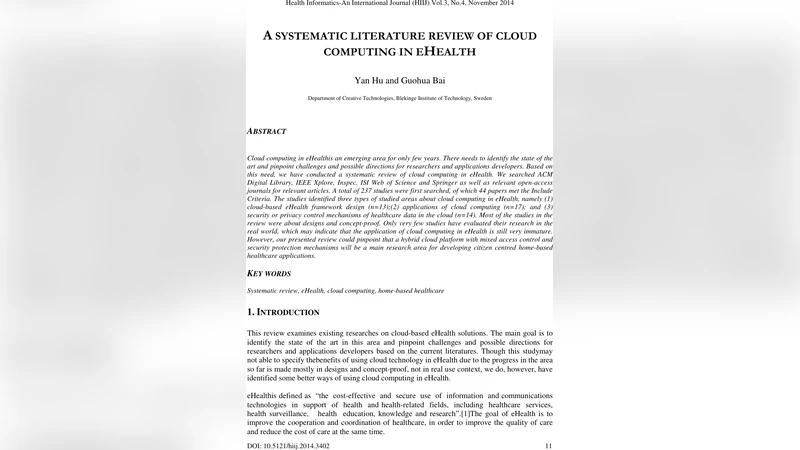
Cloud computing in eHealth is an emerging area for only few years. There needs to identify the state of the art and pinpoint challenges and possible directions for researchers and applications developers. Based on this need, we have conducted a systematic review of cloud computing in eHealth. We searched ACM Digital Library, IEEE Xplore, Inspec, ISI Web of Science and Springer as well as relevant open-access journals for relevant articles. A total of 237 studies were first searched, of which 44 papers met the Include Criteria. The studies identified three types of studied areas about cloud computing in eHealth, namely (1) cloud-based eHealth framework design (n=13); (2) applications of cloud computing (n=17); and (3) security or privacy control mechanisms of healthcare data in the cloud (n=14). Most of the studies in the review were about designs and concept-proof. Only very few studies have evaluated their research in the real world, which may indicate that the application of cloud computing in eHealth is still very immature. However, our presented review could pinpoint that a hybrid cloud platform with mixed access control and security protection mechanisms will be a main research area for developing citizen centred home-based healthcare applications.
💡 Research Summary
This paper presents a systematic literature review that maps the current state of research on cloud computing within the eHealth domain and identifies open challenges and future directions. The authors performed comprehensive searches across five major scholarly databases—ACM Digital Library, IEEE Xplore, Inspec, ISI Web of Science, and Springer—as well as relevant open‑access journals. An initial pool of 237 records was screened using predefined inclusion criteria that emphasized (1) the use of cloud infrastructure for processing, storing, or transmitting healthcare data, (2) the presence of a concrete system design or prototype, and (3) a clear scholarly contribution. After duplicate removal and abstract review, 44 papers satisfied these criteria and were subjected to detailed analysis.
The selected studies naturally clustered into three thematic categories. The first group (13 papers) focuses on the design of cloud‑based eHealth frameworks. These works propose layered architectures, discuss the selection among IaaS, PaaS, and SaaS models, and stress the importance of data standardization and interoperability. However, most remain at the conceptual or simulation stage, lacking deployment in real clinical settings. The second group (17 papers) examines concrete applications of cloud technologies, ranging from remote diagnostics and electronic health record (EHR) sharing to mobile health (mHealth) services and smart‑hospital platforms. While these case studies demonstrate technical feasibility, they are largely pilot projects; robust, longitudinal evaluations of clinical outcomes or user satisfaction are scarce. The third group (14 papers) addresses security and privacy controls for healthcare data residing in the cloud. Topics include encryption schemes, fine‑grained access control, authentication/authorization frameworks, and compliance with regulations such as HIPAA and GDPR. Notably, several papers advocate hybrid‑cloud models that combine public and private clouds, arguing that mixed‑access control mechanisms can reconcile the need for scalability with stringent privacy requirements.
Across all categories, a striking observation is the paucity of real‑world validation. The majority of research is still at the design or proof‑of‑concept level, indicating that cloud‑enabled eHealth solutions are in an early, immature phase. Moreover, critical aspects such as cost modeling, service‑level agreements (SLAs), user acceptance, and legal/ethical implications receive limited attention. In response to these gaps, the authors propose that future work should converge on a hybrid‑cloud platform equipped with layered security and mixed access‑control policies, specifically tailored for citizen‑centric, home‑based healthcare services. Such a platform would need to ensure data sovereignty, support real‑time processing, and remain cost‑effective, thereby addressing the core technical and societal challenges identified in the review.
The paper concludes that while cloud computing holds transformative potential for eHealth—offering elasticity, on‑demand resources, and collaborative data sharing—the field must move beyond theoretical designs. Rigorous, longitudinal field studies, standardized security frameworks, and coordinated policy development are essential to translate the promise of cloud‑based eHealth into reliable, scalable, and patient‑focused solutions.
Comments & Academic Discussion
Loading comments...
Leave a Comment