Using Artificial Neural Network Techniques for Prediction of Electric Energy Consumption
Due to imprecision and uncertainties in predicting real world problems, artificial neural network (ANN) techniques have become increasingly useful for modeling and optimization. This paper presents an artificial neural network approach for forecasting electric energy consumption. For effective planning and operation of power systems, optimal forecasting tools are needed for energy operators to maximize profit and also to provide maximum satisfaction to energy consumers. Monthly data for electric energy consumed in the Gaza strip was collected from year 1994 to 2013. Data was trained and the proposed model was validated using 2-Fold and K-Fold cross validation techniques. The model has been tested with actual energy consumption data and yields satisfactory performance.
💡 Research Summary
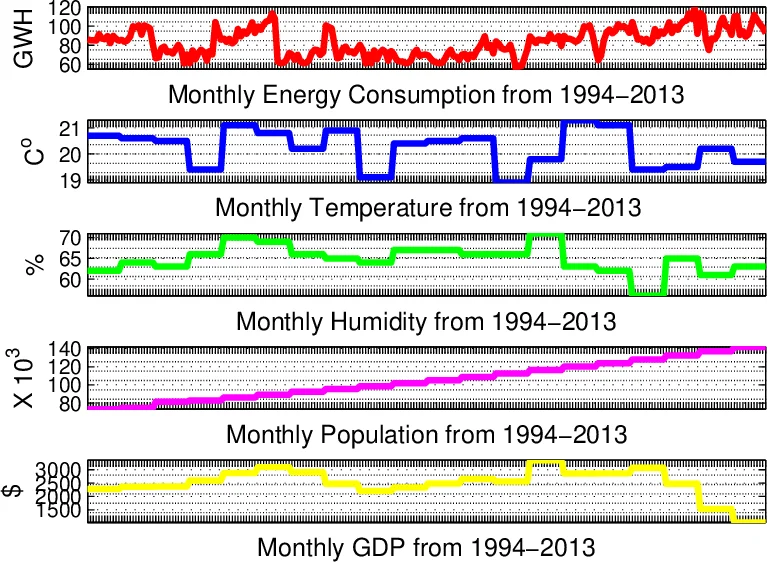
The paper presents an artificial neural network (ANN) approach for forecasting electric energy consumption in the Gaza Strip, using monthly data spanning 1994‑2013. The authors argue that traditional forecasting techniques—such as linear regression, time‑series analysis, and ARIMA—often fail to capture the nonlinear relationships between electricity demand and influential factors like weather, population growth, and economic indicators. To address this gap, they construct a feed‑forward ANN model that takes five input variables: historical electricity consumption, mean atmospheric temperature, mean relative humidity, population, and per‑capita GDP.
Data were collected from the Palestinian Central Bureau of Statistics and the World Bank. The period 1994‑2011 served as the training set, while 2012 and 2013 were reserved for testing. The network architecture (number of hidden layers, neurons per layer) and training algorithm are not described in detail, but the use of Levenberg‑Marquardt optimization is implied from the literature review. To mitigate over‑fitting and assess generalization, the authors employ two validation schemes: 2‑Fold cross‑validation and K‑Fold cross‑validation. Performance is evaluated using four error metrics: Mean Squared Error (MSE), Root Mean Squared Error (RMSE), Mean Absolute Error (MAE), and Mean Absolute Percentage Error (MAPE).
Results for 2012 show that the 2‑Fold validation yields MSE = 1.21 %, RMSE = 1.10 %, MAE = 1.21 %, and MAPE = 120.91 %; the K‑Fold validation gives higher errors (MSE = 3.87 %, MAPE = 386.54 %). For 2013, the 2‑Fold errors are MSE = 1.74 %, RMSE = 1.32 %, MAE = 1.74 %, MAPE = 173.76 %; K‑Fold errors are slightly lower (MSE = 1.88 %, MAPE = 187.65 %). Despite relatively large MAPE values, the month‑by‑month forecasts closely follow the observed consumption, indicating that the ANN captures the underlying consumption patterns.
The authors conclude that the proposed ANN model is the first of its kind applied to Gaza’s electricity demand and that it demonstrates acceptable predictive performance. They acknowledge limitations, such as the lack of a detailed description of network hyper‑parameters, absence of a comparative benchmark against other models (e.g., ARIMA, SVR), and limited discussion of data preprocessing steps (missing‑value handling, scaling). Future work is suggested to explore alternative forecasting techniques, hybrid models, and more extensive feature sets (e.g., electricity pricing, industrial composition) to improve accuracy and robustness.
Overall, the study contributes an empirical validation that ANN can be an effective tool for regional electricity demand forecasting, offering a foundation for more sophisticated energy planning and management in resource‑constrained environments.
Comments & Academic Discussion
Loading comments...
Leave a Comment