Mary Astells words in A Serious Proposal to the Ladies (part I), a lexicographic inquiry with NooJ
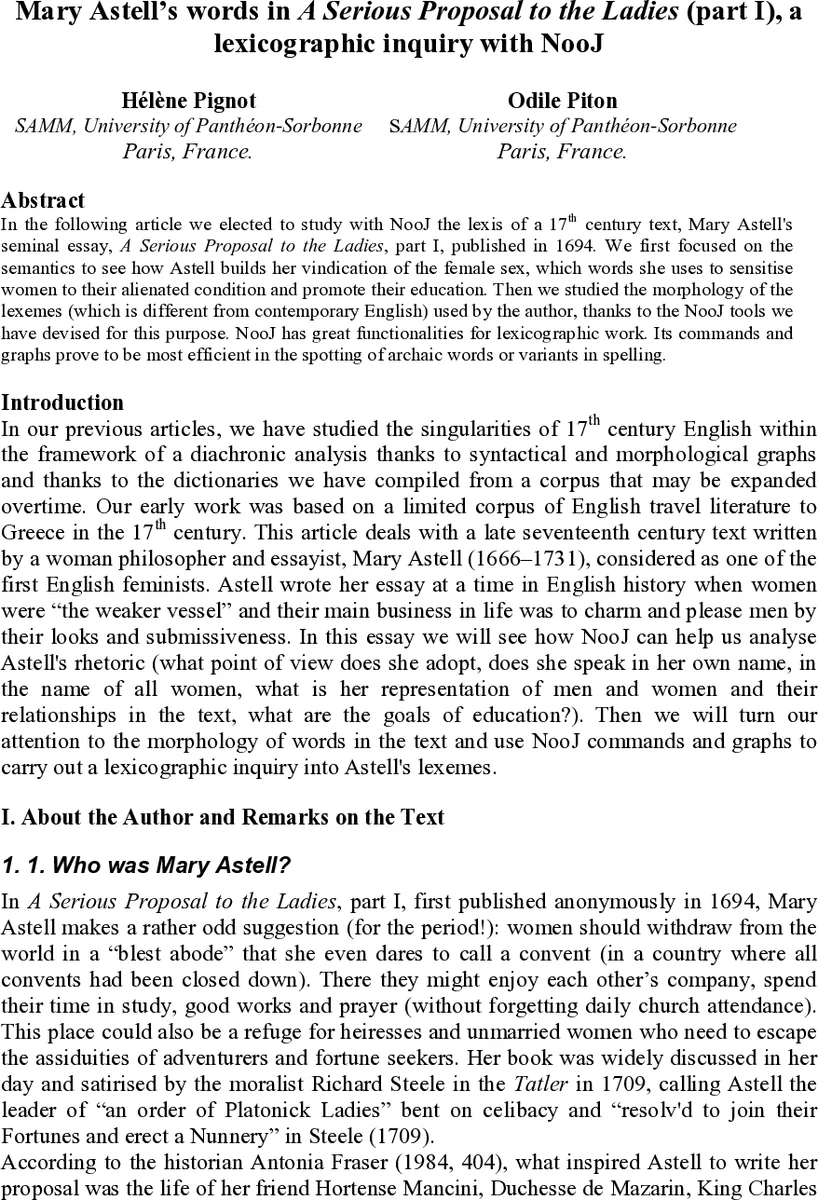
In the following article we elected to study with NooJ the lexis of a 17 th century text, Mary Astell’s seminal essay, A Serious Proposal to the Ladies, part I, published in 1694. We first focused on the semantics to see how Astell builds her vindication of the female sex, which words she uses to sensitise women to their alienated condition and promote their education. Then we studied the morphology of the lexemes (which is different from contemporary English) used by the author, thanks to the NooJ tools we have devised for this purpose. NooJ has great functionalities for lexicographic work. Its commands and graphs prove to be most efficient in the spotting of archaic words or variants in spelling. Introduction In our previous articles, we have studied the singularities of 17 th century English within the framework of a diachronic analysis thanks to syntactical and morphological graphs and thanks to the dictionaries we have compiled from a corpus that may be expanded overtime. Our early work was based on a limited corpus of English travel literature to Greece in the 17 th century. This article deals with a late seventeenth century text written by a woman philosopher and essayist, Mary Astell (1666–1731), considered as one of the first English feminists. Astell wrote her essay at a time in English history when women were “the weaker vessel” and their main business in life was to charm and please men by their looks and submissiveness. In this essay we will see how NooJ can help us analyse Astell’s rhetoric (what point of view does she adopt, does she speak in her own name, in the name of all women, what is her representation of men and women and their relationships in the text, what are the goals of education?). Then we will turn our attention to the morphology of words in the text and use NooJ commands and graphs to carry out a lexicographic inquiry into Astell’s lexemes.
💡 Research Summary
The paper presents a detailed computational linguistic study of Mary Astell’s seminal 1694 essay “A Serious Proposal to the Ladies” (Part I) using the NooJ platform. The authors set out two complementary objectives: (1) a semantic analysis that identifies the lexical items and pronoun strategies Astell employs to construct a feminist argument for women’s education and emancipation, and (2) a morphological analysis that uncovers the orthographic and morphological peculiarities of 17th‑century English as they appear in the text.
Because the source could not be processed by OCR, the researchers manually transcribed the entire essay, preserving original spelling, capitalization, and punctuation. This careful digitisation allowed NooJ to retain period‑specific features such as the frequent capitalization of nouns and the repetition of the final word or syllable at the top of the next page. The authors then built a series of NooJ dictionaries and finite‑state graphs to locate personal pronouns, long words, hyphenated compounds, juxtaposed forms, and apostrophe‑based contractions.
The pronoun analysis shows a striking pattern: the second‑person “you” appears 206 times, the inclusive “we” 373 times, while first‑person forms “I” and “me” together occur only 84 times, representing merely 0.44 % of all pronouns (1841 in total). This distribution indicates that Astell deliberately foregrounds a collective female audience, creates a sense of communal identity, and minimizes her own authorial presence—a strategy interpreted as self‑effacement typical of early modern women writers.
Lexical frequency data reveal that the most recurrent content words are religious and intellectual in nature: GOD, world, soul, virtue, nature, mind, knowledge, and piety dominate the text. These terms support Astell’s argument that women’s education is both a spiritual duty and a rational necessity. The essay also makes extensive use of vegetal metaphors (e.g., “tulips in a garden”) to depict uneducated women as ornamental yet inert, while education is likened to gardening, reinforcing the theme of cultivation.
Morphologically, the study quantifies the proportion of “long” words (six letters or more) as 19.5 % of the total token count (3659 of 18 759 words), with an average repetition rate of 2.03 per lemma. The authors designed a NooJ graph that tags words by length, enabling rapid extraction of long lexical items such as “uncharitableness” (16 letters) and “pragmaticalness” (15 letters).
Hyphenated compounds are abundant; 28 distinct hyphenated forms were identified, including “fore‑heads,” “God‑like,” “good‑will,” and “pre‑engage.” The analysis shows a systematic 17th‑century tendency to separate prefixes from roots with a hyphen, a pattern that modern English has largely abandoned. The authors also examined juxtaposed forms where two lexical items appear as separate tokens (e.g., “my self,” “her self”), reflecting a period‑specific perception of “self” as a noun. Eleven such compounds were catalogued, though the search also generated noise (e.g., “area” from “a, area”).
Apostrophe usage was investigated through a simple locate pattern for the single quote character. The text contains 329 apostrophes, exceeding the number of full stops (356) but far fewer than commas (1334). The authors compiled a specialized NooJ dictionary of 90 contracted or elided forms, many of which have disappeared from contemporary English (e.g., “e’er” for “ever,” “’twas” for “it was”). This enriched dictionary improves NooJ’s ability to parse early modern texts accurately.
Overall, the paper demonstrates that NooJ’s combination of lexical resources, finite‑state graphs, and custom commands provides an efficient workflow for extracting both semantic and morphological information from a 17th‑century feminist tract. The findings illuminate Astell’s rhetorical strategies—her use of inclusive pronouns, religious‑intellectual vocabulary, and metaphor—and expose orthographic conventions of her era, such as hyphenated prefixes, spaced reflexive pronouns, and extensive apostrophe‑based contractions. By showcasing a concrete case study, the authors argue that NooJ is a powerful tool for digital humanities scholars interested in diachronic linguistics, textual criticism, and the computational study of early modern women’s writing.
Comments & Academic Discussion
Loading comments...
Leave a Comment