JIDT: An information-theoretic toolkit for studying the dynamics of complex systems
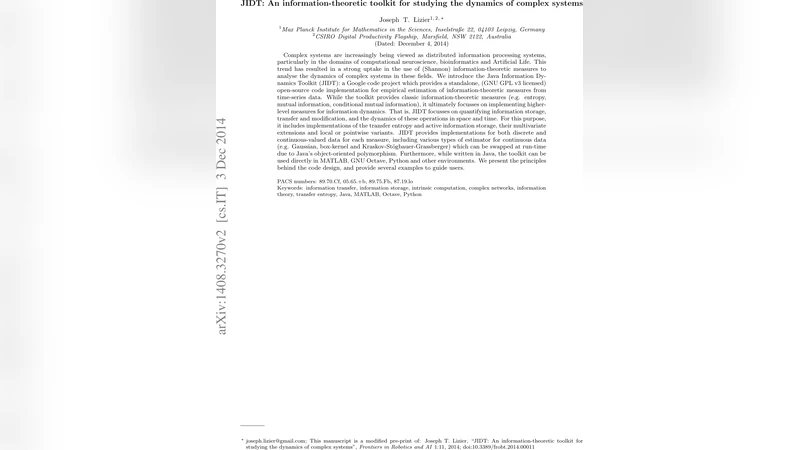
Complex systems are increasingly being viewed as distributed information processing systems, particularly in the domains of computational neuroscience, bioinformatics and Artificial Life. This trend has resulted in a strong uptake in the use of (Shannon) information-theoretic measures to analyse the dynamics of complex systems in these fields. We introduce the Java Information Dynamics Toolkit (JIDT): a Google code project which provides a standalone, (GNU GPL v3 licensed) open-source code implementation for empirical estimation of information-theoretic measures from time-series data. While the toolkit provides classic information-theoretic measures (e.g. entropy, mutual information, conditional mutual information), it ultimately focusses on implementing higher-level measures for information dynamics. That is, JIDT focusses on quantifying information storage, transfer and modification, and the dynamics of these operations in space and time. For this purpose, it includes implementations of the transfer entropy and active information storage, their multivariate extensions and local or pointwise variants. JIDT provides implementations for both discrete and continuous-valued data for each measure, including various types of estimator for continuous data (e.g. Gaussian, box-kernel and Kraskov-Stoegbauer-Grassberger) which can be swapped at run-time due to Java’s object-oriented polymorphism. Furthermore, while written in Java, the toolkit can be used directly in MATLAB, GNU Octave, Python and other environments. We present the principles behind the code design, and provide several examples to guide users.
💡 Research Summary
The paper presents the Java Information Dynamics Toolkit (JIDT), an open‑source, GPL‑v3 licensed software package designed to estimate a broad suite of information‑theoretic quantities from time‑series data, with a particular focus on the dynamics of information storage, transfer, and modification in complex systems. After motivating the need for such tools in fields like computational neuroscience, bioinformatics, and artificial life—where complex systems are increasingly viewed as distributed information processors—the authors outline the theoretical foundations of the measures implemented in JIDT. These include classic Shannon quantities (entropy, joint entropy, mutual information, conditional mutual information) as well as higher‑level “information‑dynamics” measures: active information storage (AIS), predictive information (excess entropy), transfer entropy (TE), conditional/multivariate TE, and related concepts such as separable information. Importantly, JIDT provides both the conventional average (expected) forms and pointwise (local) versions, enabling researchers to generate time‑resolved profiles of information flow.
Implementation-wise, JIDT follows a clean object‑oriented design. Each measure is defined by a Java interface (e.g., EntropyCalculator, TransferEntropyCalculator), and concrete classes implement specific estimators. For discrete data, simple histogram‑based estimators are available; for continuous data, three families are supported: a Gaussian (linear) estimator, a box‑kernel estimator, and the Kraskov‑Stögbauer‑Grassberger (KSG) nearest‑neighbour estimator. Because all estimators conform to the same interface, users can swap them at runtime simply by instantiating a different class, allowing rapid experimentation with linear versus non‑linear assumptions, different bias‑variance trade‑offs, and varying dimensionalities. The toolkit also handles embedding parameters (history length, delay) and provides utilities for multivariate conditioning.
JIDT is distributed as a standalone JAR file requiring only a Java Virtual Machine, eliminating any compilation or complex installation steps. To broaden accessibility, the authors supply thin wrappers for MATLAB, GNU Octave, and Python, allowing the same underlying Java code to be called from these environments. The paper includes a rich set of example scripts: basic Java usage patterns, MATLAB/Octave demonstrations, Python bindings, reproduction of Schreiber’s original TE examples, and a cellular automaton case study that visualises local information profiles. These examples walk the reader through data preparation, parameter selection (embedding dimension, lag, estimator choice), computation, and interpretation of results.
A comparative discussion positions JIDT against existing toolkits such as TRENTOOL and IDTxl. While those packages focus primarily on transfer entropy, JIDT distinguishes itself by offering local information measures, a full suite of storage‑related metrics (AIS, predictive information), and conditional/multivariate TE—all within a unified, polymorphic framework. This breadth makes JIDT especially suitable for researchers who wish to dissect the full information‑processing pipeline of a system, rather than a single causal link.
The authors conclude by emphasizing JIDT’s role as a bridge between information‑theoretic theory and empirical analysis. Its open‑source nature invites community contributions, and future extensions could include non‑uniform embedding, time‑varying estimators, GPU acceleration, and support for heterogeneous data types. Overall, JIDT provides a comprehensive, flexible, and user‑friendly platform for quantifying how information is stored, transferred, and transformed in complex dynamical systems.
Comments & Academic Discussion
Loading comments...
Leave a Comment