A Unifying Framework for Measuring Weighted Rich Clubs
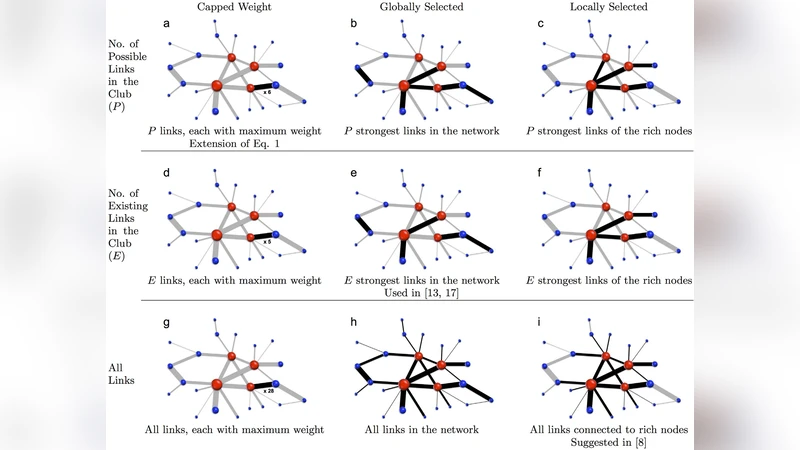
Network analysis can help uncover meaningful regularities in the organization of complex systems. Among these, rich clubs are a functionally important property of a variety of social, technological and biological networks. Rich clubs emerge when nodes that are somehow prominent or ‘rich’ (e.g., highly connected) interact preferentially with one another. The identification of rich clubs is non-trivial, especially in weighted networks, and to this end multiple distinct metrics have been proposed. Here we describe a unifying framework for detecting rich clubs which intuitively generalizes various metrics into a single integrated method. This generalization rests upon the explicit incorporation of randomized control networks into the measurement process. We apply this framework to real-life examples, and show that, depending on the selection of randomized controls, different kinds of rich-club structures can be detected, such as topological and weighted rich clubs.
💡 Research Summary
The paper addresses a longstanding methodological challenge in network science: how to reliably detect and quantify “rich clubs” in weighted networks. A rich club is a set of nodes that are “rich” according to some prominence measure (most commonly degree) and that preferentially connect to one another. While the concept is well‑established for binary graphs, extending it to weighted graphs has produced a proliferation of ad‑hoc metrics, each relying on a different definition of the null model against which the observed connectivity is compared. The authors argue that this lack of a unified framework leads to ambiguous or even contradictory conclusions about the presence of rich‑club organization.
To resolve this, they propose a unifying framework that treats the rich‑club coefficient as a ratio of observed internal weight to the expected internal weight under an explicitly defined ensemble of randomized control networks. The procedure can be summarized in three steps: (1) Choose a richness threshold r and extract the set S(r) of nodes whose richness (e.g., degree, strength, centrality) exceeds r. (2) Compute the total weight of edges that lie entirely within S(r) in the empirical network, denoted W_obs(S). (3) Generate a collection of surrogate networks that preserve selected structural properties, measure the corresponding internal weight W_i(S) for each surrogate, and take the average W_rand(S). The rich‑club coefficient is then φ(r)=W_obs(S)/W_rand(S). Values greater than one indicate that the rich nodes exchange more weight than would be expected under the chosen null model.
A key contribution of the framework is the systematic categorisation of null models along two orthogonal dimensions: (i) Topology versus weight randomisation, and (ii) preservation versus destruction of the richness ordering. Topology‑preserving randomisations keep the degree sequence intact while reshuffling edge weights; weight‑preserving randomisations keep the distribution of edge weights fixed but rewire connections. Within each of these, the authors distinguish between “richness‑preserving” surrogates (the set S(r) is identical to that in the original graph) and “richness‑shuffling” surrogates (the richness values are reassigned at random, effectively testing whether the observed rich‑club effect could arise by chance from the overall distribution of node attributes). By mixing and matching these options, researchers can isolate whether a detected rich‑club effect is driven primarily by the pattern of connections, by the allocation of weight, or by the correlation between node richness and weight.
The authors validate the framework on three empirically important networks: (1) A structural brain connectome, (2) the worldwide airline transportation network, and (3) the Internet at the Autonomous System (AS) level. In the brain connectome, topology‑preserving randomisations (i.e., shuffling weights while keeping the wiring pattern) reveal a pronounced weighted rich club that is invisible when only the binary topology is examined. This suggests that the brain’s functional integration is more strongly reflected in the magnitude of connections among hub regions than in the mere presence of those connections. In the airline network, richness‑preserving randomisations show φ(r)≈1, indicating no excess binary connectivity among major airports. However, when the richness ordering is shuffled, a substantial weighted rich‑club effect emerges, highlighting that large airports exchange disproportionately high traffic volumes with each other—a pattern that would be missed without the appropriate null model. Finally, the AS‑level Internet exhibits both a topological and a weighted rich club: high‑degree ASes are more densely interconnected than expected, and the traffic (edge weight) they exchange is also elevated. This dual‑rich‑club structure helps explain the network’s robustness to random failures while exposing its vulnerability to targeted attacks on core providers.
Beyond these case studies, the paper discusses broader implications. By making the choice of null model explicit, the framework eliminates hidden assumptions that have plagued earlier studies. It also offers a flexible platform for extending the notion of richness beyond degree—for example, using betweenness centrality, eigenvector centrality, or community‑level measures. Moreover, the methodology can be adapted to temporal or multilayer networks, where richness may evolve over time or differ across layers, enabling dynamic rich‑club analyses.
In conclusion, the authors deliver a coherent, mathematically grounded, and empirically validated approach for measuring rich clubs in weighted networks. Their unifying framework clarifies the relationship between topology, weight distribution, and node prominence, and it equips researchers with a transparent tool to dissect the multiple facets of rich‑club organization across diverse complex systems.