Optimal Lower Bounds for Projective List Update Algorithms
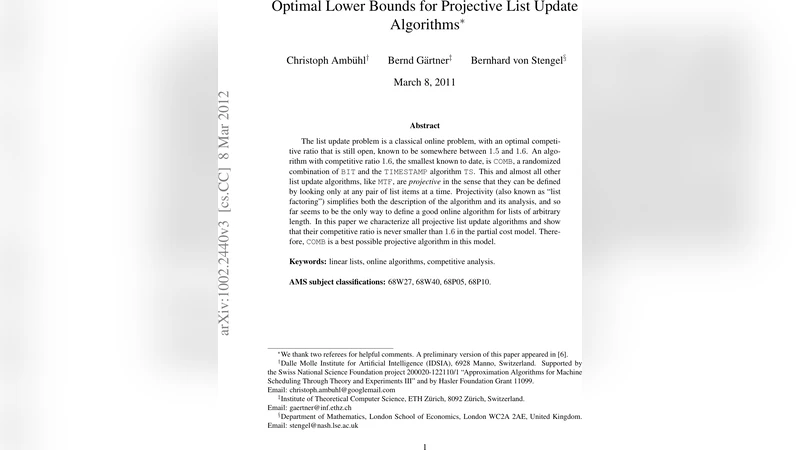
The list update problem is a classical online problem, with an optimal competitive ratio that is still open, known to be somewhere between 1.5 and 1.6. An algorithm with competitive ratio 1.6, the smallest known to date, is COMB, a randomized combination of BIT and the TIMESTAMP algorithm TS. This and almost all other list update algorithms, like MTF, are projective in the sense that they can be defined by looking only at any pair of list items at a time. Projectivity (also known as “list factoring”) simplifies both the description of the algorithm and its analysis, and so far seems to be the only way to define a good online algorithm for lists of arbitrary length. In this paper we characterize all projective list update algorithms and show that their competitive ratio is never smaller than 1.6 in the partial cost model. Therefore, COMB is a best possible projective algorithm in this model.
💡 Research Summary
The paper tackles one of the most enduring open questions in online algorithms: the exact optimal competitive ratio for the list‑update problem. In this problem a sequence of requests arrives online, each request asking for an element that resides somewhere in a singly‑linked list. After serving a request the algorithm may rearrange the list (typically by moving elements forward) in order to reduce the cost of future accesses. The performance of an online algorithm is measured by its competitive ratio, the worst‑case ratio between its total cost and that of an optimal offline algorithm that knows the entire request sequence in advance. Despite decades of research the best known lower bound is 1.5, while the best known upper bound is 1.6, achieved by the randomized algorithm COMB.
A striking feature of almost all successful list‑update algorithms, including Move‑to‑Front (MTF), BIT, TIMESTAMP (TS) and COMB, is projectivity (also called “list factoring”). A projective algorithm decides how to reorder the list by looking only at the relative order of any two items at a time; it never needs to consider the global configuration of the whole list. This property dramatically simplifies both the description of the algorithm and its analysis, and has been the main tool for designing competitive algorithms for arbitrarily long lists.
The authors set out to answer two questions: (1) What is the complete class of projective list‑update algorithms? (2) Within this class, how low can the competitive ratio be in the partial‑cost model (where the cost of accessing the i‑th element is i‑1 rather than i)?
Characterization of projective algorithms.
The paper introduces a formal framework based on a state‑transition graph for each unordered pair of items. A node represents the relative order of the pair (which one is ahead), and an edge corresponds to a request that involves one of the two items, possibly causing a swap. By stitching together the graphs for all (\binom{n}{2}) pairs, any deterministic projective algorithm can be represented as a collection of local transition rules. Randomized projective algorithms are then modeled as probability distributions over such deterministic rule sets. This representation shows that any projective algorithm is completely determined by how it treats each pair in isolation; there is no hidden global coupling.
Lower‑bound construction.
Using the pairwise representation, the authors construct an adversarial request sequence that simultaneously forces every pair to experience its worst‑case behavior. The construction relies on a carefully chosen potential function (\Phi) that assigns a numeric value to the global list state based on the positions of all pairs. For any projective algorithm (A), the expected increase in cost when serving a request is shown to satisfy
\
Comments & Academic Discussion
Loading comments...
Leave a Comment