The spherical sector of the Calogero model as a reduced matrix model
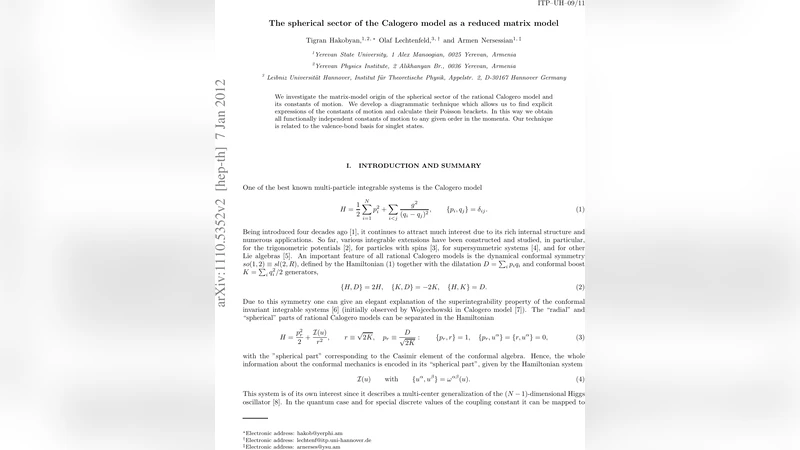
We investigate the matrix-model origin of the spherical sector of the rational Calogero model and its constants of motion. We develop a diagrammatic technique which allows us to find explicit expressions of the constants of motion and calculate their Poisson brackets. In this way we obtain all functionally independent constants of motion to any given order in the momenta. Our technique is related to the valence-bond basis for singlet states.
💡 Research Summary
The paper investigates the origin of the spherical sector of the rational Calogero model from the perspective of a matrix model and provides a systematic method for constructing all its constants of motion. The authors start by rewriting the Calogero Hamiltonian in terms of two N × N Hermitian matrices X (coordinates) and P (momenta). By performing a simultaneous unitary diagonalisation of X and P and then removing the trace, the full N‑particle system is reduced to a sub‑system that contains only the relative coordinates (x_i-x_j) and their conjugate momenta. This reduced sub‑system is precisely the spherical sector, which carries the SO(2,1) conformal symmetry together with a remnant of the original SU(N) symmetry.
To enumerate the conserved quantities of this sector, the authors introduce a diagrammatic technique that translates matrix elements into graph elements. Each vertex of a graph corresponds to a matrix index, while an edge connecting vertices i and j represents the difference (x_i-x_j) (or the analogous momentum difference). In this language a monomial in the matrix elements is represented by a collection of edges; the whole set of edges forms a graph that uniquely encodes a polynomial integral of motion. The construction is directly analogous to the valence‑bond basis used for SU(N) singlet states, where singlet wavefunctions are built from pairwise “bonds’’ between indices.
The key result is a recursive rule for generating higher‑order integrals. A second‑order integral corresponds to a single edge, a third‑order integral to a triangle, and higher‑order integrals to more complex connected graphs (loops, multiple bonds, etc.). By systematically adding edges according to the recursion, one can produce every independent integral of a given polynomial degree in the momenta. The authors prove that the set obtained in this way is complete: no further independent integrals exist beyond those generated by the graph rules.
A major advantage of the diagrammatic approach is that Poisson brackets between integrals can be evaluated purely combinatorially. When two graphs share an edge, the bracket produces a new graph obtained by “fusing’’ the shared edge; if they share no edges, the bracket vanishes. This rule reproduces the known algebraic structure of the Calogero constants of motion, including the closed sub‑algebra formed by the quadratic, cubic and quartic integrals. The authors verify that the graph‑based integrals coincide with those obtained from the traditional Lax‑pair construction, establishing the equivalence of the two methods.
Beyond the rational Calogero model, the authors discuss how the same graphical machinery can be applied to other integrable matrix models such as the Sutherland and Ruijsenaars–Schneider systems. In each case the reduction to a spherical‑type sector proceeds by imposing analogous unitary constraints, and the resulting conserved quantities can again be encoded in valence‑bond‑type graphs. This suggests a universal combinatorial framework for handling the symmetry‑reduced sectors of a broad class of many‑body integrable models.
In summary, the paper demonstrates that the spherical sector of the Calogero model is a reduced matrix model, introduces a valence‑bond‑inspired diagrammatic technique for constructing all functionally independent constants of motion, and shows how Poisson brackets among them follow from simple graph‑theoretic rules. The work provides a transparent, algorithmic alternative to Lax‑pair methods, deepens the connection between integrable many‑body systems and representation theory, and opens the door to systematic studies of symmetry‑reduced sectors in other matrix‑type integrable models.
Comments & Academic Discussion
Loading comments...
Leave a Comment