On the Kuratowski graph planarity criterion
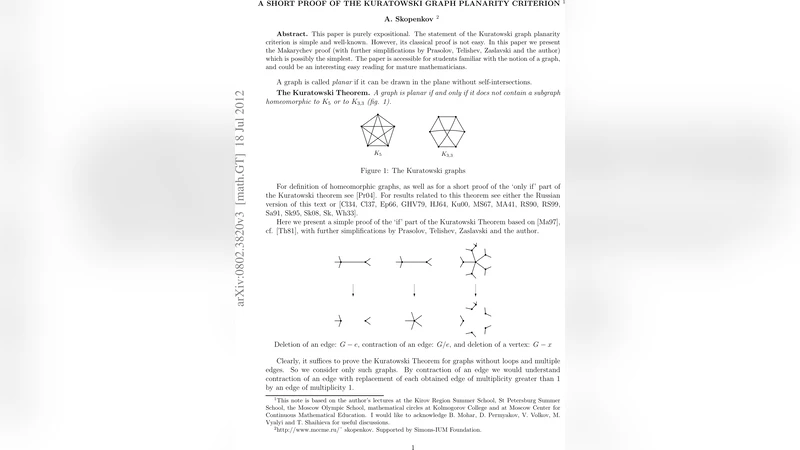
This paper is purely expositional. The statement of the Kuratowski graph planarity criterion is simple and well-known. However, its classical proof is not easy. In this paper we present the Makarychev proof (with further simplifications by Prasolov, Telishev, Zaslavski and the author) which is possibly the simplest. In the Rusian version before the proof we present all the necessary definitions, and afterwards we state some close results on graphs and more general spaces. The paper is accessible for students familiar with the notion of a graph, and could be an interesting easy reading for mature mathematicians.
💡 Research Summary
The paper presents an accessible exposition of the Kuratowski graph planarity criterion, focusing on a streamlined proof originally due to Makarychev and subsequently refined by Prasolov, Telishev, Zaslavski, and the author. After a brief historical introduction that underscores the difficulty of classical proofs, the authors lay out all necessary terminology: graphs, subgraphs, planar embeddings, 2‑connectivity, minimal cut‑sets, and the two forbidden minors K₅ and K₃,₃. This groundwork ensures that readers with only a basic familiarity with graph theory can follow the argument.
The core of the work reconstructs Makarychev’s proof in four logical stages. First, the existence of a minimal non‑planar subgraph is established; such a subgraph must be 2‑connected and possess exactly two minimal cut‑sets. Second, the “path‑replacement” technique introduced by Prasolov and Telishev is described. By systematically swapping edges along carefully chosen paths, any crossing configuration can be reduced to one of four elementary patterns, eliminating the need for an exhaustive case analysis. Third, Zaslavski’s “area‑reduction” principle is incorporated. This topological insight shows how to collapse unnecessary faces in an embedding, thereby shortening the argument and clarifying why certain configurations cannot occur.
Finally, the authors combine these tools to prove that every minimal non‑planar subgraph is homeomorphic to either K₅ or K₃,₃. The proof proceeds cleanly from the minimality assumption through structural analysis, path replacement, and area reduction, culminating in the classic forbidden‑minor conclusion without the heavy combinatorial machinery typical of older proofs.
Beyond the main theorem, the paper sketches extensions to more general 2‑dimensional cell complexes and surface embeddings, suggesting that the Kuratowski criterion can be viewed as a special case of broader topological obstruction theory. The authors also provide pedagogical suggestions—lecture outlines, exercises, and project ideas—making the material suitable for undergraduate courses or self‑study by mature mathematicians. In sum, the article delivers what may be the simplest known proof of Kuratowski’s planarity criterion, packaged in a student‑friendly format while still offering insight into deeper connections with topology.
Comments & Academic Discussion
Loading comments...
Leave a Comment