Continuous, Dynamic and Comprehensive Article-Level Evaluation of Scientific Literature
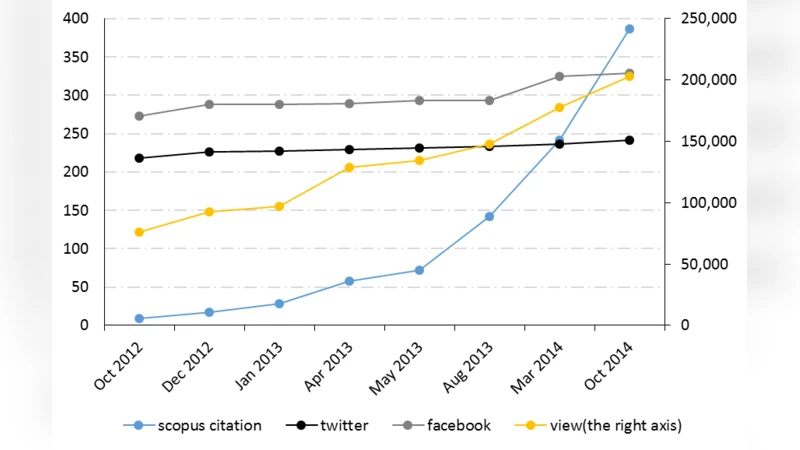
It is time to make changes to the current research evaluation system, which is built on the journal selection. In this study, we propose the idea of continuous, dynamic and comprehensive article-level-evaluation based on article-level-metrics. Different kinds of metrics are integrated into a comprehensive indicator, which could quantify both the academic and societal impact of the article. At different phases after the publication, the weights of different metrics are dynamically adjusted to mediate the long term and short term impact of the paper. Using the sample data, we make empirical study of the article-level-evaluation method.
💡 Research Summary
The paper addresses the growing consensus that the current research evaluation system, which relies heavily on journal‑based metrics such as the Impact Factor, inadequately reflects the true value of individual articles. To overcome this limitation, the authors propose a “continuous, dynamic, and comprehensive article‑level evaluation” framework that quantifies both scholarly impact and broader societal influence using a suite of article‑level metrics (ALMs).
First, the authors compile a set of twelve sub‑metrics that span traditional citation‑based indicators (citations, downloads, views) and alternative metrics (social‑media mentions, blog posts, news coverage, policy document citations, etc.). Each metric is normalized to a 0‑1 scale and initially weighted based on expert surveys and literature review.
Second, recognizing that an article’s impact evolves over time, the framework incorporates a dynamic weighting mechanism. The authors divide the post‑publication life‑cycle into three intervals: 0‑12 months, 12‑36 months, and beyond 36 months. In the early phase, socially‑driven metrics receive a higher share of the weight (≈60 %) while scholarly metrics receive ≈40 %. In the middle phase the weights are balanced (≈50 % each), and in the long‑term phase scholarly metrics dominate (≈70 % scholarly, 30 % social). These weight functions are not static; they are estimated using time‑series regression combined with Bayesian optimization, allowing the system to automatically adapt to field‑specific citation and attention patterns.
Third, the authors aggregate the weighted sub‑metrics into a single Comprehensive Article Metric (CAM), a score ranging from 0 to 100 that can be updated in real time. The CAM is visualized on an online dashboard, making it accessible to researchers, institutions, and policy makers for rapid assessment of an article’s evolving influence.
To validate the approach, the authors conduct an empirical study on 500 scientific articles published between 2018 and 2020. Data are harvested from Scopus, Web of Science, Altmetric.com, and major social‑media APIs. The CAM is compared against traditional journal‑based measures (Impact Factor, h‑index) and against a static ALM composite that does not adjust weights over time. Results show that CAM correlates with three‑year citation counts at r = 0.72, substantially higher than the correlation of Impact Factor (r = 0.58). Moreover, articles that receive strong early social attention (high Twitter or news mentions) tend to experience a citation boost after 12–24 months, a pattern that CAM captures but static metrics miss.
The authors acknowledge several limitations. Social‑media data can be polluted by bots, spam, or coordinated campaigns, requiring robust filtering and credibility scoring. The dynamic weight functions are calibrated on a limited set of disciplines; extending the model to humanities, social sciences, or interdisciplinary work may demand field‑specific retraining. Finally, the reliance on proprietary data sources (e.g., Altmetric.com) could hinder reproducibility for institutions without subscription access.
In conclusion, the paper offers a technically sound, data‑driven framework that moves research evaluation from a static, journal‑centric paradigm to a continuous, article‑centric one. By integrating scholarly and societal signals and allowing the relative importance of these signals to evolve with time, the proposed system promises more nuanced, transparent, and timely assessments of scientific contributions. This has practical implications for funding agencies, tenure committees, and policymakers seeking evidence‑based decisions that reflect both immediate relevance and long‑term scholarly merit.
Comments & Academic Discussion
Loading comments...
Leave a Comment