The Digital Humanities Unveiled: Perceptions Held by Art Historians and Computer Scientists about Computer Vision Technology
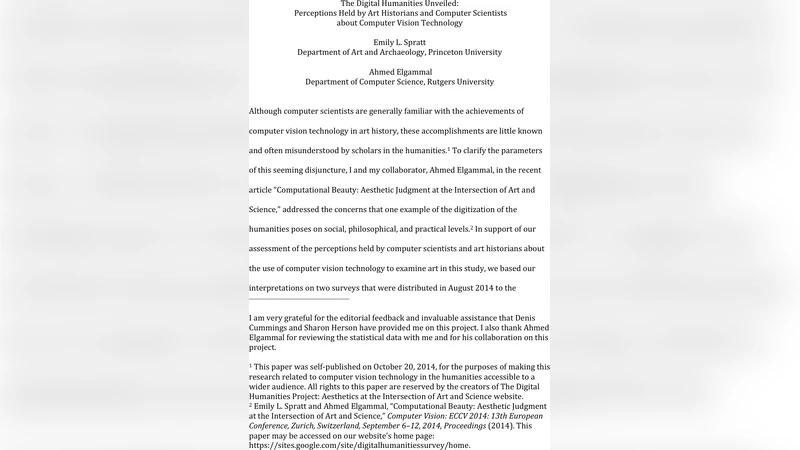
Although computer scientists are generally familiar with the achievements of computer vision technology in art history, these accomplishments are little known and often misunderstood by scholars in the humanities. To clarify the parameters of this seeming disjuncture, we have addressed the concerns that one example of the digitization of the humanities poses on social, philosophical, and practical levels. In support of our assessment of the perceptions held by computer scientists and art historians about the use of computer vision technology to examine art, we based our interpretations on two surveys that were distributed in August 2014. In this paper, the development of these surveys and their results are discussed in the context of the major philosophical conclusions of our research in this area to date.
💡 Research Summary
The paper investigates how art historians and computer scientists perceive the use of computer‑vision technology in art‑historical research. To illuminate the often‑cited gap between the technical achievements celebrated by computer scientists and the limited, sometimes mistaken, awareness among humanities scholars, the authors designed and distributed two online surveys in August 2014. A total of 140 respondents participated: 78 art historians and 62 computer scientists, all affiliated with major universities in the United States or Europe. The questionnaire was organized around four thematic clusters—technical feasibility, data reliability, interpretive authority, and ethical/legal concerns—and employed a five‑point Likert scale for each item.
Results reveal a pronounced divergence of opinion. Computer scientists overwhelmingly view computer‑vision tools (e.g., automated style classification, large‑scale image metadata generation, algorithmic authenticity testing) as ready for scholarly deployment. They cite high algorithmic accuracy, scalability, and reproducibility as strengths that can augment traditional art‑historical methods. By contrast, art historians express skepticism about the “objectivity” promised by these systems. They argue that visual meaning, cultural context, and historical nuance are intrinsically interpretive and cannot be reduced to numeric features. Consequently, they see computer‑vision outputs as supplemental aids rather than replacements for expert judgment.
A second, equally salient finding concerns perceived risks. Art historians are more likely to flag data bias (e.g., Western‑centric image corpora), copyright infringement, and the opacity of “black‑box” models as barriers to adoption. Computer scientists acknowledge these issues but tend to downplay them, emphasizing ongoing research on fairness and explainability.
The authors interpret these patterns through a philosophical lens. They contend that the two groups operate on different epistemological premises: scientists prioritize empiricism, verification, and reproducibility, while humanities scholars foreground hermeneutics, contextual depth, and the situatedness of knowledge. This epistemic mismatch shapes expectations, collaboration dynamics, and ultimately the success of interdisciplinary projects.
Practically, the paper argues for targeted educational interventions. For art historians, introductory workshops on image preprocessing, feature extraction, and the basics of machine learning could demystify the technology. For computer scientists, seminars on art‑historical methodology, visual culture theory, and the politics of representation would foster sensitivity to the domain’s interpretive demands. By building a shared vocabulary, the authors believe that joint research can move beyond tokenistic “digital humanities” gestures toward genuine methodological integration.
In conclusion, the surveys demonstrate that acceptance of computer‑vision tools is not merely a function of technical performance but hinges on cultural, ethical, and epistemic compatibility. The authors call for future work that documents concrete collaborative case studies, develops user‑centered interfaces, and codifies best‑practice guidelines for result interpretation. Such efforts, they argue, will act as a “digital mediator” between the humanities and the sciences, enabling computer‑vision to become a constructive, responsibly used instrument in the study of art.
Comments & Academic Discussion
Loading comments...
Leave a Comment