Reactive solute transport in physically and chemically heterogeneous porous media with multimodal reactive mineral facies: The Lagrangian approach
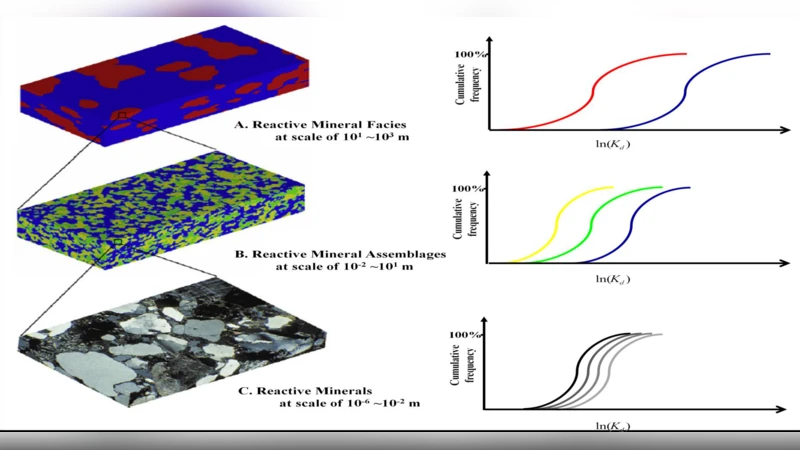
Physical and chemical heterogeneities have a large impact on reactive transport in porous media. Examples of heterogeneous attributes affecting reactive mass transport are the hydraulic conductivity (K), and the equilibrium sorption distribution coefficient (Kd). This paper uses the Deng et al. (2013) conceptual model for multimodal reactive mineral facies and a Lagrangian-based stochastic theory in order to analyze the reactive solute dispersion in three-dimensional anisotropic heterogeneous porous media with hierarchical organization of reactive minerals. An example based on real field data is used to illustrate the time evolution trends of reactive solute dispersion. The results show that the correlation between the hydraulic conductivity and the equilibrium sorption distribution coefficient does have a significant effect on reactive solute dispersion. The anisotropy ratio does not have a significant effect on reactive solute dispersion. Furthermore, through a sensitivity analysis we investigate the impact of changing the mean, variance, and integral scale of K and Kd on reactive solute dispersion.
💡 Research Summary
The paper presents a rigorous stochastic framework for analyzing reactive solute transport in three‑dimensional, anisotropic porous media that exhibit both physical (hydraulic conductivity, K) and chemical (equilibrium sorption distribution coefficient, Kd) heterogeneities. Building on the conceptual model of multimodal reactive mineral facies introduced by Deng et al. (2013), the authors treat the subsurface as a hierarchy of distinct mineral facies, each characterized by its own statistical distribution of K and Kd. These distributions are parameterized by their means (μK, μKd), variances (σ²K, σ²Kd), and integral scales (LK, LKd), while a correlation coefficient ρKH captures the joint spatial variability between hydraulic conductivity and sorption capacity.
The core of the methodology is a Lagrangian‑based stochastic theory. Solute particles are imagined to follow random trajectories governed by the underlying heterogeneous fields. By deriving the probability density function (PDF) of particle positions, the authors obtain expressions for the effective dispersion coefficients: a mechanical (shear‑induced) dispersion term that depends primarily on K, and a reactive dispersion term that incorporates the combined influence of K and Kd. Importantly, the theory explicitly shows how the sign and magnitude of ρKH modulate the reactive dispersion. When K and Kd are positively correlated, high‑conductivity zones coincide with strong sorption zones, leading to a rapid advective transport that is simultaneously retarded by intense sorption, thereby reducing the overall reactive dispersion coefficient DR(t). Conversely, a negative correlation produces a more dispersed plume because high‑conductivity pathways are associated with weak sorption.
To illustrate the theory, the authors apply it to a field‑scale dataset from a heterogeneous aquifer. The domain is discretized into three‑dimensional anisotropic blocks, each assigned to one of several mineral facies. Numerical evaluation of DR(t) over time reveals several key findings:
-
Correlation Effect (ρKH) – The reactive dispersion is highly sensitive to the K–Kd correlation. Positive correlation markedly suppresses DR, while negative correlation amplifies it. This effect dominates over other parameters because it directly couples advective speed with sorption strength.
-
Anisotropy Ratio (α = Kx/Kz) – Varying the hydraulic anisotropy ratio across a realistic range (0.5–2) produces negligible changes in DR. The results suggest that, for reactive transport, the spatial statistics of K and Kd outweigh directional differences in hydraulic conductivity.
-
Sensitivity to Statistical Moments – A systematic perturbation analysis (±20 % of each parameter) shows:
- Increasing μK accelerates bulk flow, decreasing DR.
- Raising σ²K enhances mechanical dispersion, increasing DR.
- Enlarging LK (larger integral scale) creates longer correlated high‑K zones, which tend to lower DR by promoting more coherent flow paths.
- Raising μKd strengthens sorption, strongly reducing DR.
- Increasing σ²Kd introduces heterogeneity in sorption strength, which raises DR by creating preferential low‑sorption pathways.
- Expanding LKd extends the spatial correlation of sorption properties, generally decreasing DR because sorption zones become more continuous.
These sensitivities confirm that both the magnitude and the spatial structure of K and Kd are crucial for accurate prediction of reactive plume evolution. The authors argue that field investigations must therefore prioritize joint characterization of hydraulic and sorptive properties, including their cross‑correlation, rather than treating them independently.
The paper concludes with a discussion of future extensions. Incorporating non‑linear sorption isotherms, kinetic reactions, and non‑Newtonian flow regimes would broaden the applicability of the framework. Moreover, coupling the stochastic model with data‑assimilation techniques could enable real‑time updating of the statistical parameters as new monitoring data become available, thereby improving the reliability of risk assessments and remediation design.
In summary, this work advances reactive transport modeling by integrating multimodal mineral facies concepts with a Lagrangian stochastic description, revealing that the interplay between hydraulic conductivity and sorption capacity—especially their spatial correlation—dominates reactive solute dispersion, while hydraulic anisotropy plays a secondary role. The sensitivity analysis provides practical guidance for field characterization and underscores the importance of jointly measuring K and Kd statistics to predict contaminant behavior in complex subsurface environments.
Comments & Academic Discussion
Loading comments...
Leave a Comment