A fractal approach to the dark silicon problem: a comparison of 3D computer architectures -- standard slices versus fractal Menger sponge geometry
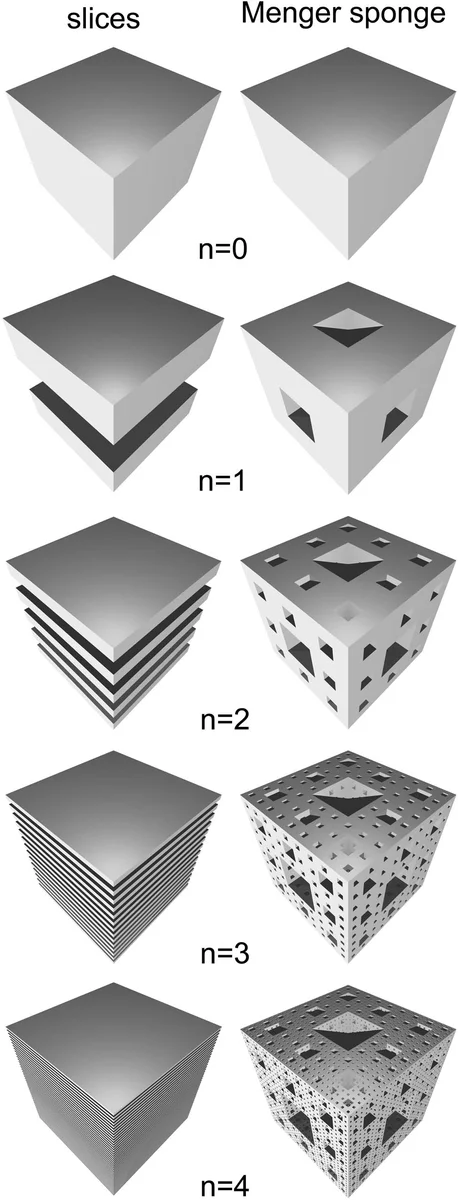
The dark silicon problem, which limits the power-growth of future computer generations, is interpreted as a heat energy transport problem when increasing the energy emitting surface area within a given volume. A comparison of two 3D-configuration models, namely a standard slicing and a fractal surface generation within the Menger sponge geometry is presented. It is shown, that for iteration orders $n>3$ the fractal model shows increasingly better thermal behavior. As a consequence cooling problems may be minimized by using a fractal architecture. Therefore the Menger sponge geometry is a good example for fractal architectures applicable not only in computer science, but also e.g. in chemistry when building chemical reactors, optimizing catalytic processes or in sensor construction technology building highly effective sensors for toxic gases or water analysis.
💡 Research Summary
The paper addresses the “dark silicon” problem – the growing inability to keep all transistors on a chip active because of excessive heat dissipation – by reframing it as a heat‑transport optimization task. The authors argue that an ideal three‑dimensional (3‑D) chip geometry should (i) maximize the active surface area within a fixed volume, thereby increasing computational power density, and (ii) maximize the volume available for a cooling medium, which improves heat removal. To explore these competing requirements, two conceptual 3‑D configurations are modeled and compared analytically.
1. Slice (standard) geometry
The first model divides a unit cube (volume V = 1, the unit can be m³, cm³ or mm³ depending on the application) into ρ = ⌊3ⁿ/2⌋ + 1 equally spaced planar slices of height L = 1/3ⁿ. The total volume occupied by the slices is V_s = ρ L and the total surface area exposed to the cooling medium is S_s = ρ(2 + 4L). As the iteration number n grows, the slice thickness shrinks, the occupied volume approaches ½ of the cube, and the surface area increase slows down.
2. Menger‑sponge (fractal) geometry
The second model uses the three‑dimensional Menger sponge, a well‑known fractal that can be regarded as the 3‑D analogue of the Sierpinski carpet. For iteration order n the sponge volume is V_M = (20/27)ⁿ, while the surface area grows according to S_M = (1/9)(20/9)ⁿ⁻¹
Comments & Academic Discussion
Loading comments...
Leave a Comment