Adaptive tracking of representative cycles in regular and zigzag persistent homology
Persistent homology and zigzag persistent homology are techniques which track the homology over a sequence of spaces, outputting a set of intervals corresponding to birth and death times of homological features in the sequence. This paper presents a method for choosing a homology class to correspond to each of the intervals at each time point. For each homology class a specific representative cycle is stored, with the choice of homology class and representative cycle being both geometrically relevant and compatible with the birth-death interval decomposition. After describing the method in detail and proving its correctness, we illustrate the utility of the method by applying it to the study of coverage holes in time-varying sensor networks.
💡 Research Summary
The paper addresses a fundamental limitation of both ordinary persistent homology and its extension, zigzag persistent homology: while these methods output intervals that record the birth and death times of homological features across a sequence of spaces, they do not specify which concrete geometric cycles correspond to each interval at any given time. This lack of concrete representatives hampers interpretation, especially in dynamic settings where one wishes to track the evolution of specific features such as coverage holes in a mobile sensor network.
The authors propose a systematic algorithm that, for every interval produced by a zigzag persistence computation, selects a single homology class and stores a specific representative cycle. The selection is guided by two principles. First, the chosen cycles must be geometrically meaningful; for example, in a planar sensor network they should trace the boundary of an actual coverage hole. Second, the selection must be compatible with the algebraic structure of the persistence module, specifically with the right filtration that underlies the standard interval decomposition. By ensuring that each one‑dimensional quotient space in the right filtration is assigned exactly one cycle, the algorithm builds a “right‑compatible” basis that respects the birth–death pairing of the module.
The technical core of the method is a careful incremental update of the right filtration as simplices are added (forward maps) or removed (backward maps) from the underlying simplicial complexes. Starting from the first homology space V₁, the algorithm maintains a nested sequence of subspaces Rᵢ⁰ ⊂ Rᵢ¹ ⊂ … ⊂ Rᵢ^{dim Vᵢ}=Vᵢ. When a simplex insertion causes the dimension of Vᵢ to increase, a new one‑dimensional quotient Rᵢ^{j}/Rᵢ^{j‑1} appears; the algorithm records the current time as the birth of a new interval and selects a cycle that spans this quotient. Conversely, when a deletion reduces the dimension, the corresponding quotient disappears, and the algorithm records the current time as the death of the interval associated with the previously stored cycle. In both cases the representative cycle is updated by applying the appropriate forward or backward linear map (the induced map on homology) so that it remains a valid representative of the same homology class after the change.
The authors prove two key correctness results. First, they show that the right‑compatible basis constructed by the algorithm indeed yields a one‑to‑one correspondence between non‑zero quotients of the right filtration and the intervals of the zigzag persistence decomposition, guaranteeing that each interval receives exactly one representative. Second, they demonstrate that the cycle updates preserve homology class, i.e., the stored cycle at any step is homologous to the original class assigned at its birth. These results together ensure that the set of stored cycles forms a coherent, time‑consistent description of the evolving homology.
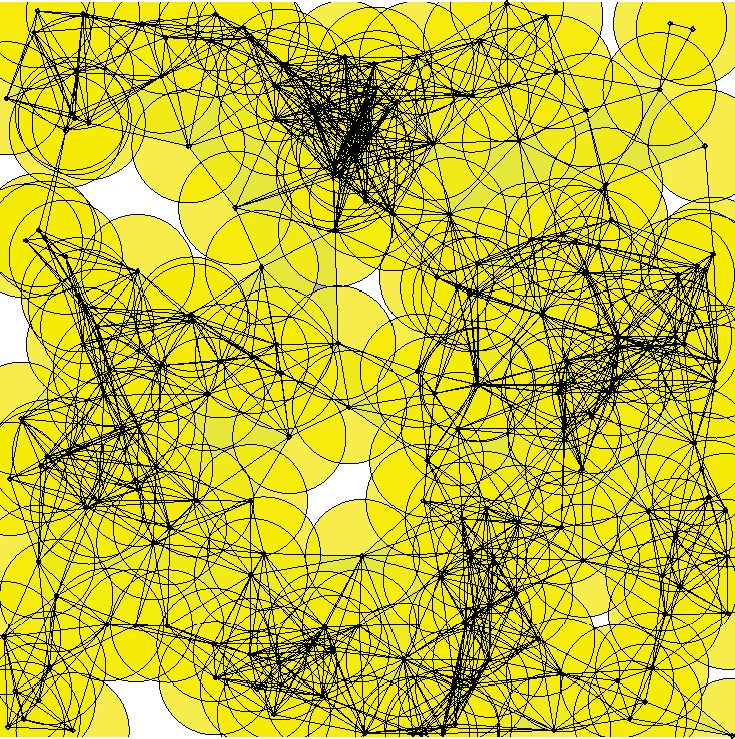
To illustrate the practical value of the approach, the paper applies the algorithm to a time‑varying sensor network. Sensors are modeled as points with isotropic coverage disks of radius r; an edge is placed between two sensors if their disks intersect, and the Rips complex of this communication graph approximates the coverage region’s topology. As sensors move, the Rips complex changes by single‑simplex insertions and deletions, producing a zigzag sequence of homology groups. Using the proposed method, the authors continuously track a representative 1‑cycle for each birth‑death interval, effectively tracing the birth, movement, and disappearance of coverage holes. Visualizations show that, unlike standard persistence which only reports intervals, the adaptive cycle tracking yields explicit hole trajectories, enabling more informed decisions about network maintenance, sensor redeployment, or coverage guarantees.
The paper concludes by noting that while a canonical basis (one cycle per hole) exists for planar regions via Alexander duality, such a basis cannot be directly lifted to the higher‑dimensional Rips complex. Nevertheless, the adaptive tracking algorithm provides a practical compromise: it supplies geometrically sensible representatives that evolve consistently with the underlying algebraic persistence. Future work may extend the method to higher‑dimensional homology, non‑planar settings, or large‑scale real‑time implementations.
Comments & Academic Discussion
Loading comments...
Leave a Comment