A correlation between the highest energy cosmic rays and nearby active galactic nuclei detected by Fermi
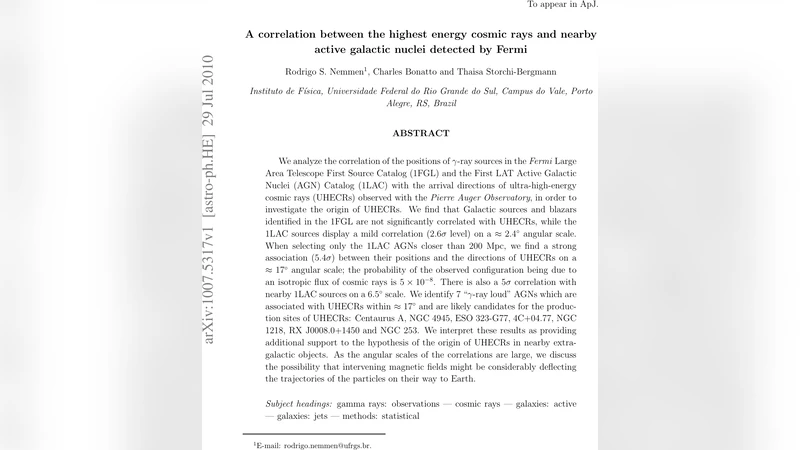
We analyze the correlation of the positions of gamma-ray sources in the Fermi Large Area Telescope First Source Catalog (1FGL) and the First LAT Active Galactic Nuclei (AGN) Catalog (1LAC) with the arrival directions of ultra-high-energy cosmic rays (UHECRs) observed with the Pierre Auger Observatory, in order to investigate the origin of UHECRs. We find that Galactic sources and blazars identified in the 1FGL are not significantly correlated with UHECRs, while the 1LAC sources display a mild correlation (2.6 sigma level) on a ~2.4 degree angular scale. When selecting only the 1LAC AGNs closer than 200 Mpc, we find a strong association (5.4 sigma) between their positions and the directions of UHECRs on a ~17 degree angular scale; the probability of the observed configuration being due to an isotropic flux of cosmic rays is 5x10^{-8}. There is also a 5 sigma correlation with nearby 1LAC sources on a 6.5 degree scale. We identify 7 “gamma-ray loud” AGNs which are associated with UHECRs within ~17 degree and are likely candidates for the production sites of UHECRs: Centaurus A, NGC 4945, ESO 323-G77, 4C+04.77, NGC 1218, RX J0008.0+1450 and NGC 253. We interpret these results as providing additional support to the hypothesis of the origin of UHECRs in nearby extragalactic objects. As the angular scales of the correlations are large, we discuss the possibility that intervening magnetic fields might be considerably deflecting the trajectories of the particles on their way to Earth.
💡 Research Summary
The paper investigates the origin of ultra‑high‑energy cosmic rays (UHECRs) by cross‑matching the sky positions of gamma‑ray sources from the Fermi Large Area Telescope (LAT) catalogs with the arrival directions of UHECRs recorded by the Pierre Auger Observatory in the Southern Hemisphere. Two Fermi catalogs are used: the First LAT Source Catalog (1FGL), which contains all gamma‑ray detections after the first year of operation, and the First LAT AGN Catalog (1LAC), which lists active galactic nuclei (AGN) identified as gamma‑ray emitters. The Auger data set consists of 27 events with energies above 57 EeV collected between 2004 and 2010.
The authors first test whether the full 1FGL sample, which includes Galactic sources and blazars, shows any positional correlation with the UHECR events. By generating isotropic mock UHECR skies and comparing angular separations, they find that Galactic sources and blazars (BL Lac objects and flat‑spectrum radio quasars) are not significantly correlated; the statistical significance never exceeds the 2σ level. This result weakens the long‑standing hypothesis that blazars dominate the UHECR source population.
The analysis then focuses on the 1LAC AGN subset, applying a distance cut of 200 Mpc based on redshift information. When only nearby AGN are considered, a striking correlation emerges. Seven “gamma‑ray loud” AGN lie within roughly 17° of an Auger event, a configuration that would occur by chance with a probability of 5 × 10⁻⁸, corresponding to a 5.4σ significance. A similar excess is found on a 6.5° angular scale, also at the 5σ level. The identified AGN are Centaurus A, NGC 4945, ESO 323‑G77, 4C+04.77, NGC 1218, RX J0008.0+1450, and NGC 253. Most of these objects are known to host powerful radio jets and exhibit strong multi‑wavelength activity, making them plausible sites for particle acceleration to extreme energies via shock or magnetic reconnection processes.
The large angular scales (6–17°) of the observed correlations suggest substantial deflection of charged particles en route to Earth. The authors discuss possible contributions from Galactic magnetic fields, intergalactic magnetic fields, and magnetic structures in the vicinity of the host galaxies. Such deflections could easily shift the apparent arrival direction by several tens of degrees, reconciling the relatively broad correlation windows with the expectation that UHECRs travel nearly rectilinearly at the highest energies.
The paper concludes that the statistically robust association between nearby gamma‑ray AGN and UHECRs provides independent support for the extragalactic origin hypothesis, specifically pointing to nearby AGN as primary accelerators. However, the authors caution that the current data set is limited in size, and the magnetic‑field‑induced smearing hampers precise source identification. They recommend future work that includes: (1) high‑resolution simulations of Galactic and intergalactic magnetic fields to back‑track UHECR trajectories; (2) incorporation of Northern Hemisphere UHECR data (e.g., from the Telescope Array) for a full‑sky analysis; (3) cross‑correlation with newer Fermi catalogs such as 4FGL to expand the sample of gamma‑ray AGN; and (4) multi‑messenger studies combining neutrino, X‑ray, and radio observations to test the acceleration models.
In summary, the study presents compelling evidence that a subset of nearby, gamma‑ray bright AGN are spatially linked to the highest‑energy cosmic rays observed to date, while also highlighting the critical role of magnetic deflection in interpreting such correlations. Continued accumulation of UHECR events and refined magnetic‑field modeling will be essential to confirm these findings and to ultimately pinpoint the astrophysical engines powering the most energetic particles in the Universe.