Astronomy in Antarctica
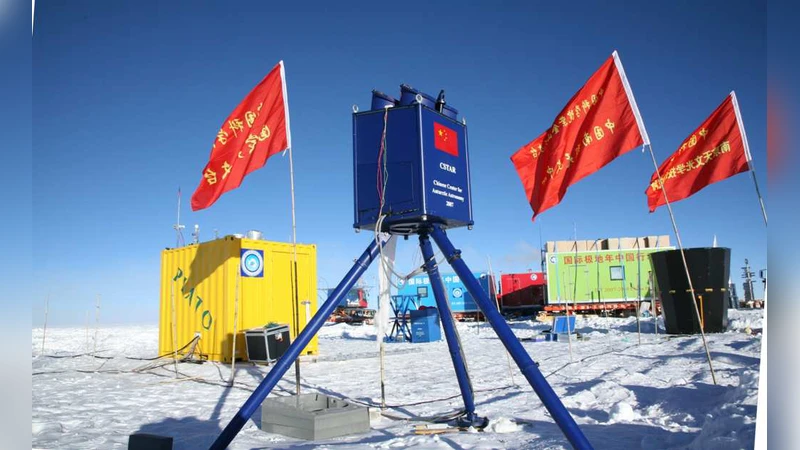
Antarctica provides a unique environment for astronomy. The cold, dry and stable air found above the high plateau, as well as the pure ice below, offers new opportunities across the photon & particle spectrum. The summits of the plateau provide the best seeing conditions, the darkest skies and the most transparent atmosphere of any earth-based observing site. Astronomical activities are now underway at four plateau sites: the Amundsen-Scott South Pole Station, Concordia Station at Dome C, Kunlun Station at Dome A and Fuji Station at Dome F, in addition to long duration ballooning from the coastal station of McMurdo. Astronomy conducted includes optical, IR, THz & sub-mm, measurements of the CMBR, solar, as well as high energy astrophysics involving measurement of cosmic rays, gamma rays and neutrinos. Antarctica is also the richest source of meteorites on our planet. An extensive range of site testing measurements have been made over the high plateau. We summarise the facets of Antarctica that are driving developments in astronomy, and review the results of the site testing experiments undertaken to quantify those characteristics of the plateau relevant for it pursuit. We outline the historical development of the astronomy on the continent, and then review the principal scientific results to have emerged over the past three decades of activity in the discipline. We discuss how science is conducted in Antarctica, and in particular the difficulties, as well as the advantages, faced by astronomers seeking to bring their experiments there. We also review some of the political issues that will be encountered, both at national and international level. Finally, we discuss where Antarctic astronomy may be heading in the coming decade, in particular plans for IR & THz astronomy, including new facilities being considered for these wavebands at high plateau stations.
💡 Research Summary
The paper provides a comprehensive review of why Antarctica, and in particular the high‑plateau sites, have become a premier location for ground‑based astronomy across the electromagnetic spectrum and for high‑energy particle detection. The authors first describe the physical environment of the plateau: elevations above 3000 m, winter‑time temperatures often below –60 °C, and an exceptionally dry atmosphere with precipitable water vapor (PWV) typically less than 0.1 mm. These conditions yield a sky that is both extraordinarily transparent in the sub‑millimetre/THz bands and remarkably stable, with median seeing values around 0.3 arcsec and wind speeds usually under 3 m s⁻¹. The cold, low‑turbulence air reduces thermal background and scintillation, while the pure ice provides an excellent, low‑emissivity substrate for instrument mounting and, in the case of neutrino detectors, a massive Cherenkov medium.
Four plateau stations are now active: Amundsen‑Scott South Pole Station, Concordia at Dome C, Kunlun at Dome A, and Fuji at Dome F. In addition, long‑duration ballooning from the coastal McMurdo Station extends the observational reach into the upper atmosphere. The paper catalogs the major experiments at each site. At the South Pole, the BICEP/Keck series and the South Pole Telescope have delivered the most sensitive measurements of the cosmic microwave background (CMB) polarization, placing tight limits on primordial B‑modes. IceCube, embedded in the ice, has opened the field of high‑energy neutrino astronomy, detecting astrophysical neutrinos and probing cosmic‑ray sources. Dome C hosts the AST3 optical/near‑IR telescopes and the PLATO survey, providing continuous winter‑time monitoring of transients. Dome A, the driest site, is the focus of THz and far‑infrared projects, while Dome F supports sub‑millimetre spectroscopy. Balloon experiments from McMurdo have contributed to measurements of solar physics, atmospheric chemistry, and ultra‑high‑energy cosmic rays.
A substantial portion of the review is devoted to site‑testing campaigns. Instruments such as Differential Image Motion Monitors (DIMM), Multi‑Aperture Scintillation Sensors (MASS), radiosondes, and sky‑brightness radiometers have quantified PWV, turbulence profiles, and sky brightness over multiple years. The data confirm that the winter months (May–September) offer the best conditions, with PWV often below 0.05 mm and negligible atmospheric emission in the 200–300 µm window. These results underpin the scientific justification for building larger facilities.
The authors also discuss the operational challenges unique to Antarctica. Extreme cold stresses electronics and mechanical components, requiring custom‑designed hardware and extensive pre‑deployment testing. Personnel face six‑month isolation during the polar night, limited medical support, and the need for self‑sufficiency. Power is supplied mainly by diesel generators, imposing logistical constraints on fuel delivery and strict environmental compliance. Data transmission relies on limited‑bandwidth satellite links, necessitating on‑site data reduction and robust remote‑monitoring systems.
Political and legal aspects are examined in the context of the Antarctic Treaty System and the Protocol on Environmental Protection. All scientific activities must undergo rigorous Environmental Impact Assessments, manage waste, and avoid disturbance of the pristine ecosystem. International collaboration is essential, but it also introduces complexities in scheduling, data sharing, and governance of shared facilities.
Looking ahead, the paper outlines ambitious plans for the next decade. Proposals include a 10‑meter class infrared/THz telescope at Dome A or Dome C, designed to exploit the ultra‑dry atmosphere for spectroscopy of the earliest galaxies and star‑forming regions. Interferometric arrays are being considered to achieve sub‑arcsecond resolution at far‑infrared wavelengths. Expanded balloon and high‑altitude unmanned aerial vehicle programs aim to complement ground‑based observations and provide continuous monitoring of the upper atmosphere. The authors argue that these developments will cement Antarctica’s role as a unique, irreplaceable platform for probing the early universe, the physics of extreme particles, and the dynamics of our own solar environment.
In summary, the paper demonstrates that Antarctica’s combination of low temperature, low water vapour, atmospheric stability, and vast, dark skies offers unparalleled advantages for a wide range of astronomical investigations. While logistical, technical, and regulatory hurdles remain, the scientific returns—exemplified by breakthrough CMB polarization results, the discovery of astrophysical neutrinos, and pioneering THz observations—justify continued and expanded investment in Antarctic astronomy.
Comments & Academic Discussion
Loading comments...
Leave a Comment