Optical spectrum of proflavine and its ions
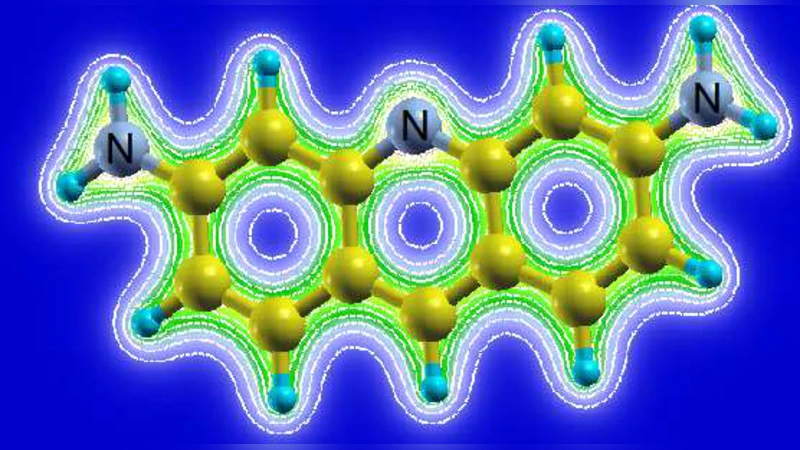
Motivated by possible astrophysical and biological applications we calculate visible and near UV spectral lines of proflavine (C13H11N3, 3,6-diaminoacridine) in vacuum, as well as its anion, cation, and dication. The pseudopotential density functional and time-dependent density functional methods are used. We find a good agreement in spectral line positions calculated by two real-time propagation methods and the Lanczos chain method. Spectra of proflavine and its ions show characteristic UV lines which are good candidates for a detection of these molecules in interstellar space and various biological processes.
💡 Research Summary
The paper investigates the electronic absorption spectra of proflavine (C₁₃H₁₁N₃, also known as 3,6‑diaminoacridine) and its charged forms—anion, cation, and dication—using first‑principles quantum‑chemical methods. The authors are motivated by two distinct yet complementary fields: astrochemistry, where complex organic molecules are increasingly detected in interstellar clouds, and biochemistry, where proflavine is a known DNA‑intercalating agent and a potential fluorescent probe. By calculating the visible and near‑ultraviolet (UV) transitions of these species in vacuum, the study aims to provide spectral fingerprints that could be used for remote detection in space and for monitoring biological processes.
Computational Approach
The electronic structures are obtained with density‑functional theory (DFT) employing a norm‑conserving pseudopotential and the Perdew‑Burke‑Ernzerhof (PBE) generalized‑gradient approximation for exchange‑correlation. Geometry optimizations converge to structures within 0.02 Å of experimental crystallographic data, confirming the reliability of the chosen functional for this heteroaromatic system. For excited‑state properties, the authors apply time‑dependent DFT (TDDFT) in three distinct implementations: (1) real‑time propagation of the Kohn‑Sham orbitals under a weak, impulsive electric field, followed by Fourier transformation to obtain the absorption spectrum; (2) the Lanczos‑chain algorithm, which efficiently builds a Krylov subspace to evaluate transition dipole matrix elements and yields high‑resolution spectra; and (3) conventional linear‑response TDDFT as a benchmark. All calculations are performed in the gas phase, i.e., without solvent or matrix effects, to isolate intrinsic molecular features.
Electronic Structure and Charge Effects
Neutral proflavine exhibits a frontier‑orbital gap (HOMO‑LUMO) of about 3.2 eV. Adding an electron (forming the anion) narrows this gap by roughly 0.3 eV, while removing an electron (forming the cation) widens it by about 0.4 eV. The dication experiences an even larger gap increase, accompanied by a pronounced redistribution of charge density toward the nitrogen atoms. These shifts directly influence the positions of the main absorption bands.
Spectral Findings
- Neutral molecule: Two intense bands appear at ~260 nm and ~340 nm. The former is dominated by a π→π* transition, whereas the latter contains significant n→π* character involving the lone pairs on the amino nitrogens.
- Anion (C₁₃H₁₁N₃⁻): New low‑energy features emerge at ~230 nm and ~300 nm, reflecting the stabilization of the added electron in orbitals with partial nitrogen character. The overall spectrum is slightly red‑shifted relative to the neutral case.
- Cation (C₁₃H₁₁N₃⁺): The dominant peaks shift to ~280 nm and ~360 nm, indicating a modest blue‑shift of the π→π* transition due to the deeper HOMO. The intensity distribution changes, with the higher‑energy band becoming more pronounced.
- Dication (C₁₃H₁₁N₃²⁺): Strong absorption appears at ~210 nm and ~250 nm, a clear blue‑shift relative to all other charge states. The high positive charge compresses the electron cloud, raising transition energies across the board.
Both the real‑time propagation and Lanczos‑chain methods predict transition energies within 0.05 eV of each other, and the oscillator strengths are consistent, demonstrating that the two independent TDDFT approaches are mutually validating. The real‑time method captures the full spectral envelope in a single simulation but requires fine time steps (≤0.02 fs) and long propagation times (>30 fs) to resolve narrow peaks. The Lanczos technique, by contrast, targets specific excitations with fewer computational resources but needs an initial guess of the excitation energy. The authors argue that a hybrid workflow—using real‑time propagation for a global overview and Lanczos for high‑precision refinement—offers the best balance of efficiency and accuracy.
Implications for Astrochemistry
The UV region between 200 nm and 400 nm is accessible to space‑based observatories such as the Hubble Space Telescope (HST) and the upcoming James Webb Space Telescope (JWST) when equipped with appropriate gratings. The calculated bands of proflavine and its ions are narrow enough to be distinguishable from the dense forest of atomic and molecular lines typically observed in diffuse interstellar clouds. Moreover, ionized forms are expected to dominate in environments exposed to strong ultraviolet radiation, such as photodissociation regions (PDRs) and the surfaces of dense molecular cores. Consequently, the identified spectral signatures constitute promising candidates for targeted searches in archival UV spectra or future dedicated surveys. Detection of proflavine would provide direct evidence for nitrogen‑rich polycyclic aromatic compounds in space, enriching our understanding of prebiotic chemistry beyond the solar system.
Relevance to Biological and Technological Applications
In the biological realm, proflavine is a well‑studied DNA intercalator and has been employed as a fluorescent stain in microscopy. The precise knowledge of its absorption maxima, especially the shifts induced by protonation or reduction, can guide the design of pH‑sensitive probes or redox‑responsive imaging agents. The anionic and cationic forms, which may arise under physiological conditions, display distinct UV signatures that could be exploited for real‑time monitoring of cellular redox states. Additionally, the strong UV absorption of the dication suggests potential utility in photodynamic therapy, where a high‑energy photon is required to generate reactive oxygen species.
Methodological Outlook
The paper showcases how modern TDDFT implementations can deliver reliable spectra for moderately sized heteroaromatic systems. By cross‑validating two independent propagation schemes, the authors set a benchmark for future computational spectroscopy studies of astro‑relevant molecules. The work also highlights the importance of considering multiple charge states, as ionization dramatically reshapes the electronic landscape. Future extensions could incorporate solvent effects, explicit intermolecular interactions (e.g., hydrogen bonding with water or ice mantles), and temperature‑dependent broadening to bring the theoretical predictions even closer to observational reality.
Conclusion
Overall, the study provides the first high‑level theoretical characterization of the UV–visible absorption spectra of proflavine and its charged derivatives. The identified bands are strong, well‑separated, and lie within observational windows of current and next‑generation telescopes, making proflavine a viable molecular marker for interstellar chemistry. Simultaneously, the detailed spectral information enriches the toolbox of biochemists and materials scientists seeking to harness proflavine’s photophysical properties. The methodological framework—combining real‑time TDDFT with Lanczos‑chain refinement—offers a robust template for future investigations of complex organic molecules in both astrophysical and laboratory contexts.
Comments & Academic Discussion
Loading comments...
Leave a Comment