The Significant Digit Law in Statistical Physics
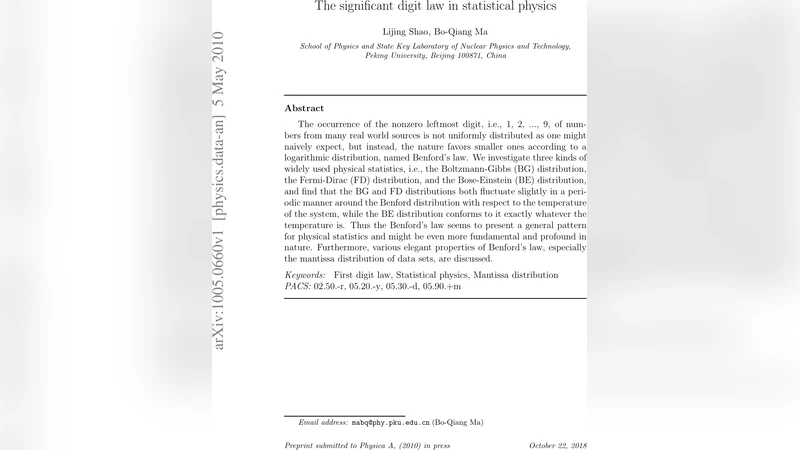
The occurrence of the nonzero leftmost digit, i.e., 1, 2, …, 9, of numbers from many real world sources is not uniformly distributed as one might naively expect, but instead, the nature favors smaller ones according to a logarithmic distribution, named Benford’s law. We investigate three kinds of widely used physical statistics, i.e., the Boltzmann-Gibbs (BG) distribution, the Fermi-Dirac (FD) distribution, and the Bose-Einstein (BE) distribution, and find that the BG and FD distributions both fluctuate slightly in a periodic manner around the Benford distribution with respect to the temperature of the system, while the BE distribution conforms to it exactly whatever the temperature is. Thus the Benford’s law seems to present a general pattern for physical statistics and might be even more fundamental and profound in nature. Furthermore, various elegant properties of Benford’s law, especially the mantissa distribution of data sets, are discussed.
💡 Research Summary
The paper investigates whether the well‑known Benford’s law—stating that the leading non‑zero digit d (1 ≤ d ≤ 9) of many real‑world numbers follows the logarithmic distribution P(d)=log₁₀(1+1/d)—also governs the most fundamental statistical distributions used in physics. The authors focus on three canonical ensembles: the Boltzmann‑Gibbs (BG) distribution, the Fermi‑Dirac (FD) distribution, and the Bose‑Einstein (BE) distribution. For each case they calculate the probability that a randomly drawn energy value has a given leading digit by integrating the respective probability density over the energy intervals where the digit equals d, i.e. over
Comments & Academic Discussion
Loading comments...
Leave a Comment