Lawvere-Tierney sheaves in algebraic set theory
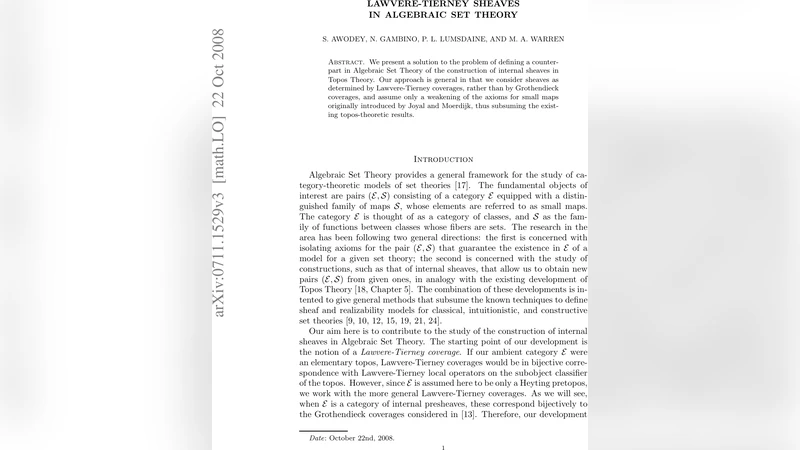
We present a solution to the problem of defining a counterpart in Algebraic Set Theory of the construction of internal sheaves in Topos Theory. Our approach is general in that we consider sheaves as determined by Lawvere-Tierney coverages, rather than by Grothendieck coverages, and assume only a weakening of the axioms for small maps originally introduced by Joyal and Moerdijk, thus subsuming the existing topos-theoretic results.
💡 Research Summary
The paper addresses the long‑standing problem of formulating an internal sheaf construction within Algebraic Set Theory (AST) that parallels the well‑established sheaf theory in elementary topos theory. In the topos setting, sheaves are usually defined via Grothendieck coverages, and the resulting sheaf topos inherits all the logical and categorical structure of the ambient topos. AST, on the other hand, is built on a category 𝒞 equipped with a distinguished class of “small maps” 𝒮, originally axiomatized by Joyal and Moerdijk through four stringent conditions (P1–P4). Those axioms guarantee that 𝒞 behaves like a predicative universe of sets, but they also exclude many natural models, especially those involving class‑level objects or realizability constructions.
The authors propose a two‑fold generalisation. First, they weaken the small‑map axioms, dropping the full regularity and boundedness requirements while retaining enough stability (closure under composition, pullback, and a weakened form of descent) to keep the basic categorical machinery intact. This relaxation allows the framework to accommodate a broader spectrum of models, including class‑theoretic ones where not every pullback of a small map remains small.
Second, instead of relying on Grothendieck coverages, the paper adopts Lawvere‑Tierney (LT) coverages—endomorphisms j : Ω → Ω of the internal truth‑object Ω that satisfy the usual LT axioms (preservation of truth, monotonicity, and idempotence). An LT coverage can be viewed as a “logical” way of specifying which subobjects are to be regarded as covering, and it works uniformly in any elementary topos. By transplanting this notion into AST, the authors define a j‑sheaf (or j‑sheaf object) as an object X for which the canonical map X → j X is an isomorphism, where j X denotes the j‑closure of the subobject classifier applied to X. Crucially, the definition is formulated so that it interacts well with the weakened small‑map structure: the class of j‑sheaves is closed under finite limits, exponentiation, and the formation of small colimits.
The main technical results can be summarised as follows:
-
Construction of the sheaf subcategory – For any LT coverage j on an AST‑model (𝒞, 𝒮), the full subcategory 𝒞_j of j‑sheaves inherits a small‑map class 𝒮_j, making (𝒞_j, 𝒮_j) itself an AST‑model. This shows that the sheaf construction is internal to the theory and does not require leaving the AST framework.
-
Sheafification functor – There exists a left adjoint a_j : 𝒞 → 𝒞_j (the sheafification or “j‑reflection”) which is left exact and preserves small maps. The adjunction (a_j ⊣ i_j) (where i_j is the inclusion) mirrors the classical sheafification adjunction in topos theory, confirming that the LT‑based approach reproduces the expected categorical behaviour.
-
Equivalence with Grothendieck sheaves – When a Grothendieck coverage G is given, one can construct a corresponding LT coverage j_G such that the category of G‑sheaves coincides (up to equivalence) with 𝒞_{j_G}. Conversely, any LT coverage arises from a Grothendieck coverage in the presence of the full Joyal‑Moerdijk axioms, establishing a precise bridge between the two perspectives.
-
Stability under logical operations – The authors verify that the internal logic of (𝒞, 𝒮) descends to (𝒞_j, 𝒮_j): logical connectives, quantifiers, and the internal notion of truth are preserved under sheafification. This is essential for applications to predicative set theory, where one wishes to reason internally about sheaves just as one does about sets.
To demonstrate the robustness of their framework, the paper works out three concrete examples:
-
Classical set‑theoretic model V – Here the small maps are the usual monomorphisms between sets, and the LT coverage reduces to the identity; the sheaf subcategory is the whole category, confirming compatibility with standard set theory.
-
Realizability models – In these models small maps are defined via realizability relations, which typically fail the full regularity axiom. The weakened axioms suffice, and the LT sheaf construction yields the expected realizability sheaf topos, showing that computational interpretations fit naturally into the AST‑LT picture.
-
Class‑level AST models – For categories of classes equipped with a notion of “small class”, the Grothendieck approach breaks down because covering families may be proper classes. The LT coverage, however, can be defined purely logically, and the resulting sheaf subcategory provides a well‑behaved “class‑sheaf” topos, illustrating the genuine necessity of the LT method.
In conclusion, the paper succeeds in transplanting the elegant Lawvere‑Tierney sheaf construction from elementary topos theory into the more flexible, predicative environment of Algebraic Set Theory. By weakening the small‑map axioms and employing LT coverages, the authors obtain a sheaf construction that works for a wide variety of models, subsumes the classical Grothendieck‑based results, and preserves the essential logical structure. This work not only fills a conceptual gap in the literature but also opens the door to new applications of AST in areas such as constructive set theory, realizability, and categorical foundations of mathematics.
Comments & Academic Discussion
Loading comments...
Leave a Comment