On the thermal impact on the excavation damaged zone around deep radioactive waste disposal
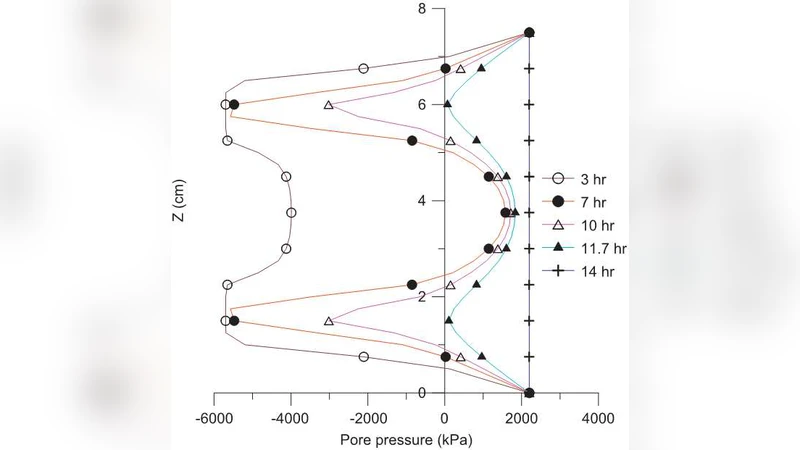
Clays and claystones are considered in some countries (including Belgium, France and Switzerland) as a potential host rock for high activity long lived radioactive waste disposal at great depth. One of the aspects to deal with in performance assessment is related to the effects on the host rock of the temperature elevation due to the placement of exothermic wastes. The potential effects of the thermal impact on the excavated damaged zone in the close field are another important issue that was the goal of the TIMODAZ European research project. In this paper, some principles of waste disposal in clayey host rocks at great depth are first presented and a series of experimental investigations carried out on specific equipment specially developed to face the problem are presented. Both drained and undrained tests have been developed to investigate the drained thermal volume changes of clays and claystone and the thermal pressurization occurring around the galleries. This importance of proper initial saturation (under in-situ stresses) and of satisfactory drainage conditions (in spite of the significantly low permeability of claystones) is emphasized, leading to the development of a new hollow cylinder apparatus. It is observed that claystones cannot be considered as overconsolidated clays given that they can exhibit, as the Callovo-Oxfordian claystone does, a thermoplastic contraction. Mechanical and thermal hardening are however observed, extending to claystones the knowledge already gained on clays. A new method of determining in the laboratory the thermal pressurization coefficient is described and the data obtained allow completing existing data in the field. Finally, the hollow cylinder apparatus makes it possible to demonstrate that the good self-sealing properties of clays and claystones can be extended to temperature effects, an important conclusion in terms of performance assessment.
💡 Research Summary
The paper presents the results of the European TIMODAZ project, which investigated how the heat generated by high‑activity long‑lived radioactive waste affects the excavation damaged zone (EDZ) surrounding deep clay or clay‑stone repositories. After a brief overview of the rationale for using low‑permeability argillaceous formations in Belgium, France, Switzerland and other countries, the authors describe a series of laboratory tests specifically designed to reproduce in‑situ stress, saturation and drainage conditions. Two complementary testing strategies were employed.
In the drained series, specimens were first saturated under the in‑situ vertical effective stress (≈15 MPa) and then slowly heated from ambient temperature to 80 °C while allowing pore water to drain freely. The resulting thermal volume change curves revealed a dual behaviour: modest thermal expansion up to about 30 °C, followed by a pronounced thermoplastic contraction above roughly 60 °C. This contraction, observed in Callovo‑Oxfordian clay‑stone, demonstrates that such rocks cannot be treated as simply over‑consolidated clays; they exhibit a temperature‑dependent non‑linear response that must be captured in performance models.
The undrained series focused on thermal pressurisation, i.e., the rapid rise in pore pressure when heating occurs faster than drainage can occur. To measure this effect, the researchers developed a novel hollow‑cylinder apparatus that incorporates internal pressure transducers while preventing fluid escape. Heating at 5 °C min⁻¹ produced pore‑pressure increments that allowed the determination of the thermal pressurisation coefficient (Λ) ranging from 0.03 to 0.12 MPa °C⁻¹, depending on temperature and the degree of drainage. When drainage was insufficient, Λ increased sharply, leading to pore‑pressure spikes exceeding 2 MPa—levels that could trigger further fracturing and expansion of the EDZ.
A third set of experiments examined the self‑sealing capacity of the host rock under thermal loading. Artificial fractures were created in the specimens and then subjected to temperatures between 30 °C and 80 °C. Over time, the fractures progressively closed, and hydraulic conductivity dropped by three to four orders of magnitude, indicating that heat‑induced particle migration and viscous fluid redistribution can restore sealing even in the presence of a temperature rise.
The authors synthesize these findings into three key insights for repository safety assessment: (1) accurate replication of in‑situ saturation and drainage conditions is essential for reliable thermal‑mechanical predictions; (2) clay‑stones display thermoplastic contraction and thermal hardening, behaviours that differ from conventional over‑consolidated clays and must be incorporated into constitutive models; and (3) the intrinsic self‑sealing property of argillaceous rocks persists under elevated temperatures, mitigating the feared increase in hydraulic connectivity of the EDZ.
By providing experimentally derived thermal volume change data, thermal pressurisation coefficients, and evidence of temperature‑enhanced sealing, the paper supplies critical parameters for coupled thermo‑hydro‑mechanical (THM) models used in long‑term performance assessments of deep geological repositories. The work underscores the necessity of integrating thermal effects into the design safety margins and demonstrates that, with proper engineering controls, the thermal impact of high‑level waste can be managed without compromising the integrity of the surrounding clay or clay‑stone host rock.
Comments & Academic Discussion
Loading comments...
Leave a Comment