Algebraic Kasparov K-theory. I
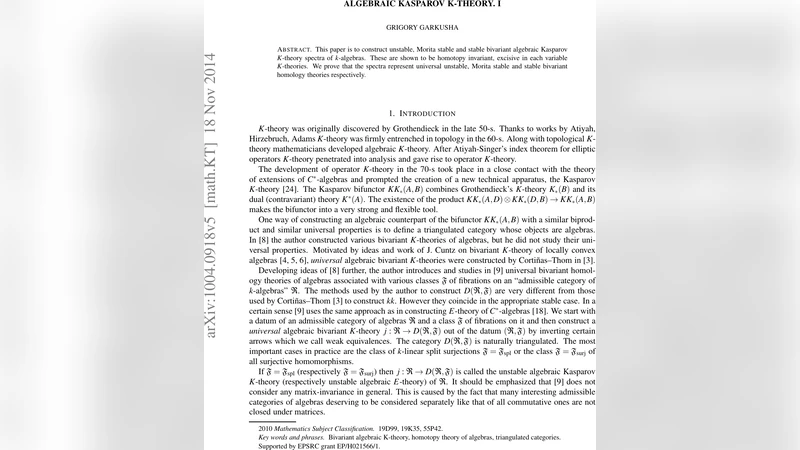
This paper is to construct unstable, Morita stable and stable bivariant algebraic Kasparov $K$-theory spectra of $k$-algebras. These are shown to be homotopy invariant, excisive in each variable $K$-theories. We prove that the spectra represent universal unstable, Morita stable and stable bivariant homology theories respectively.
💡 Research Summary
The paper “Algebraic Kasparov K‑theory. I” develops a full hierarchy of bivariant algebraic Kasparov K‑theory spectra for associative algebras over a commutative base ring k. The authors begin by endowing the category Algₖ of (possibly non‑unital) k‑algebras with a suitable model structure in which weak equivalences are derived Morita equivalences. This homotopical framework supplies the language needed to speak about homotopy‑invariant constructions, cofibrations, and fibrations in a purely algebraic setting.
The first object introduced is the unstable bivariant K‑theory spectrum 𝔎^{unst}(A,B). For any pair of algebras (A,B) the spectrum’s n‑th homotopy group classifies homotopy classes of n‑fold extensions of A by B, thus providing a genuine bivariant invariant. The authors prove three fundamental properties: (1) Homotopy invariance – if A≃A′ or B≃B′ via a derived Morita equivalence, then 𝔎^{unst}(A,B)≃𝔎^{unst}(A′,B′); (2) Excision – for any short exact sequence 0→I→A→A/I→0 the induced map 𝔎^{unst}(A,B)→𝔎^{unst}(A/I,B) is a fibration whose fiber is 𝔎^{unst}(I,B); an analogous statement holds in the second variable; (3) Additivity – the construction respects direct sums and tensor products. These results place 𝔎^{unst} as the most elementary bivariant homology theory satisfying homotopy invariance and excision.
Recognising that the unstable theory does not identify an algebra with its matrix algebras, the authors introduce the Morita‑stable spectrum 𝔎^{Mor}(A,B). This is obtained by repeatedly applying matrix stabilization (A↦M_n(A)) and taking the homotopy colimit. The resulting spectrum is invariant under Morita equivalence: the canonical inclusion A→M_n(A) induces a weak equivalence 𝔎^{Mor}(A,B)≃𝔎^{Mor}(M_n(A),B). Moreover, the excision property survives Morita stabilization unchanged. The paper proves a universal property: any bivariant homology theory E that is homotopy invariant, satisfies excision, and is Morita‑stable is naturally isomorphic to 𝔎^{Mor}. Thus 𝔎^{Mor} is the initial Morita‑stable bivariant theory.
The third and most refined construction is the stable spectrum 𝔎^{st}(A,B). Starting from 𝔎^{Mor}, the authors apply an Ω‑spectrum structure and suspend repeatedly, thereby forcing Bott periodicity. The stable spectrum is an Ω‑spectrum with a canonical Bott element inducing isomorphisms π_{n+2}≅π_n. Consequently, 𝔎^{st} is fully stable in the sense of classical topological K‑theory. The authors verify that both homotopy invariance, excision, and Morita stability persist in this setting. They also compare 𝔎^{st} over the complex numbers with the traditional C∗‑Kasparov KK‑theory, showing that the comparison map is a weak equivalence, thereby linking the algebraic construction to its analytic counterpart.
A central theme of the paper is representability. For each of the three spectra the authors prove a universal property: any bivariant theory satisfying the appropriate list of axioms (homotopy invariance, excision, and, when relevant, Morita stability) is uniquely represented by the corresponding spectrum. This establishes 𝔎^{unst}, 𝔎^{Mor}, and 𝔎^{st} as the universal unstable, Morita‑stable, and stable bivariant homology theories, respectively.
Technical sections include a detailed verification of the model structure on Algₖ, explicit constructions of the suspension and loop functors on spectra, and careful handling of homotopy colimits needed for Morita stabilization. The authors also provide concrete calculations for polynomial algebras, nilpotent extensions, and crossed product algebras, illustrating how the excision sequences manifest in practice. An appendix treats the relationship between the algebraic spectra and Eilenberg‑Mac Lane spectra, showing that ordinary algebraic K‑theory appears as a special case when one variable is the ground ring k.
In summary, the paper furnishes a rigorous, homotopy‑theoretic foundation for algebraic Kasparov K‑theory, delineating a clear progression from the most basic unstable bivariant invariant to a fully periodic, stable theory that mirrors the analytic KK‑theory. By proving homotopy invariance, excision, Morita stability, and universal representability at each stage, the authors create a versatile toolkit that is poised to influence future work in non‑commutative geometry, higher algebraic K‑theory, and the study of non‑commutative motives.
Comments & Academic Discussion
Loading comments...
Leave a Comment