On the spectrum of the magnetohydrodynamic mean-field alpha^2-dynamo operator
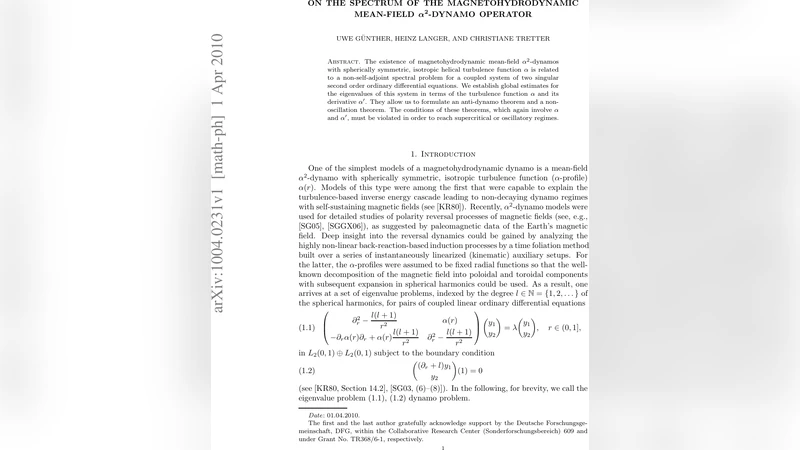
The existence of magnetohydrodynamic mean-field alpha^2-dynamos with spherically symmetric, isotropic helical turbulence function alpha is related to a non-self-adjoint spectral problem for a coupled system of two singular second order ordinary differential equations. We establish global estimates for the eigenvalues of this system in terms of the turbulence function alpha and its derivative alpha’. They allow us to formulate an anti-dynamo theorem and a non-oscillation theorem. The conditions of these theorems, which again involve alpha and alpha’, must be violated in order to reach supercritical or oscillatory regimes.
💡 Research Summary
The paper investigates the spectral properties of the mean‑field magnetohydrodynamic (MHD) α²‑dynamo when the turbulent helicity function α(r) is assumed to be spherically symmetric and isotropic. Under these symmetry assumptions the induction equation reduces to a coupled system of two singular second‑order ordinary differential equations for scalar potentials that describe the magnetic field and its curl. Because the underlying operator is not self‑adjoint, its eigenvalues can be complex, reflecting simultaneous growth/decay and oscillatory behaviour of magnetic modes.
The authors first formulate the eigenvalue problem with appropriate boundary conditions (perfectly conducting or insulating outer sphere) and then derive global bounds for the eigenvalues λ in terms of the supremum norms of α and its radial derivative α′. The key estimates show that the real part of any eigenvalue is bounded by a constant times ‖α‖∞, while the imaginary part is bounded by a constant times ‖α′‖∞. These bounds are obtained by a combination of variational techniques, comparison theorems for non‑self‑adjoint Sturm‑Liouville systems, and careful treatment of the singularities at the centre and at the outer radius.
From the bounds the authors prove two fundamental theorems. The “anti‑dynamo theorem” states that if both ‖α‖∞ and ‖α′‖∞ are below certain critical values (α_c and α′_c), then every eigenvalue has a negative real part; consequently all magnetic perturbations decay and no dynamo action is possible. The “non‑oscillation theorem” asserts that if ‖α′‖∞ stays below a second critical threshold β_c, then all eigenvalues are real, i.e., the system cannot support oscillatory (complex‑frequency) modes. In other words, a sufficiently smooth α(r) precludes magnetic field reversals or travelling‑wave behaviour.
Conversely, to reach a super‑critical regime (positive growth rate) the bound on ‖α‖∞ must be violated, and to obtain oscillatory dynamos the bound on ‖α′‖∞ must be exceeded. The paper illustrates these conditions with explicit examples: a linear profile α(r)=α₀ r and a sinusoidal profile α(r)=α₀ sin(πr/R). Numerical calculations confirm that when α₀ surpasses the analytically predicted critical value, a pair of eigenvalues crosses into the right half‑plane, producing exponential growth. When the gradient of α becomes large enough, complex conjugate eigenvalue pairs appear, signalling oscillatory dynamo modes.
The results have direct implications for astrophysical and laboratory dynamos. They provide a rigorous criterion for designing turbulence profiles that either suppress dynamo action (e.g., in experiments where magnetic field growth is undesirable) or deliberately induce growth and reversals (e.g., in models of planetary or stellar magnetic fields). By linking the spectral behaviour to simple integral norms of α and α′, the paper offers a practical diagnostic tool that can be applied without solving the full eigenvalue problem.
In summary, the work translates the abstract non‑self‑adjoint spectral problem of the α²‑dynamo into concrete, verifiable conditions on the helicity function and its radial derivative. It establishes clear mathematical thresholds separating decaying, growing, and oscillatory regimes, thereby advancing both the theoretical understanding of mean‑field dynamos and the practical guidance for experimental and numerical investigations.
Comments & Academic Discussion
Loading comments...
Leave a Comment