Deep Chandra Observations of the Crab-like Pulsar Wind Nebula G54.1+0.3 and Spitzer Spectroscopy of the Associated Infrared Shell
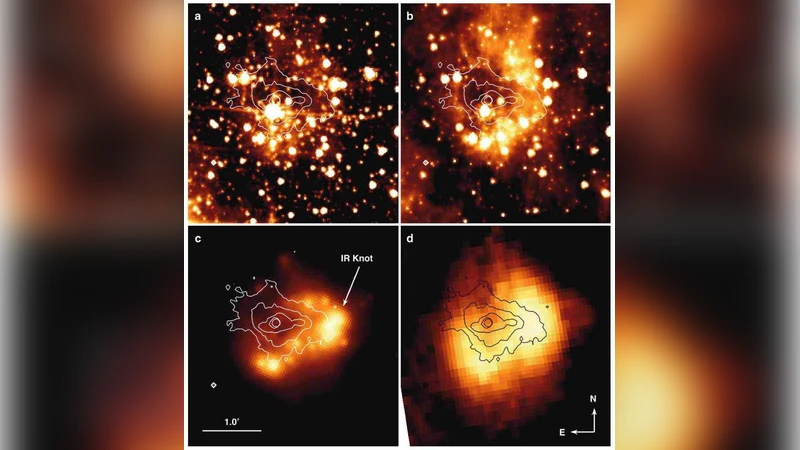
G54.1+0.3 is a young pulsar wind nebula (PWN), closely resembling the Crab, for which no thermal shell emission has been detected in X-rays. Recent Spitzer observations revealed an infrared (IR) shell containing a dozen point sources arranged in a ring-like structure, previously proposed to be young stellar objects. An extended knot of emission located in the NW part of the shell appears to be aligned with the pulsar’s X-ray jet, suggesting a possible interaction with the shell material. Surprisingly, the IRS spectrum of the knot resembles the spectrum of freshly formed dust in Cas A, and is dominated by an unidentified dust emission feature at 21 microns. The spectra of the shell also contain various emission lines and show that some are significantly broadened, suggesting that they originate in rapidly expanding supernova (SN) ejecta. We present the first evidence that the PWN is driving shocks into expanding SN ejecta and we propose an alternative explanation for the origin of the IR emission in which the shell is composed entirely of SN ejecta. In this scenario, the freshly formed SN dust is being heated by early-type stars belonging to a cluster in which the SN exploded. Simple dust models show that this interpretation can give rise to the observed shell emission and the IR point sources.
💡 Research Summary
The authors present a multi‑wavelength investigation of the young pulsar‑wind nebula (PWN) G54.1+0.3, combining deep Chandra X‑ray imaging with Spitzer infrared (IR) spectroscopy. G54.1+0.3 is often described as a “Crab‑like” system because its X‑ray morphology shows a bright torus and a collimated jet, yet no thermal shell associated with the supernova (SN) ejecta has ever been detected in X‑rays. Recent Spitzer observations revealed an IR shell surrounding the PWN, populated by roughly a dozen point‑like sources arranged in a ring. Initially these sources were interpreted as young stellar objects (YSOs) embedded in a star‑forming region.
The new analysis overturns that picture. The IR shell exhibits strong, broad emission lines of ionised metals such as
Comments & Academic Discussion
Loading comments...
Leave a Comment