Relativistic particle acceleration in developing Alfv{e}n turbulence
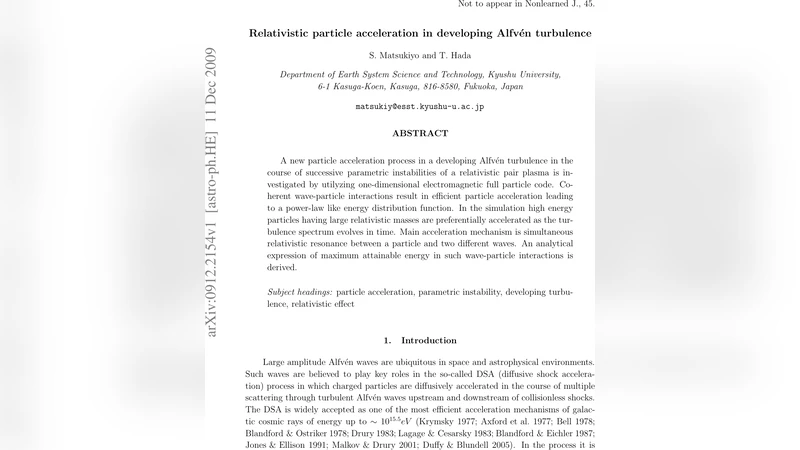
A new particle acceleration process in a developing Alfv'{e}n turbulence in the course of successive parametric instabilities of a relativistic pair plasma is investigated by utilyzing one-dimensional electromagnetic full particle code. Coherent wave-particle interactions result in efficient particle acceleration leading to a power-law like energy distribution function. In the simulation high energy particles having large relativistic masses are preferentially accelerated as the turbulence spectrum evolves in time. Main acceleration mechanism is simultaneous relativistic resonance between a particle and two different waves. An analytical expression of maximum attainable energy in such wave-particle interactions is derived.
💡 Research Summary
The paper investigates a novel particle‑acceleration mechanism that operates in a developing Alfvén‑wave turbulence generated by successive parametric instabilities in a relativistic pair plasma. Using a one‑dimensional electromagnetic full‑particle (Particle‑in‑Cell) code, the authors initialize the system with a monochromatic, large‑amplitude Alfvén wave propagating in a plasma composed of electrons and positrons of equal mass. The wave undergoes the classic parametric decay instability, splitting into a backward‑propagating ion‑acoustic‑like mode (in the pair plasma this is a density‑fluctuation mode) and a forward‑propagating compressional magnetic mode. These daughter waves interact nonlinearly, producing a broadband spectrum that broadens in both frequency and wavenumber as the turbulence “develops” rather than remaining a static, random cascade.
A key observation from the simulations is that a subset of particles experiences a rapid, coherent energy gain once the turbulence has evolved sufficiently. The high‑energy particles are those whose Lorentz factor γ becomes large enough that their velocity approaches the phase velocity of the dominant Alfvénic fluctuations. In this relativistic regime the usual cyclotron resonance condition ω − k·v ≈ Ω/γ is modified, and the particles can satisfy resonance simultaneously with two distinct wave modes: a forward‑propagating Alfvén wave and a backward‑propagating compressional (or acoustic) wave. This “simultaneous resonance” allows the particle to draw energy from both waves in a coordinated manner, leading to an acceleration rate far exceeding that of a single‑wave interaction.
The authors derive an analytical expression for the maximum attainable energy. By imposing the double‑resonance condition and solving for the particle momentum, they obtain a formula in which the maximum energy scales with the wave amplitude A, the inverse of the wavenumber difference Δk, and the initial Lorentz factor γ₀. The expression predicts that larger wave amplitudes, smaller Δk, and higher initial particle energies all increase the final energy, in agreement with the numerical results. The simulated energy spectra evolve from an initial thermal distribution to a power‑law tail (∝ E⁻p) whose slope depends on the turbulence level and on the degree of relativistic mass increase of the accelerated particles. Notably, the acceleration is “mass‑selective”: particles that have already acquired a larger relativistic mass are preferentially further accelerated, producing a positive feedback loop that steepens the high‑energy tail.
The paper contrasts this coherent, double‑resonance acceleration with conventional stochastic (diffusive) acceleration mechanisms such as diffusive shock acceleration, emphasizing that the former can generate high‑energy power‑law spectra on much shorter timescales because it does not rely on random scattering but on phase‑locked wave‑particle interactions. The authors discuss astrophysical contexts where such conditions may be realized, including pulsar wind nebulae, relativistic jets, and supernova‑remnant shocks where strong Alfvénic turbulence and relativistic pair plasmas coexist. They argue that the mechanism could help explain observed non‑thermal electron and positron spectra that are difficult to reconcile with pure shock‑driven models.
In conclusion, the study provides (1) a detailed numerical demonstration of turbulence‑driven, relativistic double‑resonance acceleration, (2) an analytical framework for estimating the maximum energy attainable in such interactions, and (3) a plausible pathway for generating power‑law energetic particle populations in high‑energy astrophysical environments. Future work is suggested to extend the simulations to two and three dimensions, to incorporate realistic magnetic‑field geometries, and to compare directly with observational data from gamma‑ray telescopes and cosmic‑ray detectors.
Comments & Academic Discussion
Loading comments...
Leave a Comment