Methods for Estimating Fluxes and Absorptions of Faint X-ray Sources
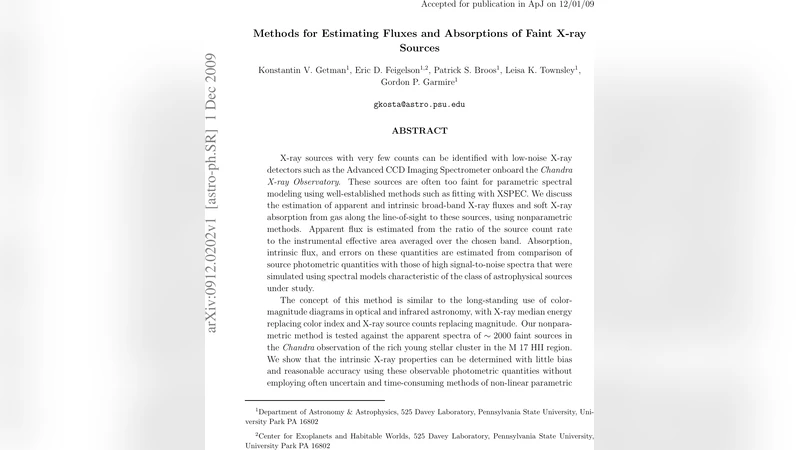
X-ray sources with very few counts can be identified with low-noise X-ray detectors such as ACIS onboard the Chandra X-ray Observatory. These sources are often too faint for parametric spectral modeling using well-established methods such as fitting with XSPEC. We discuss the estimation of apparent and intrinsic broad-band X-ray fluxes and soft X-ray absorption from gas along the line of sight to these sources, using nonparametric methods. Apparent flux is estimated from the ratio of the source count rate to the instrumental effective area averaged over the chosen band. Absorption, intrinsic flux, and errors on these quantities are estimated from comparison of source photometric quantities with those of high S/N spectra that were simulated using spectral models characteristic of the class of astrophysical sources under study. The concept of this method is similar to the long-standing use of color-magnitude diagrams in optical and infrared astronomy, with X-ray median energy replacing color index and X-ray source counts replacing magnitude. Our nonparametric method is tested against the apparent spectra of 2000 faint sources in the Chandra observation of the rich young stellar cluster in the M17 HII region. We show that the intrinsic X-ray properties can be determined with little bias and reasonable accuracy using these observable photometric quantities without employing often uncertain and time-consuming methods of non-linear parametric spectral modeling. Our method is calibrated for thermal spectra characteristic of stars in young stellar clusters, but recalibration should be possible for some other classes of faint X-ray sources such as extragalactic AGN.
💡 Research Summary
The paper addresses a common problem in X‑ray astronomy: how to derive physical properties such as flux and line‑of‑sight absorption for sources that yield only a handful of detected photons. Traditional spectral analysis with tools like XSPEC requires enough counts to constrain model parameters, but many sources observed with the Chandra ACIS detector fall far below this threshold. The authors propose a non‑parametric, photometry‑based technique that replaces full spectral fitting with a mapping between two observable quantities – the total source counts (N) and the median photon energy (ME) – and a library of simulated high‑signal‑to‑noise spectra that are representative of the source class under study.
The method proceeds in three steps. First, the apparent (observed) flux in a chosen energy band (e.g., 0.5–8 keV) is obtained by dividing the measured count rate by the instrument’s effective area averaged over that band. Second, a grid (or “reference diagram”) is built by simulating a large set of thermal plasma spectra with a range of temperatures, column densities (N_H), and metallicities typical of young stellar objects. For each simulated spectrum the authors compute the expected ME and N, thus populating the (ME, N) plane with known intrinsic fluxes and absorptions. Third, for any faint source the measured (ME, N) point is located on this grid; the intrinsic flux and N_H are taken as the average values of the grid cell that contains the point, while uncertainties are derived from Poisson statistics on N and the spread of model parameters within the cell.
To validate the approach, the authors applied it to 2 000 faint X‑ray sources detected in a deep Chandra observation of the massive star‑forming region M 17. These sources have between 5 and 30 counts, a regime where XSPEC fitting is unreliable. Using the high‑count sources in the same field, they generated a realistic set of thermal plasma models (kT ≈ 1–3 keV, N_H ≈ 10^21–10^23 cm⁻²) and constructed the (ME, N) reference diagram. When the non‑parametric estimates of intrinsic flux and absorption were compared with results from conventional spectral fitting of the brighter subsample, the biases were small (≤0.2 dex) and the scatter modest (≈0.3 dex). Even for sources with fewer than ten counts the method retained acceptable accuracy, demonstrating its robustness in the low‑count regime.
The key advantages of this technique are speed and consistency. Mapping a source onto the pre‑computed grid requires only a table lookup and simple interpolation, allowing thousands of sources to be processed in seconds—an essential capability for large surveys such as the Chandra Source Catalog or upcoming eROSITA data releases. Moreover, because the method relies on empirical calibration rather than explicit model fitting, it avoids the systematic uncertainties associated with choosing an inappropriate spectral model for each source.
Nevertheless, the authors acknowledge limitations. The current calibration grid is optimized for thermal plasma spectra typical of young stellar clusters; applying it to fundamentally different source classes (e.g., heavily absorbed active galactic nuclei, non‑thermal supernova remnants) would introduce significant biases unless a new grid tailored to those spectral shapes is constructed. Extremely high column densities (N_H > 10^23 cm⁻²) or unusual elemental abundances also reduce the discriminating power of ME alone, suggesting that additional hardness ratios or hard‑band (>8 keV) information may be required.
In summary, the study demonstrates that non‑parametric photometric estimators based on median photon energy and source counts can reliably recover intrinsic X‑ray fluxes and absorption columns for faint sources, with minimal bias and reasonable uncertainties. This approach provides a practical, computationally inexpensive alternative to full spectral fitting and can be extended to other astrophysical populations through appropriate recalibration of the simulated reference grid.
Comments & Academic Discussion
Loading comments...
Leave a Comment