X-ray polarimetry in Astrophysics with the Gas Pixel Detector
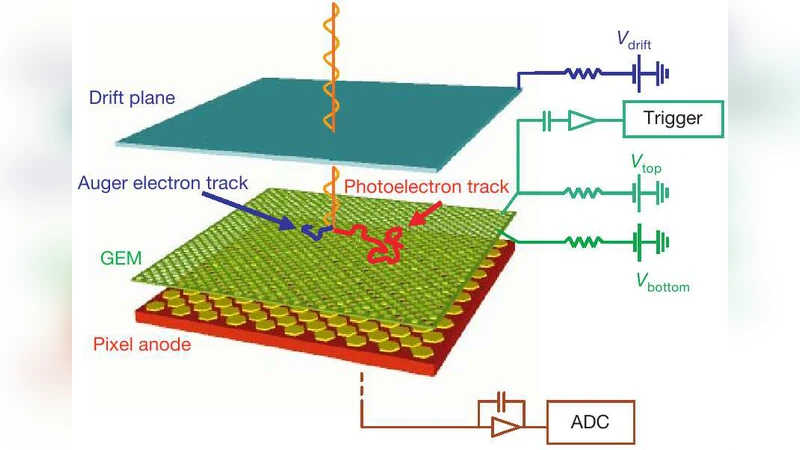
The Gas Pixel Detector, recently developed and continuously improved by Pisa INFN in collaboration with IASF-Roma of INAF, can visualize the tracks produced within a low Z gas by photoelectrons of few keV. By reconstructing the impact point and the original direction of the photoelectrons, the GPD can measure the linear polarization of X-rays, while preserving the information on the absorption point, the energy and the time of individual photons. Applied to X-ray Astrophysics, in the focus of grazing incidence telescopes, it can perform angular resolved polarimetry with a huge improvement of sensitivity, when compared with the conventional techniques of Bragg diffraction at 45 degrees and Compton scattering around 90 degrees. This configuration is the basis of POLARIX and HXMT, two pathfinder missions, and is included in the baseline design of IXO, the very large X-ray telescope under study by NASA, ESA and JAXA.
💡 Research Summary
The paper presents a comprehensive description of the Gas Pixel Detector (GPD), a novel X‑ray polarimeter developed by the INFN‑Pisa group in collaboration with INAF‑IASF Roma. The GPD exploits the fact that a photoelectron emitted after the absorption of an X‑ray photon in a low‑Z gas retains information about the photon’s linear polarization: the initial emission direction follows a cos 2θ distribution whose phase and amplitude encode the polarization angle and degree. By filling a thin gas cell (typically a He‑DME mixture at 1–2 atm) with a high‑granularity pixelated read‑out ASIC (≈50 µm pixel pitch), the detector records a two‑dimensional image of each photoelectron track. Advanced reconstruction algorithms extract the impact point (photon absorption location), the initial segment of the track (to infer the emission direction), the total collected charge (photon energy), and a precise time stamp. Consequently, a single event yields position, energy, time, and polarization information simultaneously.
The authors emphasize several performance advantages over traditional polarimetry techniques. Bragg diffraction at 45° offers high modulation but suffers from very low efficiency and a narrow energy band; Compton scattering around 90° provides broader energy coverage but with modest modulation factors and limited effective area. In contrast, the GPD’s intrinsic quantum efficiency is set by the gas absorption cross‑section, which is an order of magnitude larger than the solid‑state or crystal‑based alternatives in the 2–8 keV band. Moreover, because the detector can be placed directly at the focal plane of a grazing‑incidence telescope, it enables angularly resolved polarimetry (polarization maps) with arcsecond‑scale spatial resolution—a capability unavailable to the older techniques.
Technical implementation details are discussed in depth. The ASIC integrates 105 channels, each with pre‑amplifier, shaper, and discriminator, and performs on‑chip digitisation. Real‑time processing on an FPGA extracts the barycenter of the charge cloud (impact point) and computes the first moments of the charge distribution to estimate the initial track direction. Noise figures are kept below 50 e⁻ rms, allowing a modulation factor of ~0.5 at 3 keV and ~0.3 at 6 keV. The detector’s dead time is <10 µs, supporting count rates up to several kHz, which is sufficient for bright X‑ray sources. Calibration procedures using polarized laboratory beams and unpolarized continuum sources are described, demonstrating systematic uncertainties below 1 % after correction.
The paper then outlines three mission concepts that incorporate the GPD. POLARIX, a small‑scale Italian path‑finder, will mount a single GPD at the focus of a modest (≈1 m) Wolter‑I telescope to perform the first systematic survey of X‑ray polarization from pulsars, magnetars, and active galactic nuclei. The Chinese Hard X‑ray Modulation Telescope (HXMT) will host a GPD‑based polarimeter module extending the energy coverage up to ~30 keV, thereby probing higher‑energy emission mechanisms. Finally, the International X‑ray Observatory (IXO), a joint NASA‑ESA‑JAXA effort, includes the GPD as its baseline polarimeter. Coupled with a 5‑meter class mirror, IXO’s GPD is expected to achieve a Minimum Detectable Polarization (MDP) of ~1 % for a 10⁻⁴ ph cm⁻² s⁻¹ source in a 10⁵ s exposure, opening the possibility to map polarization structures in black‑hole accretion disks, relativistic jets, and supernova remnants.
Future development directions are identified: optimization of gas mixtures (e.g., adding CO₂ or CF₄ to improve drift properties), reduction of pixel pitch to enhance track reconstruction at higher energies, implementation of radiation‑hard ASIC designs for long‑duration missions, and the exploration of detector arrays to increase effective area. The authors also discuss the potential for combining the GPD with energy‑discriminating filters or multilayer optics to broaden the operational band up to ~15 keV while preserving modulation.
In conclusion, the Gas Pixel Detector represents a transformative technology for X‑ray astrophysics. By converting the microscopic photoelectron track into a macroscopic polarization measurement without sacrificing spatial, spectral, or temporal resolution, it dramatically improves sensitivity and opens new scientific windows. The successful integration of the GPD into POLARIX, HXMT, and the planned IXO mission demonstrates its readiness for flight and its central role in the next generation of X‑ray polarimetry. Continued refinements are expected to further lower systematic errors and expand the energy range, ensuring that X‑ray polarimetry becomes a routine observational tool in high‑energy astrophysics.
Comments & Academic Discussion
Loading comments...
Leave a Comment