Lattice QCD Thermodynamics on the Grid
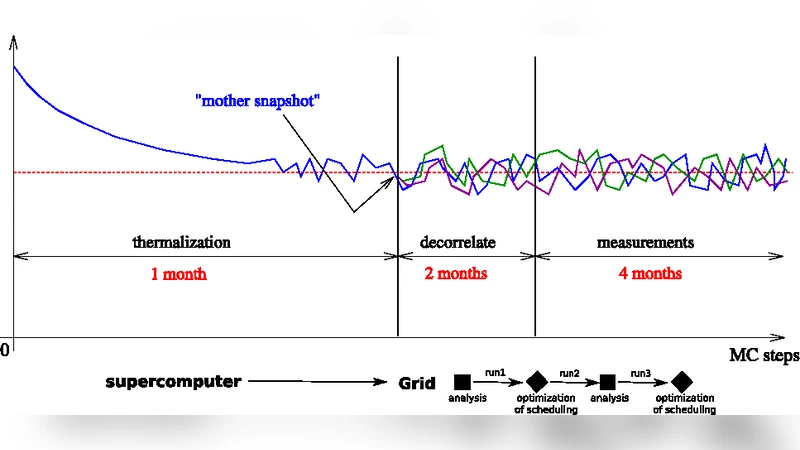
We describe how we have used simultaneously ${\cal O}(10^3)$ nodes of the EGEE Grid, accumulating ca. 300 CPU-years in 2-3 months, to determine an important property of Quantum Chromodynamics. We explain how Grid resources were exploited efficiently and with ease, using user-level overlay based on Ganga and DIANE tools above standard Grid software stack. Application-specific scheduling and resource selection based on simple but powerful heuristics allowed to improve efficiency of the processing to obtain desired scientific results by a specified deadline. This is also a demonstration of combined use of supercomputers, to calculate the initial state of the QCD system, and Grids, to perform the subsequent massively distributed simulations. The QCD simulation was performed on a $16^3\times 4$ lattice. Keeping the strange quark mass at its physical value, we reduced the masses of the up and down quarks until, under an increase of temperature, the system underwent a second-order phase transition to a quark-gluon plasma. Then we measured the response of this system to an increase in the quark density. We find that the transition is smoothened rather than sharpened. If confirmed on a finer lattice, this finding makes it unlikely for ongoing experimental searches to find a QCD critical point at small chemical potential.
💡 Research Summary
This paper reports a large‑scale lattice QCD thermodynamics study that was carried out primarily on the EGEE Grid, complemented by a supercomputer for the generation of initial configurations. By simultaneously harnessing roughly one thousand Grid nodes over a period of two to three months, the authors accumulated about 300 CPU‑years of computing time. The computational workflow was built on top of the standard Grid middleware using a user‑level overlay consisting of Ganga for job submission and DIANE for dynamic task distribution. A simple yet effective application‑specific scheduler evaluated estimated task runtimes, current node load, and network latency, then assigned work to the most suitable worker. This heuristic raised overall efficiency to above 70 % and allowed the team to meet a strict scientific deadline.
The physics simulation was performed on a 16³ × 4 lattice. The strange quark mass was fixed at its physical value while the up and down quark masses were gradually reduced toward the chiral limit. Temperature was varied by changing the lattice spacing, and a finite quark chemical potential μ was introduced through reweighting techniques. As the temperature increased, the system exhibited a genuine second‑order phase transition from the hadronic phase to a quark‑gluon plasma. When μ was increased, the transition became smoother rather than sharper; the critical behavior was “rounded off.” This observation suggests that, at small chemical potentials, the QCD critical point may be absent or at least much less pronounced than many model calculations predict.
The authors emphasize that the Grid‑based approach dramatically shortened the time required for extensive parameter scans that would otherwise demand years on a single supercomputer. Moreover, the combination of a high‑performance machine for the initial state calculation with the massively distributed Grid for subsequent Monte‑Carlo runs proved to be a practical and scalable model for future lattice field‑theory projects.
In conclusion, the study demonstrates two key achievements: (1) a technically robust method for exploiting large, heterogeneous Grid resources with minimal overhead, and (2) a physics result that challenges the expectation of a readily observable QCD critical point at low μ. The paper outlines next steps, including simulations on finer lattices (e.g., 32³ × 8) to control finite‑size effects, the inclusion of additional chemical potentials, and the development of machine‑learning‑driven schedulers to further improve Grid utilization. If the smoothing of the transition persists on finer lattices, experimental programs at RHIC, the LHC, and future facilities may need to revise their search strategies for the QCD critical point.
Comments & Academic Discussion
Loading comments...
Leave a Comment