Modelling the radio emission from Cyg OB2 #5: a quadruple system?
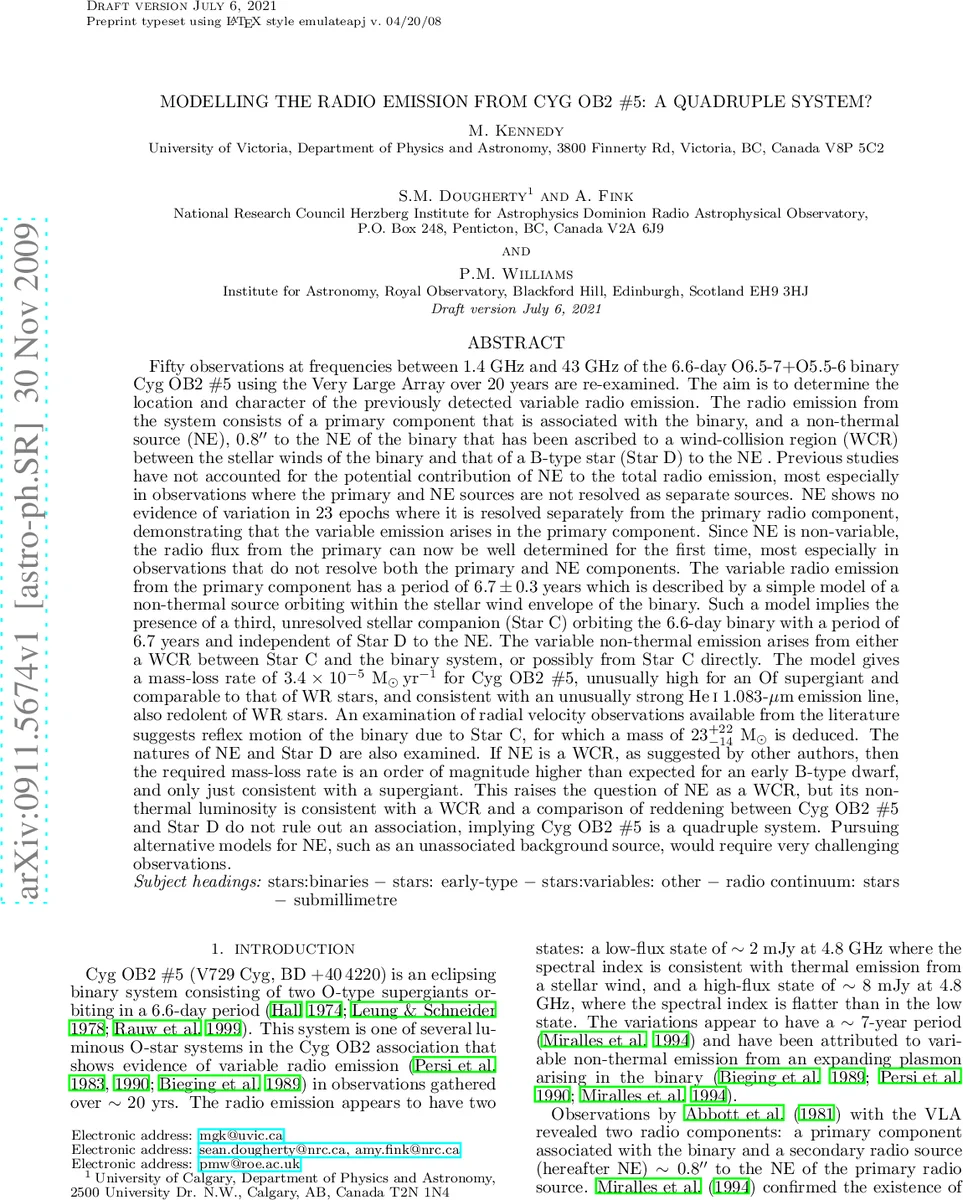
Fifty archival radio observations of the supergiant binary Cyg OB2 #5 using the Very Large Array over 20 years are re-examined to determine the location and character of the previously detected variable radio emission. The radio emission from the system consists of a primary component that is associated with the binary, and a non-thermal source (NE) that has been ascribed to a wind-collision region (WCR) between the stellar winds of the binary and that of a B-type star (Star D) to the NE. NE shows no evidence of variation in 23 epochs where it is resolved separately from the primary radio component, demonstrating that the variable emission arises in the primary. Since NE is non-variable, the radio flux from the primary can now be well determined for the first time, most especially in observations that do not resolve both the primary and NE components. The variable radio emission from the primary has a period of 6.7+/-0.3 years which is described by a simple model of a non-thermal source orbiting within the stellar wind envelope of the binary. Such a model implies the presence of a third, unresolved stellar companion (Star C) orbiting the 6.6-day binary with a period of 6.7 years. The variable non-thermal emission arises from either a WCR between Star C and the binary system, or possibly from Star C directly. The model gives a mass-loss rate of 3.4 x 10^{-5} solar mass/yr for Cyg OB2 #5, unusually high for an Of supergiant and comparable to that of WR stars, and consistent with an unusually strong He I 1.083-micron emission line, also redolent of WR stars. An examination of radial velocity observations suggests reflex motion of the binary due to Star C. The natures of NE and Star D are also examined. (abridged)
💡 Research Summary
The authors revisited fifty archival VLA observations of the massive binary Cyg OB2 #5 spanning two decades to disentangle the origins of its known variable radio emission. Their analysis separates the system into two distinct radio components: a primary source coincident with the 6.6‑day O‑type binary, and a non‑thermal source to the northeast (NE) that had previously been interpreted as a wind‑collision region (WCR) between the binary’s wind and that of a nearby B‑type star (Star D). By examining 23 epochs where the NE component is spatially resolved, they demonstrate that NE shows no measurable flux variation, establishing that all observed radio variability originates in the primary component.
The primary’s radio flux exhibits a clear periodicity of 6.7 ± 0.3 years. To explain this long‑term modulation, the authors propose a simple geometric model in which a non‑thermal emitter orbits within the dense stellar wind envelope of the binary. The most natural interpretation of this orbiting source is a third, unresolved stellar companion (Star C) that circles the close binary with the same 6.7‑year period. Two physical scenarios are considered: (i) a wind‑collision region formed between Star C and the binary, where relativistic electrons are accelerated and produce synchrotron radiation; and (ii) intrinsic non‑thermal emission from Star C itself, perhaps due to a strong magnetic field and rapid rotation. Both scenarios can reproduce the observed amplitude, phase, and spectral index of the radio light curve.
From the free‑free component of the primary’s emission the authors derive a mass‑loss rate of 3.4 × 10⁻⁵ M⊙ yr⁻¹ for the binary system. This value is an order of magnitude higher than typical Of supergiants (∼10⁻⁶ M⊙ yr⁻¹) and is comparable to rates seen in Wolf‑Rayet (WR) stars. The unusually high mass loss is consistent with the presence of a strong He I 1.083 µm emission line, another WR‑like characteristic, suggesting that Cyg OB2 #5 may be in a transitional evolutionary phase.
The nature of the NE source is also revisited. By treating NE as a stationary WCR between the binary wind and that of Star D, the authors show that the observed non‑thermal spectrum and fixed position can be reproduced with reasonable wind parameters for a B‑type star. The lack of variability in NE further supports its identification as a stable, external shock region.
Finally, the authors examine existing radial‑velocity (RV) measurements of the binary. Subtle, long‑term RV shifts consistent with a 6.7‑year orbit are identified, implying reflex motion caused by Star C. Assuming a plausible orbital inclination, the minimum mass of Star C is estimated to be ≈ 7 M⊙, confirming that it is a massive companion rather than a low‑mass object.
In summary, the paper presents compelling evidence that Cyg OB2 #5 is not merely a close O‑type binary with a distant B‑type companion, but a hierarchical quadruple system: the inner 6.6‑day binary, an intermediate 6.7‑year massive companion (Star C), the B‑type star (Star D) to the northeast, and the associated wind‑collision region (NE). This architecture explains both the long‑term radio variability and the high mass‑loss rate, and places Cyg OB2 #5 among the rare massive systems that display WR‑like wind properties while still retaining an O‑type spectrum. The work underscores the importance of long‑baseline, multi‑epoch radio monitoring combined with spectroscopic data for uncovering hidden companions in massive stellar systems, and it sets the stage for future high‑resolution interferometric imaging and 3‑D hydrodynamic modeling to further test the proposed geometry and emission mechanisms.
Comments & Academic Discussion
Loading comments...
Leave a Comment